Organized retail crime squeezes Big Lots stores, tightening controls and workloads
Big Lots workers are seeing theft rings turn into extra locks, extra walks and extra pressure on the floor, not just a shrink number.

Organized retail crime is a store-floor problem at Big Lots
Organized retail crime reaches Big Lots as a practical operations issue: fewer items on the shelf, more controls on the floor, and more time spent watching product than serving customers. For associates, the damage is not abstract. It shows up in locked cases, tighter receiving routines, more camera coverage, more frequent floor walks, and the constant tension between keeping merchandise accessible and keeping it from walking out the door.
That matters because organized retail crime is not just random shoplifting. The Federal Bureau of Investigation defines Organized Retail Theft as the large-scale theft of retail merchandise with the intent to resell the stolen items for financial gain, and says groups may use fencing operations and steal from multiple stores. The National Retail Federation describes the same pattern as a structured criminal enterprise that steals goods and pushes them through resale channels, which is why discount chains with easy-to-move goods tend to feel the pressure first.
Why the pressure lands hard in discount retail
Big Lots sits in a category where value is the selling point and the vulnerability. Low-priced, highly portable merchandise is exactly the kind of product that can be concealed quickly and resold just as quickly, so the company’s shelves can become a target for organized theft rings looking for volume. Big Lots said in its 2024 SEC filings that it operated 1,392 stores and an e-commerce platform as of February 3, 2024, and later said it still operated 1,392 stores in 48 states as of May 4, 2024, which gives you a sense of how broad the exposure is across the chain.
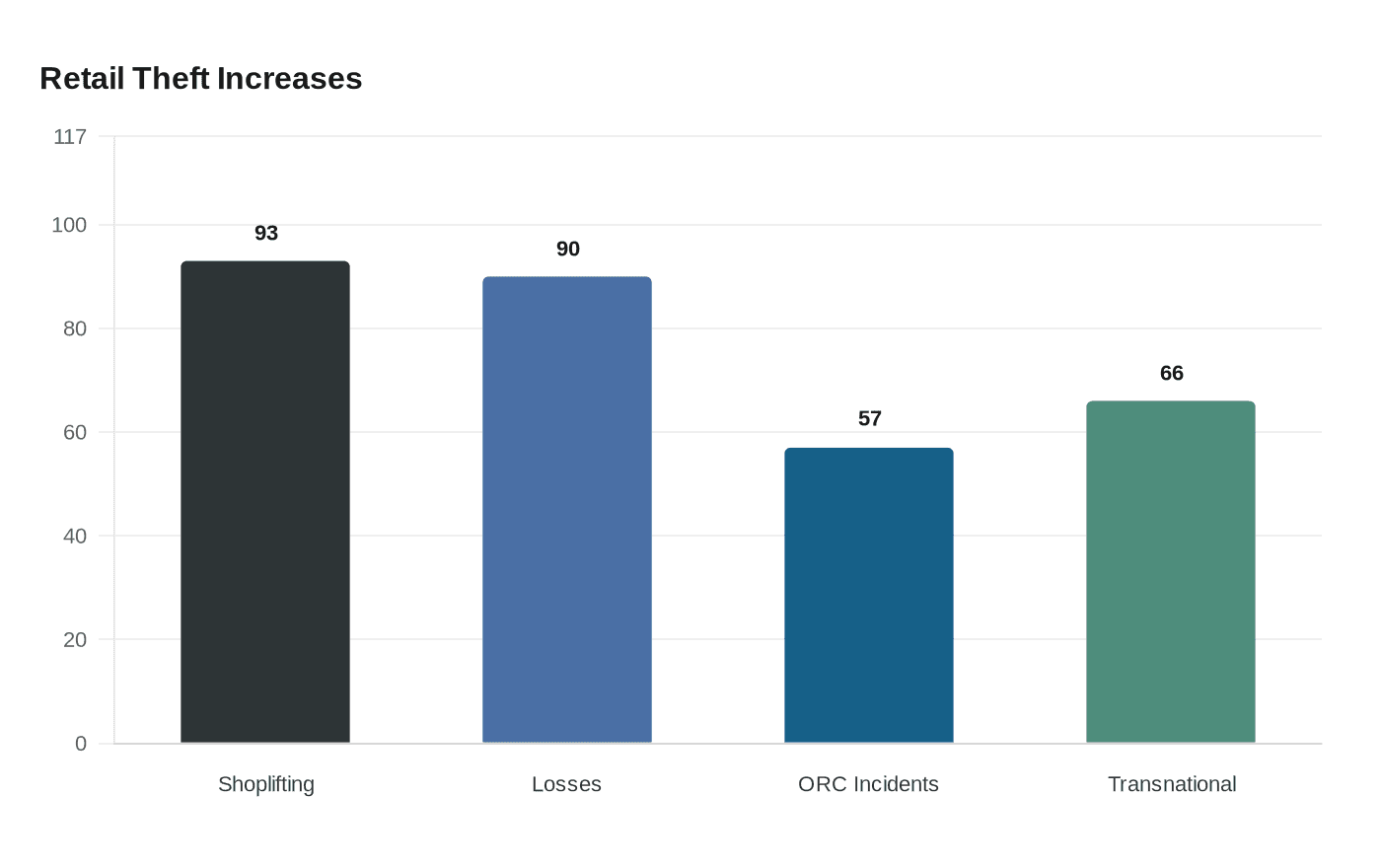
The scale of the theft problem has also widened across retail. NRF’s 2024 retail theft report said retailers saw a 93% increase in shoplifting incidents since 2019, a 90% increase in dollar losses from shoplifting, and a 57% year-over-year rise in ORC incidents. NRF later said in October 2025 that 66% of retailers reported transnational ORC involvement in thefts against their companies since 2024, which suggests the problem is increasingly organized across borders, not just across parking lots.
What changes on the sales floor
When shrink rises, the pain spreads well beyond the loss-prevention team. Margin gets squeezed, replenishment gets harder, and management often responds with more controls or stricter procedures that change how the store feels to shop and to work. For associates, that can mean more time walking aisles, checking endcaps, monitoring high-risk categories and dealing with customers who now need help to access items that used to sit out in the open.
A Big Lots floor under theft pressure can look different in several very specific ways:
- More locked cases for small, easily resold goods
- More bag checks and receipt checks at the front end
- Tighter receiving steps in the backroom
- More camera coverage and more frequent floor walks
- More time spent recovering merchandise and straightening the aisle after incidents
Those changes may reduce loss, but they also slow the rhythm of the store. A customer who needs an associate to unlock a case is no longer in a self-service trip, and that creates a tradeoff Big Lots workers know well: the more controlled the store becomes, the harder it can be to keep the sales floor easy to shop.
The safety issue is bigger than shrink
The biggest mistake is treating organized retail crime as only a money problem. It is also a safety issue, because theft rings raise the odds of confrontation, make the floor more unpredictable and push workers into situations where they have to choose between protecting merchandise and avoiding escalation. That is especially hard in discount retail, where staffing is already tight and the same associate may be expected to cover checkout, recovery and customer service at once.
The National Retail Federation’s framing matters here because it points to a networked business model, not a one-off bad actor. If theft, transport and resale are all connected, then the response cannot stop at a locked cabinet or a warning sign. Retailers have to think about how people are deployed, how often the floor is covered, which categories get secured and how much friction customers will tolerate before the shopping trip becomes a hunt for an employee.
Why the policy response remains uneven
On the legal side, the patchwork is still a problem. A Congressional Research Service report says there is no federal law specifically prohibiting organized retail crime, and that the issue has mainly been handled through state and local law enforcement. That leaves retailers relying on a mix of store-level controls, police partnerships and internal analytics rather than one clear national framework.
That is why industry groups such as the U.S. Chamber of Commerce and the Retail Industry Leaders Association describe ORC as more than a store nuisance. They treat it as a public-safety and supply-chain issue because repeated theft can distort inventory planning, weaken service levels and force chains to spend more on prevention just to preserve basic operations. For a chain like Big Lots, where every recovered item matters, prevention is not an abstract compliance project; it is part of keeping the store open and functional.
Big Lots’ financial strain makes every loss feel larger
Big Lots’ own corporate stress makes the theft problem feel even sharper. The company filed for Chapter 11 bankruptcy on September 9, 2024, saying it had entered into a sale agreement with an affiliate of Nexus Capital Management LP, and court materials identified the case as No. 24-11967 in the U.S. Bankruptcy Court for the District of Delaware. In a business already dealing with weak sales, restructuring pressure, store closures and later going-out-of-business sales, theft prevention stops being a side issue and becomes part of survival.
That is the real lesson for Big Lots workers. Organized retail crime is not only about what disappears from the shelf. It changes how the store is staffed, how the floor is policed, how easily customers can shop and how much pressure lands on the people who are left to manage all of it. In a low-margin chain, the fight against ORC is also a fight over labor, service and whether the store can still feel like a store.
This article was produced by Prism’s automated news system from verified source data, official records, and press releases, then run through automated quality and moderation checks before publishing. The system is built and supervised by the people who set the standards it runs under. Read our full AI policy.
Did this article answer your question?