Why Big Lots depends on buying well and moving fast
Big Lots’ floor chaos often reflects the business model, not just bad execution. When buying is disciplined and goods keep moving, value retail looks messy but works.

Why the floor can look disorderly and still be on model
At Big Lots, a reset that feels rushed or a department that looks patched together is often the visible side of a hard retail truth: value chains live or die by how well they buy and how fast they move product. The surprise finds customers want only show up when inventory is uneven, opportunistic, and time-sensitive, which means the store can feel like it is always being rearranged to catch up with the merchandise.

That is especially true in off-price and closeout retail, where the business is not built on a neat, repeatable assortment. It is built on buying advantages, quick turns, and a floor that can make an odd batch of goods look intentional enough to sell. For workers, that helps explain why leadership pressure often lands on speed, presentation, and freshness at the same time.
What the strongest off-price chains actually do well
Morningstar’s analysis of TJX shows what winning value retail looks like at scale. The company’s prices are generally 20% to 60% below full-price retailers, it works with more than 21,000 global vendors, and it relies on rapid inventory turnover and a low-fixture store model. In fiscal 2026, TJX generated more than $60 billion in sales and operated more than 5,000 stores, while Morningstar estimates its Marmaxx division captures roughly half of U.S. off-price sales.
That matters because it shows the real engine behind the sector is not just discounting. It is disciplined buying, broad sourcing, and the ability to keep product moving before the value disappears. When that system works, the store feels full of discovery; when it slips, the floor fills with stranded inventory, stale signage, and work that never quite catches up.
Why shoppers are leaning harder on value now
Deloitte’s 2026 global retail outlook reinforces why this model still has room to work. The firm surveyed 330 retail executives, and 40% said Americans are now deal-driven or cost-conscious, including higher-income households. At the same time, 96% of retail leaders expect revenue growth and 81% expect margin expansion in 2026, which tells you how much pressure remains on retailers to grow without giving up discipline.
Deloitte also describes an AI-led market that rewards agility, speed, and execution. For a chain like Big Lots, that is not an abstract strategy memo. It is a signal that buying teams, planners, and store leaders are being judged on how quickly they can spot what will sell, get it to the floor, and keep the customer feeling like the trip was worth it.
Why Big Lots is the cautionary case
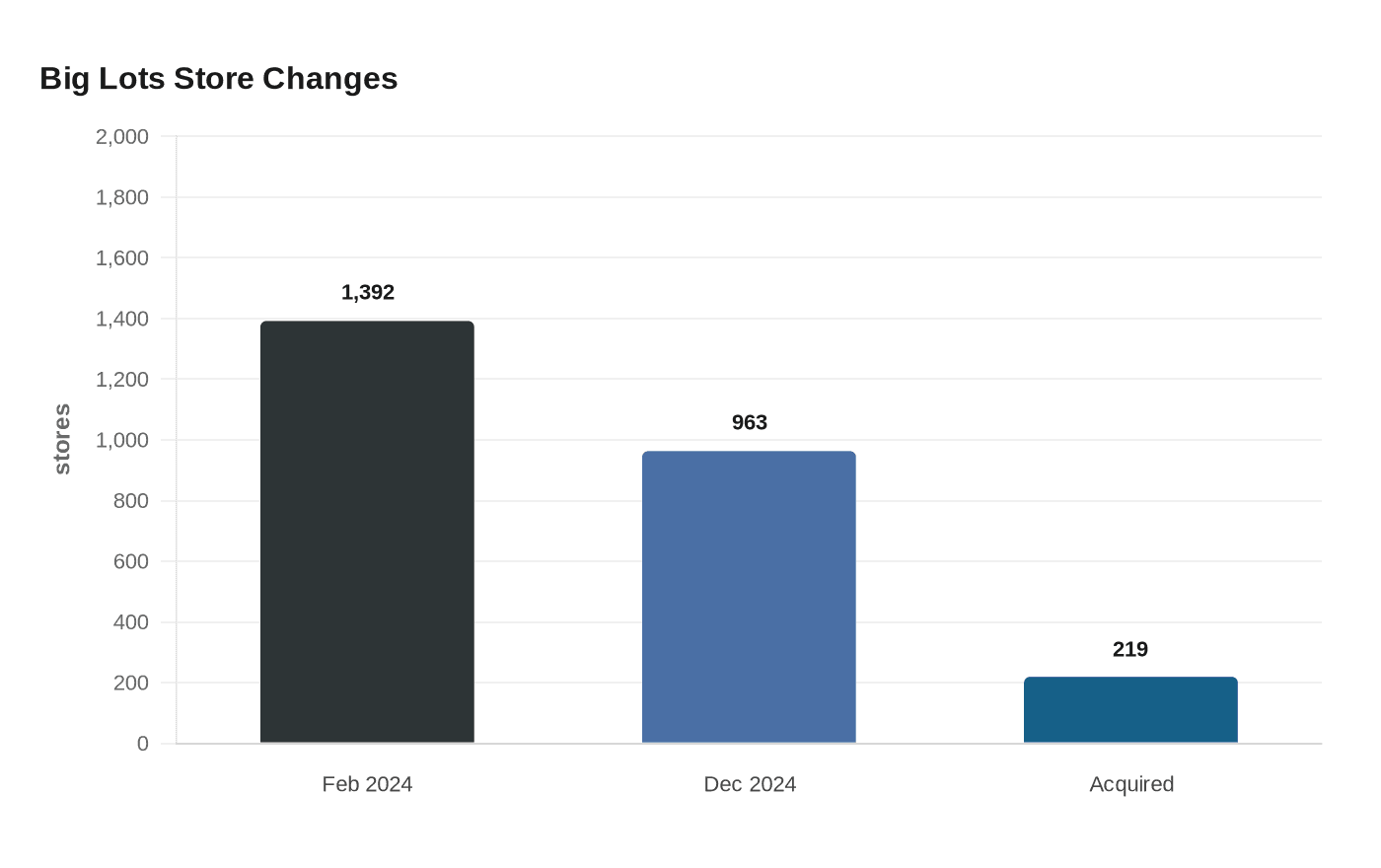
Big Lots has long lived in the same broad world as off-price and closeout retail, but its recent history shows how fragile that model can be when several systems weaken at once. The company was founded in 1967 as Consolidated Stores, and SEC filings show it operated 1,392 stores and an e-commerce platform as of February 3, 2024. That is a large footprint to support when traffic softens and the merchandise flow gets choppy.
The company filed for Chapter 11 bankruptcy on September 9, 2024. CNBC reported that Big Lots cited high interest rates, inflation, and sluggish demand for home goods, including furniture and decor, which had become harder to sell in a weak housing market. Those forces hit the exact places value retail depends on most: customer traffic, inventory velocity, and the ability to finance the next round of buys.
Big Lots first entered a sale agreement with an affiliate of Nexus Capital Management LP, a move that was supposed to preserve jobs and keep stores running. That deal later fell through, and by December 2024 the company said it would begin going-out-of-business sales at its remaining 963 stores. In January 2025, the bankruptcy process led to a transaction in which Gordon Brothers Retail Partners transferred 200 to 400 stores to Variety Wholesalers, and Variety Wholesalers later said it acquired 219 Big Lots stores and two distribution centers.
What this means for workers on the floor
For store teams, the lesson is that value retail is not just about being cheap. It is about timing, judgment, and the ability to turn whatever arrives into a floor set that looks purposeful enough to create urgency. If the buying team lands a strong deal but the store cannot flex quickly, the message gets diluted; if the set looks polished but the product is weak, there is nothing compelling to sell.
That is why a messy-looking department is not always a sign of failure, and a neat one is not always a sign of strength. In value retail, the real question is whether the store has enough fresh inventory, enough price advantage, and enough speed to keep customers seeing a reason to come back. Workers who understand that rhythm can read leadership priorities more clearly, especially when they hear more about “execution” than about any one product category.
The most important signal in all of this is simple: value retail rewards retailers that can buy well, move fast, and keep the bargain obvious on the floor. Big Lots shows what happens when that balance breaks, and the broader market shows why the companies that maintain it keep winning.
This article was produced by Prism’s automated news system from verified source data, official records, and press releases, then run through automated quality and moderation checks before publishing. The system is built and supervised by the people who set the standards it runs under. Read our full AI policy.
Did this article answer your question?