DOL explains overtime rules as Dollar General faces safety overhaul
Dollar General’s safety overhaul puts overtime, retaliation, and harassment on the same checklist as blocked exits. For workers, the federal rules are the real backstop.
What the overtime rule really means on the sales floor
The federal overtime rule is simple in theory and easy to miss in practice: covered, non-exempt workers must get at least the federal minimum wage, and overtime at one and one-half times the regular rate after 40 hours in a workweek. The U.S. Department of Labor’s retail guidance is useful because it translates those rules into store reality, where shift changes, truck days, closings, and call-outs can push people past the limit fast.
That matters at Dollar General because the company is not a small neighborhood chain. In its fiscal 2025 annual report, the company said it was founded in 1939 and reported a fiscal year ended January 31, 2025. A later SEC filing said its fiscal 2026 annual report covers the year ended January 30, 2026. When a company with thousands of stores runs lean, wage mistakes can spread just as fast as a bad pricing tag or a missed front-end recovery.
For workers, the key question is whether all hours worked are being counted. If you are asked to finish tasks before clocking in, stay after clocking out, work through meal breaks, or help close after the timecard stops, those can become wage-and-hour issues, not just “store culture.” The DOL also notes that some retail or service employees paid by commissions may be exempt from overtime, which makes it especially important for associates and managers to know which pay rules actually apply in their store.
Why the safety overhaul matters to pay and scheduling
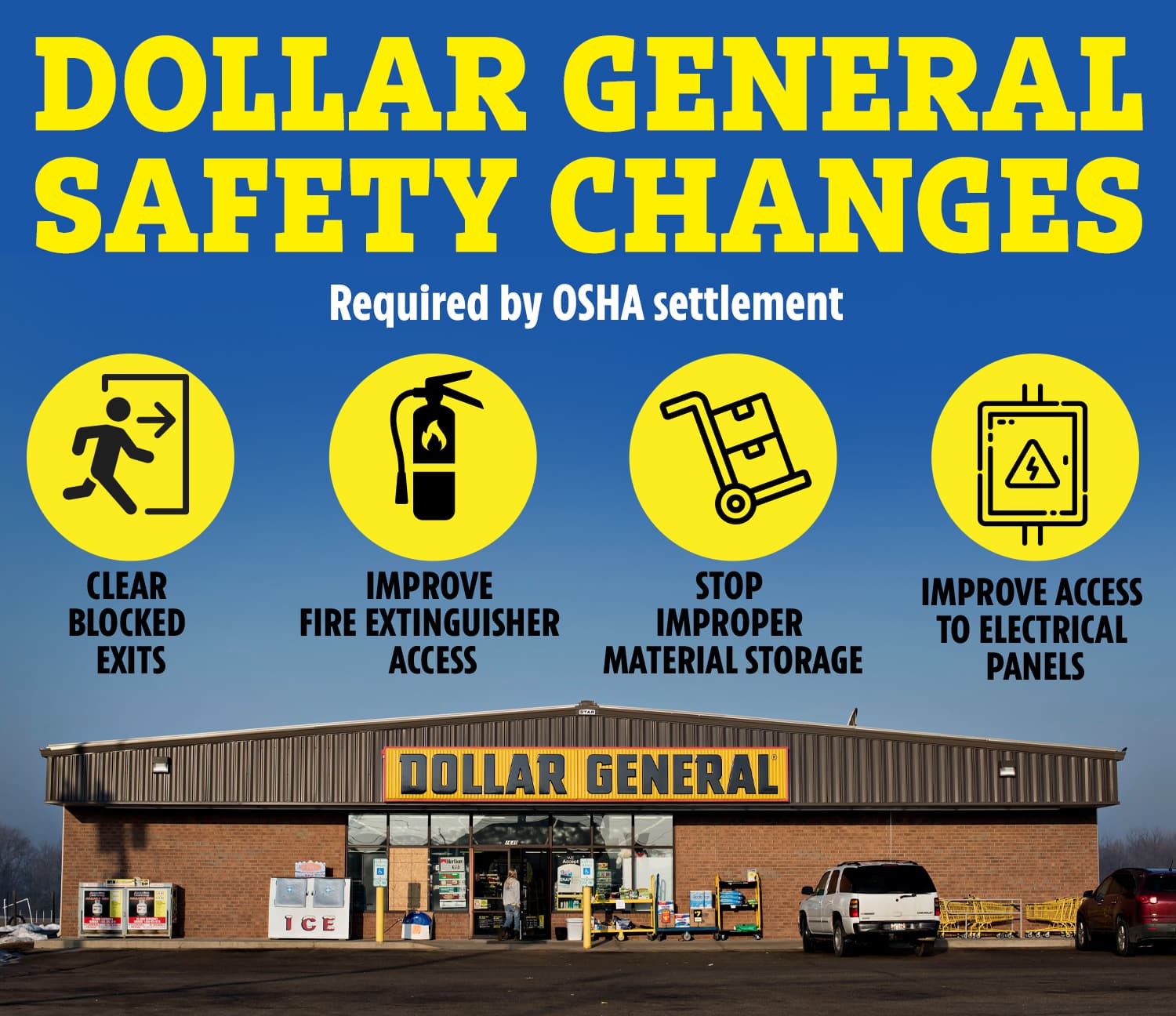
On July 11, 2024, the Occupational Safety and Health Administration announced a corporate-wide settlement with Dollar General and its retail subsidiaries that requires major safety changes across stores nationwide. The company agreed to pay $12 million in penalties, and the agreement calls for additional safety managers, reduced inventory to prevent blocked exits, worker training, and a safety committee with employee participation.
The details matter because they describe the kind of risks retail employees run into every day. OSHA said future hazards such as blocked exits, access to fire extinguishers and electrical panels, and improper material storage generally must be corrected within 48 hours during the agreement term. That is not a paperwork exercise. In a store where stock is stacked in the wrong place, an exit blocked by freight, or an electrical panel buried behind overstock can create a safety emergency for the people left to work the floor.
For Dollar General employees, the message is practical: safety problems are often schedule problems and staffing problems too. If one person is expected to ring, stock, clean, and recover the store at the same time, pressure builds to cut corners, skip breaks, or keep working in unsafe conditions. OSHA’s settlement shows that those conditions are not just annoying. They can become federal enforcement issues.
When retaliation is part of the problem
The Wage and Hour Division says workers are protected from retaliation when they ask about pay or hours, assert their rights, file complaints, or cooperate with investigations. The protection is broad for a reason. In retail, people usually raise concerns in the middle of real work, not in a neat legal memo. A question about missing overtime, a complaint about off-the-clock cleanup, or a report about blocked exits can trigger pushback if management sees the worker as a problem.
Federal law treats that pushback seriously. According to the DOL’s retaliation pages, adverse actions can include firing, demotion, reduced hours, or denial of overtime or promotion. That list should sound familiar to anyone in a store that controls schedules tightly. If your hours suddenly shrink after you complain, or if you stop getting the overtime shifts you used to receive, that can be more than a bad schedule month.
Dollar General’s history makes the point sharper. The company has faced repeated federal enforcement actions, including a July 2024 EEOC case in Oklahoma where the agency said Dollar General would pay $295,000 to settle allegations of age discrimination, harassment, and retaliation. The EEOC said a regional director called older district managers “grumpy old men,” said he was building “a millennial team,” and threatened workers with “young blood” or termination. The agency also said managers were fired or forced to quit after reporting harassment.
Those facts matter because they show how retaliation can work in a chain with layered management. It may not look like an outright order to stay quiet. It can show up as a cut in hours, a transfer, a frozen promotion path, or an ugly shift assignment after someone speaks up.
Harassment rules apply on the retail floor too
The EEOC’s harassment guidance is clear: federal law prohibits harassment tied to protected characteristics such as race, color, religion, sex, national origin, age 40 or older, disability, and genetic information. In a store setting, that means the standard is not whether the behavior is brushed off as “joking” or “just how this manager talks.” The question is whether the conduct is tied to a protected trait and whether it becomes severe enough to affect the work environment.
Dollar General’s cases show how fast this can turn into legal exposure. In one matter, the EEOC said the company settled a sexual harassment lawsuit for $50,000 after allegations that an assistant manager complained and was transferred to a more difficult store with fewer and less convenient hours and a longer commute. In another, the EEOC alleged that a female employee was subjected to daily lewd comments and then fired after reporting the harassment.
For store employees, the practical lesson is direct. Harassment is not only about offensive language. It becomes a workplace rights issue when complaints lead to worse schedules, worse assignments, or termination. For managers, that means the response to a report matters as much as the underlying conduct. Ignoring complaints or moving the complainant instead of addressing the harasser can create a new problem on top of the old one.
What Dollar General workers should watch for
A federal rights problem often starts with something that looks routine:
- An associate is told to keep working before clock-in or after clock-out.
- A shift lead is paid for 40 hours, but the workload regularly runs past that mark.
- A worker asks about missing overtime and then loses hours.
- A complaint about safety, pay, or harassment is followed by a demotion, a transfer, or a stalled promotion.
- A store with blocked exits, buried fire extinguishers, or poor material storage keeps operating as if nothing is wrong.
That is why the DOL’s plain-language pages are worth keeping in mind. The overtime rule, the retaliation protections, and the anti-harassment baseline are not abstract federal talking points. They are the guardrails that matter when a retail chain is large enough to set the pace of thousands of stores and lean enough that one bad decision can spread from one shift to the next.
Dollar General’s safety overhaul is a signal that regulators are still watching the company closely. For workers, the deeper lesson is that pay problems, scheduling pressure, and retaliation often travel with the same management style that allows safety hazards to pile up in the first place.
This article was produced by Prism’s automated news system from verified source data, official records, and press releases, then run through automated quality and moderation checks before publishing. The system is built and supervised by the people who set the standards it runs under. Read our full AI policy.
Did this article answer your question?