DOL Clarifies NLRA Guidance, Raising Organizing Stakes for Goldman Sachs
The DOL issued plain-language NLRA guidance clarifying employer and worker options for union organizing, raising practical stakes for Goldman Sachs employees weighing recognition or an NLRB election.

The U.S. Department of Labor has clarified how the National Labor Relations Act applies to private-sector organizing, spelling out employer practices and the concrete steps workers can take to form a union. That plain-language guidance tightens the playbook for both Goldman Sachs management and employees as organizing campaigns gain public attention and momentum across finance and other sectors.
"The National Labor Relations Act (NLRA) grants most private sector employees the right to form or join unions and prohibits employers from interfering with their right to organize and bargain collectively," the DOL guidance states, framing the legal baseline for workplace campaigns. The agency urged employers to adopt recommended practices such as neutrality and voluntary recognition and to ensure employees know their rights. "Make sure your employees are aware of their rights to organize and bargain collectively – for example, by circulating the poster developed under E.O. 13496," the guidance advises.
For workers, the DOL materials and the agency's worker-facing pages make the mechanics explicit. "Once organizers collect signed cards or petitions from their co-workers, there are generally two paths to follow to form a union:" One path is a majority-signup or voluntary-recognition route: "A majority of employees in the bargaining unit sign cards/petitions seeking union representation" and "Workers ask their employer to recognize the union voluntarily." The guidance explains how voluntary recognition can speed the transition to bargaining: "Voluntary recognition is a way of respecting your employees’ choice to form a union and have collective bargaining representation based on a showing of majority support and without a formal election. While employers are generally not required to provide this recognition, a growing number of businesses are doing so. Voluntarily recognizing a union starts the collective bargaining relationship on a positive note. It streamlines the process for beginning negotiations on wages, hours, and other terms and conditions of employment."
The alternative is the National Labor Relations Board election pathway, which requires a lower initial threshold to trigger formal proceedings. The DOL materials restate the NLRB mechanics: "Have at least 30% of coworkers sign union authorization cards/petitions" and "File a petition for a union election with the NLRB." If a union wins "50% +1 of the vote, your employer must bargain in good faith over working conditions."
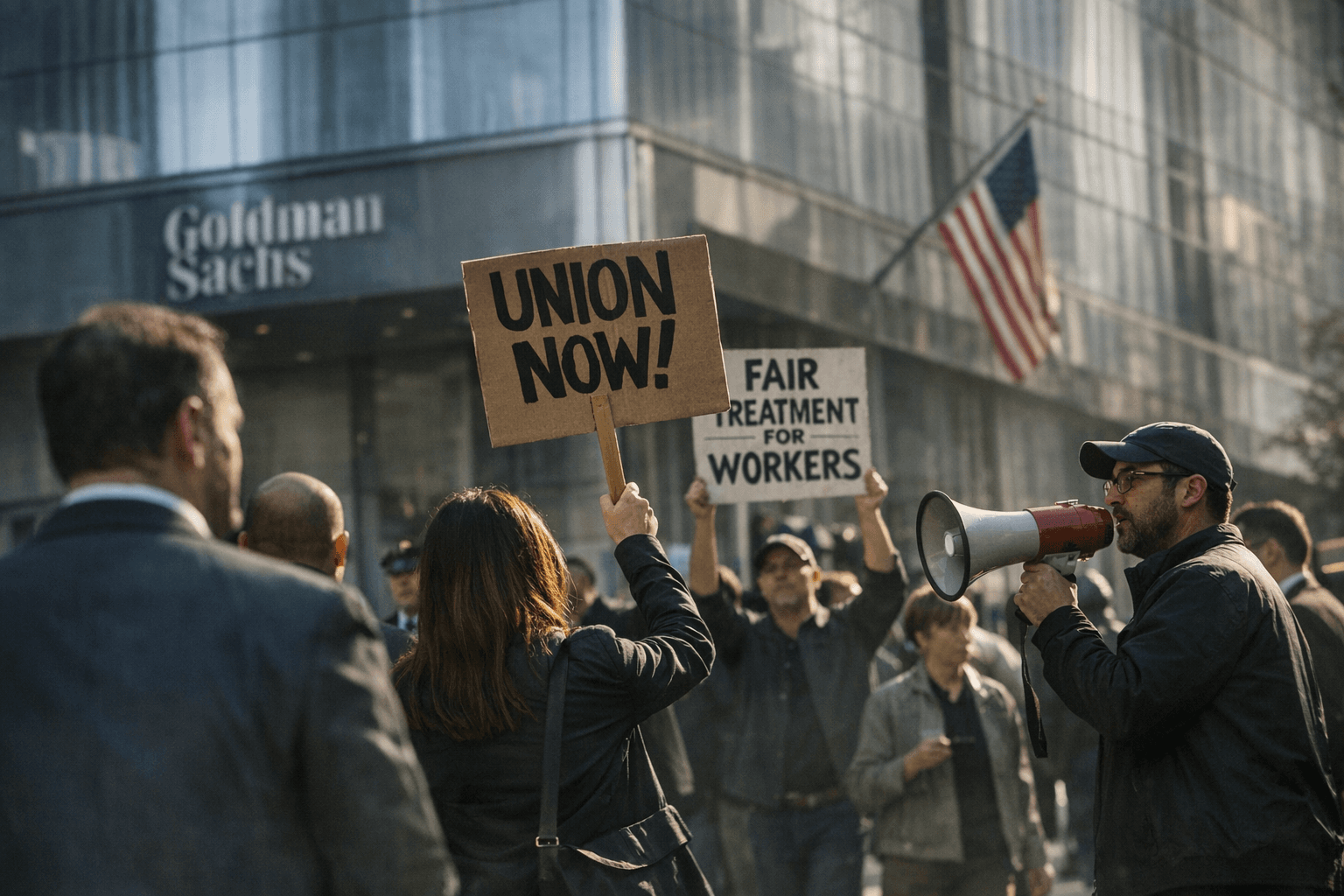
For Goldman Sachs employees, the guidance crystallizes options. Organizers can form an organizing committee, gather authorization cards, and choose whether to press for voluntary recognition or pursue an NLRB election. For managers and HR leaders at Goldman Sachs, the DOL’s emphasis on neutrality and making rights visible increases pressure to document communications and consider whether voluntary recognition would expedite resolution and initial bargaining.
The DOL also points employers and employees to dispute-resolution support such as the Federal Mediation and Conciliation Service and to informational resources from the National Labor Relations Board and other federal centers. For direct assistance, the Department of Labor lists its Washington office and hotline: U.S. Department of Labor, 200 Constitution Ave NW, Washington, DC 20210; 1-866-4-USA-DOL / 1-866-487-2365.
The guidance shifts the tactical landscape for finance firms where organizing conversations are occurring in trading floors, operations, and tech teams. Whether Goldman Sachs leadership moves toward voluntary recognition or contests a petition in an NLRB election, the DOL roadmap makes the thresholds and consequences clear. For employees, the next steps are concrete: talk with co-workers, collect authorizations, and decide whether to seek voluntary recognition or push for an NLRB vote. For management, the choice will affect the tone of bargaining and the speed at which contract talks begin.
Know something we missed? Have a correction or additional information?
Submit a Tip