Goldman Sachs Deploys Claude-Powered Agents to Automate Trade and Compliance Work
Marco Argenti's six-month Anthropic embed puts Claude agents on a collision course with trade reconciliation and KYC workflows employing thousands across Goldman's back office.
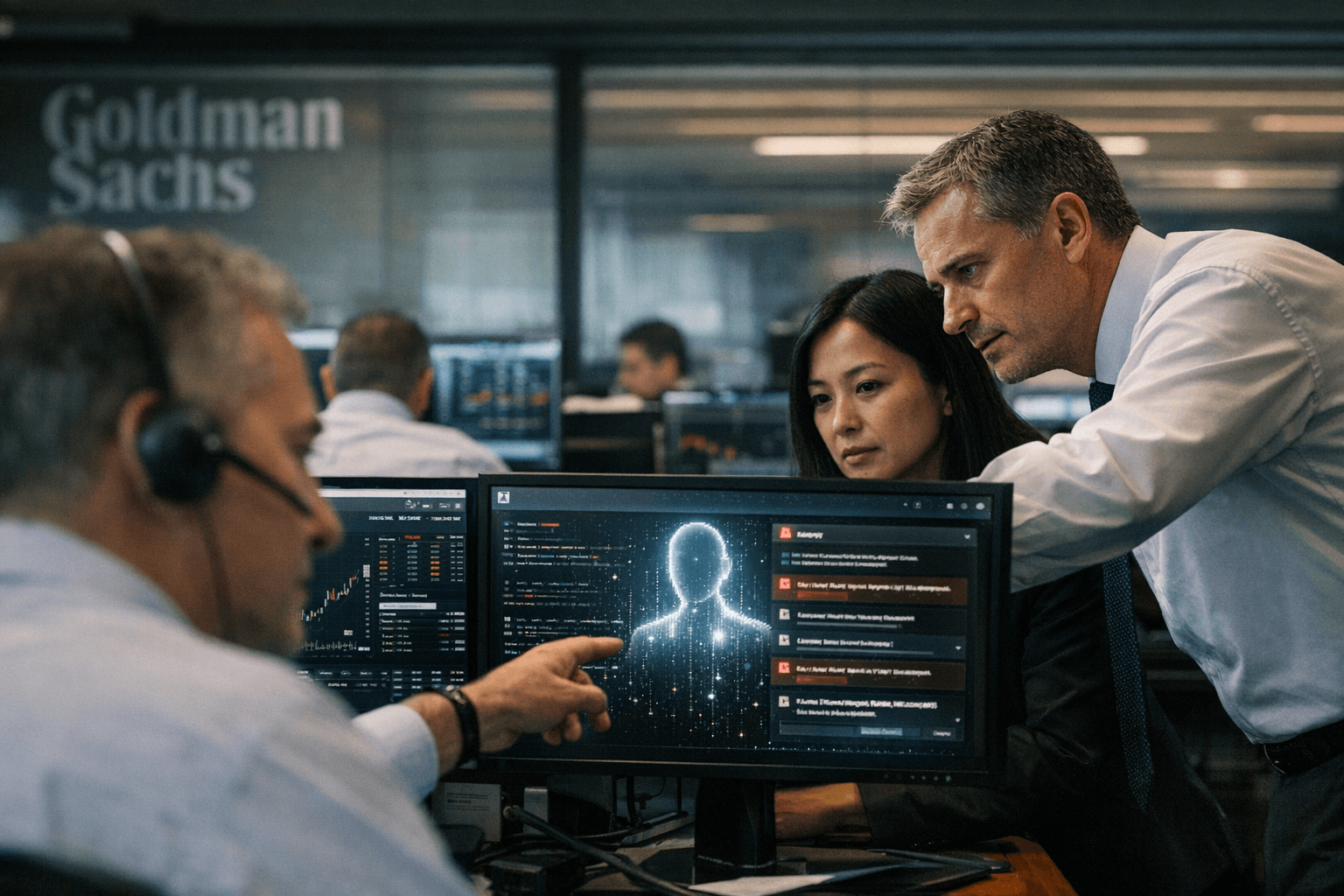
To build its agents for trade accounting and client onboarding, Goldman and Anthropic engineers spent months with domain experts at the bank, observing how people navigate their computers, where processes bottleneck, and what the actual work looks like in practice. What they built is specific: agents that review documents, extract entities, and apply judgment to ownership structures. "We ended up with these agents that are reviewing documents, extracting entities, determining, for example, whether you need to ask for another document or determining if you have an ownership on a certain company and your spouse also has an ownership, then you need to do a separate KYC for that, because they're co-owners," CIO Marco Argenti said.
For the past six months, Goldman embedded Anthropic engineers inside its operations to co-develop autonomous agents targeting at least two specific workflows: trade accounting and reconciliation, and client vetting and onboarding. The firm is in the early stages of deployment, and Argenti has said he expects to launch the agents "soon," though he declined to provide a specific date. The initiative is framed within Goldman's OneGS 3.0 operating model and follows CEO David Solomon's stated strategy of making generative AI central to a multiyear effort to control headcount growth and accelerate internal workflows.
The project started from a narrower bet on coding. Goldman piloted Devin, an autonomous AI coder, which became widely used among its engineers. That experience led Argenti to a broader question he put to CNBC: "Claude is really good at coding. Is that because coding is kind of special, or is it about the model's ability to reason through complex problems, step-by-step, applying logic?" The conclusion inside Goldman is that "there are these other areas of the firm where we could expect the same level of automation and the same level of results that we're seeing on the coding side."
Trade reconciliation is a particularly demanding target. Indranil Bandyopadhyay, principal analyst at Forrester, described the core challenge: "In trade accounting, much of the operational burden sits in reconciliation: comparing fragmented data across internal ledgers, counterparty confirmations and external bank statements." The agents must parse enormous volumes of trade data, cross-reference regulatory requirements, and flag exceptions while maintaining audit trails that satisfy regulators.
Argenti has framed the resulting tools as "a digital co-worker for many of the professions within the firm that are scaled, are complex and very process intensive." For operations analysts, reconciliation specialists, and KYC reviewers, the shift is structural. Goldman pairs Claude agents with rules systems and human oversight to resolve exception-heavy workflows, which means the volume of routine processing is the first thing absorbed; what remains on the human side is exception escalation, model validation, and client relationship judgment. Model governance sign-off and human-in-the-loop controls are built into the compliance architecture for every agent, given the regulated nature of these tasks.
Anthropic's recent model updates have made the commercial case more immediate, and Argenti has hinted the program could eventually allow Goldman to reduce reliance on costly third-party platforms for functions Claude's agents can replicate. Staff in affected workflows who can demonstrate skills in model oversight, exception handling, or data operations are best positioned as pilot deployments move to production. Those who cannot will find that the OneGS 3.0 efficiency logic leaves limited room for roles defined primarily by transaction volume.
This article was produced by Prism’s automated news system from verified source data, official records, and press releases, then run through automated quality and moderation checks before publishing. The system is built and supervised by the people who set the standards it runs under. Read our full AI policy.
Did this article answer your question?