Goldman Sachs leans on 1979 business principles to define culture
Goldman’s old 1979 principles still steer the firm, but a 2026 ethics-code update shows the culture keeps getting stress-tested.
A 1979 blueprint still doing the work
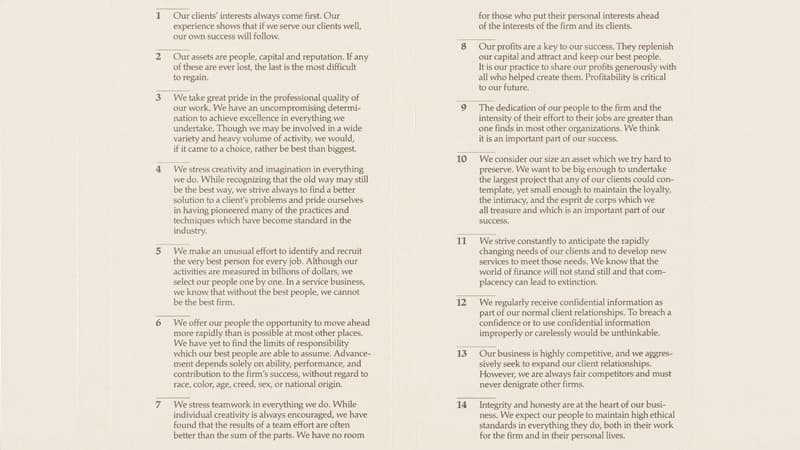
Goldman Sachs does not describe culture as a slogan. It describes it as a system: partnership, client service, integrity, and excellence, held together by 14 Business Principles that John Whitehead wrote in 1979 and Goldman says still anchor the firm more than four decades later. That matters because at a bank like this, culture is not decorative. It shapes who gets trusted with clients, how people make judgment calls under pressure, and what happens when a deal, deadline, or internal ask pulls in a different direction.

The firm’s public message is simple enough to fit on a page, but the ambition behind it is bigger. Goldman says it aspires to be the world’s most exceptional financial institution, and it presents those principles as the operating rules behind that claim. The point is not just that the firm has values, but that it expects those values to govern behavior in a place where speed, hierarchy, and competition can easily swallow them.
Why Whitehead put the principles in writing
Whitehead wrote the 14 Business Principles because Goldman was growing fast in the late 1970s and he worried that half the employees would soon be new, making it harder to pass down the culture by example alone. He circulated an early draft to partners on April 18, 1979, and finalized copies were distributed to employees in the summer of that year. Goldman later says the principles were included in annual financial reports and given to every new employee during onboarding, which turns them into more than an artifact of firm history.
That long shelf life is the real signal. Goldman says only two changes have ever been made to the principles, which tells employees and outsiders that the firm wants stability in the rules that define how it behaves. In a workplace where reputations are built over years and can be damaged in a week, that kind of institutional memory is part of the brand, but it is also a control mechanism.
What the principles are supposed to do on the desk
For analysts, associates, VPs, and managing directors, the value framework functions as a test for messy decisions. If a choice improves client service, supports teamwork, and can be defended with integrity and excellence, it fits Goldman’s stated culture. If it cannot, the firm’s own logic suggests the decision should be revisited rather than rationalized away.
That matters in a business where people often juggle incompatible demands, from client deadlines to internal politics to the daily pressure of proving they belong. Goldman’s values language is meant to be operational, not ornamental, and it is tied directly to the Code of Business Ethics and Conduct. For people considering a career there, the message is that performance still matters, but so does a fairly explicit ethical framework that is supposed to shape how performance is delivered.
The 2026 code update shows the culture is still being revised
Goldman’s Code of Business Conduct and Ethics was updated effective February 25, 2026, and the firm says the revision reflects its core values as well as refinements to policies and procedures. Those refinements included responsible communication and fair treatment, two ideas that sound abstract until they hit a real team dynamic, a difficult client interaction, or a manager deciding how far a push should go.
That update is important because it shows Goldman is still translating its values into rules that affect day-to-day work. The code says people must uphold partnership, client service, integrity, and excellence, and the firm links that directly to the idea that its reputation and future depend on acting honestly and with integrity. In other words, the culture page is not just about aspiration. It is part of the machinery that tells employees what the firm wants them to do when the pressure is on.
Goldman also says it offers channels for raising integrity concerns without reprisal through its Business Integrity Program. That is the practical backstop to the values language. A culture statement only matters if people believe they can surface problems without blowing up their careers, and Goldman is clearly aware that the credibility of the whole framework depends on that trust.
The post-crisis layer: when values become governance
The clearest sign that Goldman’s culture has been tested, not just celebrated, is the Business Standards Committee the firm created in May 2010. Its job was to review business standards and practices across every major business, region, and activity, which is a far broader exercise than a standard compliance refresh. The committee’s January 2011 report made 39 recommendations, covering client service, conflicts and business selection, structured products, transparency and disclosure, committee governance, training and professional development, and employee evaluation and incentives.
That list reads like a map of where culture can go wrong inside a major bank. It is not just about avoiding misconduct. It is about how the firm rewards behavior, how it selects business, how it handles disclosure, and whether incentive systems reinforce the right instincts or the wrong ones. Goldman said the committee’s purpose was to strengthen ownership and accountability for client service and reputational risk management, which gets to the heart of the gap between a partnership ideal and the reality of a large, complex financial institution.
The committee’s own framing was even sharper: the question is not simply whether the firm can do something, but whether it should. That distinction matters in a place where the wrong answer can show up later as a client dispute, a compliance issue, or a reputation hit that reverberates through hiring and leadership credibility.
Why the culture story reaches beyond employees
Goldman’s values framework is not limited to internal morale. On its sustainability and reporting pages, the firm says it takes a broad view of how it is managed and how it engages external stakeholders, including policy engagement, political participation, lobbying disclosures, vendor conduct, anti-money-laundering expectations, and anti-bribery and anti-corruption standards. That widens the circle of accountability well beyond the office floor.
The firm’s own history also helps explain why the language remains so central. John C. Whitehead and John L. Weinberg became co-heads in 1976, and Goldman says Whitehead later helped codify the principles after the firm’s rapid growth made informal transmission less reliable. The same institution that once worried about how to preserve a partnership culture while scaling now keeps updating its ethics code and integrity channels to preserve that same promise in a much more complicated business.
The result is a culture story with a built-in tension. Goldman wants to be seen as stable, principled, and partnership-driven, yet it keeps revisiting the machinery around those ideals because the pressures of modern finance never stop testing them. That is the real read on the firm’s public culture: not a frozen creed from 1979, but a standing instruction to make the principles survive contact with the business.
This article was produced by Prism’s automated news system from verified source data, official records, and press releases, then run through automated quality and moderation checks before publishing. The system is built and supervised by the people who set the standards it runs under. Read our full AI policy.
Did this article answer your question?