Goldman Sachs Pay Explained: Base, Bonus, and Equity Across All Levels
Goldman's shift away from the annual SRA to rolling manager-led cuts changes everything about how and when your pay and job security are actually decided.
The Hidden Mechanics of Goldman Sachs Compensation
Most people at Goldman Sachs can name their base salary. Far fewer understand the machinery underneath it: why two analysts in different divisions with identical titles can see 30% variance in their year-end bonus, why a promotion to associate triggers a comp reset that dwarfs any midyear raise, and why the single firmwide event that once determined your job security each spring no longer exists in its traditional form. The mechanics matter more than the headline numbers, and the calendar matters more than most employees realize.
Base, Bonus, and Equity: What You Actually Take Home
The compensation structure runs on three rails: fixed base salary, an annual cash bonus, and deferred equity or carried-interest awards that grow more significant as you advance.
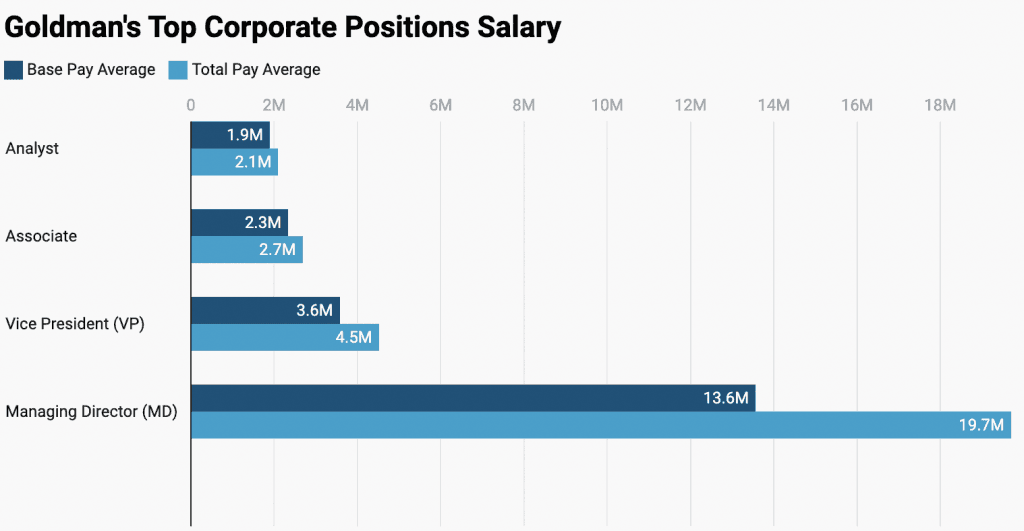
Base salary is the foundation, but its relative weight flips as you climb. At the analyst level, Goldman raised entry-level base pay to $110,000, a move that forced competitors to reset their own benchmarks. At the associate level, base salaries at bulge-bracket firms typically run $180,000-$250,000; at VP, that range shifts to roughly $230,000-$270,000. For managing directors, base becomes almost incidental: total compensation can reach $475,000 to over $1,000,000, with the firm's Levels.fyi data showing the highest-reported MD-level investment banker total at approximately $1,004,000. The base is the floor; everything above it is performance-contingent.
The annual cash bonus is where the real differentiation happens. It is calibrated at three intersecting levels: firmwide pool, division performance, and individual performance scores. Front-office roles in revenue-generating businesses have historically received the largest allocations; middle and back-office teams see smaller and more variable awards. In a strong year like 2025, when Goldman averaged $399,000 in per-employee compensation (up from $359,000 the prior year), rising tides lifted many boats. But the distribution was not uniform. Equities traders, who posted the highest quarterly revenue in Goldman's history in Q4 2025, were well positioned. Fixed income, where revenue grew just 8.9% for the full year, faced a tighter pool. Your division's line on the earnings call is a direct input into your envelope.
Deferred equity becomes a meaningful variable starting at the associate level. Analyst bonuses are typically paid 100% in cash, but the deferred share rises quickly above that: associate and VP awards can carry 20-30% in deferred compensation, while MD bonuses often defer 30-50% into performance share units (PSUs) or similar instruments. These awards typically vest over multiple years and may include performance hurdles tied to the firm's returns or stock price. The practical implication is that the further up you are, the more your realized compensation depends not just on your current-year performance but on the firm's trajectory over the vesting period.
The Promotion Ladder and Its Pay Consequences
Goldman uses a structured hierarchy: analyst, associate, vice president, managing director, and partner. Promotion between each level is an inflection point for both base salary and bonus eligibility, not merely a title change.
Junior promotions from analyst to associate typically follow a two-to-three year track and run on relatively predictable annual or biennial cycles depending on division and geography. The larger, higher-stakes promotions to managing director and partner involve senior leadership sign-offs and, at the partner level, the kind of firm-wide deliberation that is conducted confidentially and infrequently. Getting to VP is a function of sustained performance; getting to MD requires a visible franchise. The bonus multiplier at each step is substantial, which is why missing a promotion cycle by even one year has multi-year compounding consequences for total earnings.
The SRA Is No Longer What It Was
For years, Goldman's Strategic Resource Assessment was the event employees circled on the calendar. Typically executed in the first half of the year, the SRA was a firmwide performance review that produced a concentrated wave of exits. In March 2025, that process resulted in cuts of between 3% and 5% of staff, representing roughly 1,395 to 2,325 positions from a base headcount of approximately 46,500.
In 2026, the traditional spring SRA cycle is not happening. Instead, Goldman is moving performance-based reductions to a rolling model, with actions expected to begin in April and continue in phases through the summer. This is not a rebranding exercise. It represents a structural shift in how the firm manages underperformance: managers now have more latitude to initiate reductions year-round, without waiting for a firmwide cycle to provide cover or coordination.
For employees, the practical consequence is significant. The old model had a predictable cadence that created at least a rough sense of when you needed to perform. The rolling model eliminates that window. A quiet quarter with limited visibility, a desk restructuring, or a manager who stops scheduling regular one-on-ones can now translate into action at any point in the year, not just in spring. Continuous documentation of impact is no longer optional.
The Comp-Cycle Calendar: When Decisions Actually Get Made
Understanding the rough timing of Goldman's compensation machinery helps you position your contributions at the right moments.
The year runs roughly as follows:
1. Q3 (July-September): Midyear check-ins are the first formal calibration point.
Division heads begin assessing where revenue lines are tracking and what the firmwide bonus pool trajectory looks like. This is when manager perceptions begin to harden. If your contributions are not documented and visible by September, you are starting from a deficit.

2. Q4 (October-December): Senior managers formally begin evaluating performance for year-end bonuses.
Cross-division calibration sessions happen during this window. Sponsor conversations and performance ratings are set here; by December, most outcomes are effectively determined even if they haven't been communicated.
3. January: Bonus numbers begin communicating to employees, typically in the third week of January.
Goldman communicated 2025 bonuses starting around January 16. Deferred equity grants are confirmed at this stage.
4. Q1-Q2 (February-June): Promotion cycles, particularly for VP and below, tend to run in early spring.
With the SRA now converted to rolling reductions, this window also carries more performance-management risk than in prior years, as manager-led actions can initiate without a firmwide trigger.
Five Actions to Improve Your Outcome Before the Next Window Closes
The midyear check-in cycle is the most underutilized leverage point for Goldman employees. Here is how to use the next few months effectively:
- Quantify everything before Q3 calibrations. Revenue attributed, deals closed, automation savings, run-rate cost reductions. Managers presenting your case in calibration rooms need numbers, not narratives. If you are in technology or operations, "productivity" projects with measurable client or cost impact are the defensible currency.
- Request an explicit midyear calibration conversation. Do not wait for your manager to schedule it. Ask directly. The shift to rolling performance management means managers who are not proactively calibrating with you may not be your advocates in the fall cycle.
- Secure a sponsor above your manager. Bonus and promotion outcomes at Goldman are not set by your direct manager alone; cross-divisional calibration sessions involve voices from above. A VP or MD sponsor who can speak to your contribution is a structural advantage.
- Align your stated objectives to the firm's stated priorities for the year. Goldman's AI-related initiatives, including its deployment of AI tools in areas like accounting and operations, have elevated "measurable productivity" as a performance criterion. Frame your work in terms that map to firm priorities, not just desk-level metrics.
- Audit your deferred equity timeline now. If you have outstanding sign-on awards, unvested equity, or compensation with relocation conditions, confirm the vesting schedule with HR before any career decisions, especially given the rolling reduction environment. Special circumstances including long-term leave or relocation should be discussed with the compensation team proactively.
- Document your own performance in writing. Under the rolling reduction model, PIPs and performance rationales are generated at the manager level at any time. Having your own contemporaneous record of contributions, client feedback, and project outcomes puts you in a better position to respond if a performance conversation becomes adversarial.
- Track your business unit's revenue trajectory publicly. Quarterly earnings calls are free information. If your desk's business line is cited as a headwind, the bonus pool math is working against you regardless of individual performance. Knowing this early lets you make informed decisions about lateral moves or cross-divisional transfers before the pool is set.
Red Flags: What Reliably Hurts Outcomes
Certain patterns consistently predict worse bonus and promotion outcomes, and some signal elevated reduction risk under the rolling model. Abrupt desk restructurings or business unit revenue declines that show up in earnings commentary are the clearest leading indicators. If your role's objectives are not being tracked or updated in firm systems, that absence of documentation works against you in calibration. A manager who stops scheduling regular one-on-ones is not a neutral signal; under the rolling model, a disengaged manager is a liability. Sudden changes to performance-scoring frameworks within a division, or public reporting of firm-wide hiring slowdowns, should prompt a proactive check-in with HR or your compensation team rather than a wait-and-see approach. The employees most exposed in rolling reduction environments are those with low visibility, undocumented contributions, and no sponsorship outside their immediate reporting line.
What the Numbers Tell You
Goldman's average per-employee compensation reaching $399,000 in 2025 reflects a strong revenue year, but averages obscure the distribution. Equities desks had a record quarter; fixed income underperformed. A firm-wide average says very little about what lands in your account in January. The employees who navigate the new rolling performance environment most effectively are those who treat their comp cycle as a year-round practice: quantifying outcomes continuously, aligning to firm priorities explicitly, and maintaining relationships with sponsors who have a seat in the rooms where calibration actually happens.
This article was produced by Prism’s automated news system from verified source data, official records, and press releases, then run through automated quality and moderation checks before publishing. The system is built and supervised by the people who set the standards it runs under. Read our full AI policy.
Did this article answer your question?