Goldman Sachs says AI can scale banking without adding headcount
Goldman’s AI push looks less like layoffs than a redesign: back-office workflows are first in line, while judgment-heavy coverage roles gain leverage.
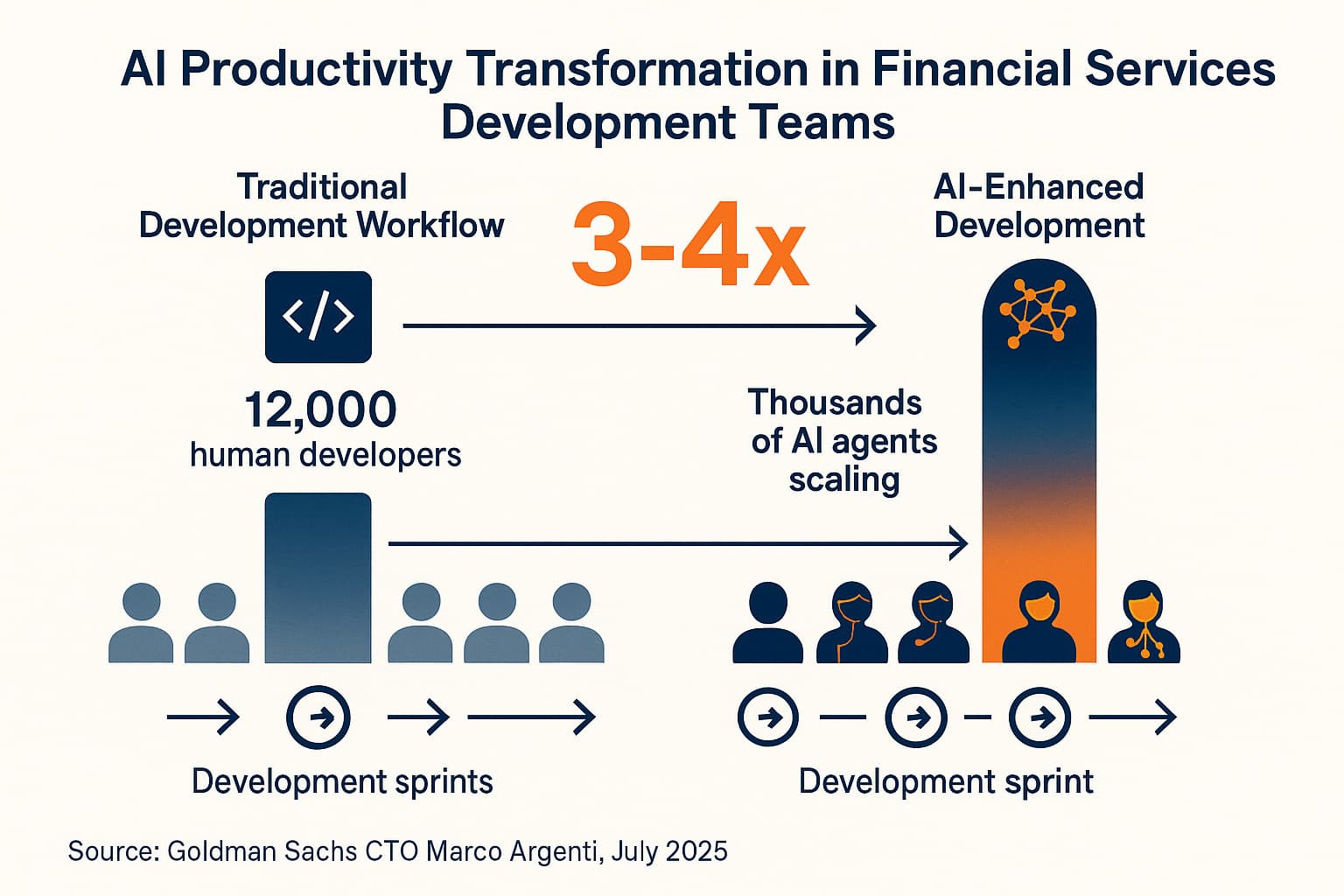
Goldman Sachs is signaling that AI will change the firm’s staffing math before it changes its headcount. John Waldron’s description of the bank as a “human assembly line” points to a workplace where the first jobs to be automated are the repetitive, high-volume pieces of banking: trade accounting, client onboarding, document production, and the first pass at routine materials that analysts and associates now grind through late at night. The message to employees is not that Goldman is preparing for a mass purge. It is that management expects technology to raise throughput the way robotics transformed factory floors, letting the bank do more work without hiring in proportion.
That matters because Goldman is not speaking from a weak position. The firm said 2025 net revenues rose 9% to $58.3 billion, earnings per share climbed 27% to $51.32, and return on equity reached 15.0%. It also said firmwide net revenues are up roughly 60% since its January 2020 Investor Day, while historical principal investments fell by more than 90%, from about $64 billion to $6 billion. At the same time, Goldman said it had 47,400 employees at the end of December 2025. Those numbers give the AI strategy a clear baseline: a profitable bank with a large workforce is trying to add capacity without rebuilding the payroll.
The clearest clues about where the work is going came earlier this year, when Goldman was reported to be working with Anthropic’s Claude to automate trade accounting and client onboarding. Those are the kind of tasks junior bankers, operations staff, and support teams often absorb as necessary but time-consuming work. If those workflows become autonomous or semi-autonomous, analysts and associates may spend less time on process-heavy execution and more time supervising outputs, checking exceptions, and pushing faster drafts to senior bankers. That raises the bar on speed and polish, but it also reduces the value of pure repetition as a path to proving oneself.
For vice presidents and managing directors, the shift is more complicated. AI should make judgment, client coverage, and oversight more valuable, not less, because those are the functions that remain when the machine handles the first layer of production. But Goldman’s earlier warning of potential job cuts and a hiring slowdown under its “OneGS 3.0” push suggests the promotion pipeline could get tighter, not looser, if fewer seats open below the top of the house. Goldman says it remains the No. 1 M&A adviser for the 23rd straight year, and it says policy uncertainty, geopolitical events, and technological developments can still shake markets. Inside the firm, that combination means AI is now part of the staffing model, not just the tech stack.
This article was produced by Prism’s automated news system from verified source data, official records, and press releases, then run through automated quality and moderation checks before publishing. The system is built and supervised by the people who set the standards it runs under. Read our full AI policy.
Did this article answer your question?