Goldman Sachs sees optical networking as key AI infrastructure growth driver
Goldman Sachs says the next AI trade is the network, not just the chip. That shift could move client money, internal coverage priorities, and who gets credit on the desk.
The bottleneck Goldman thinks the market is missing
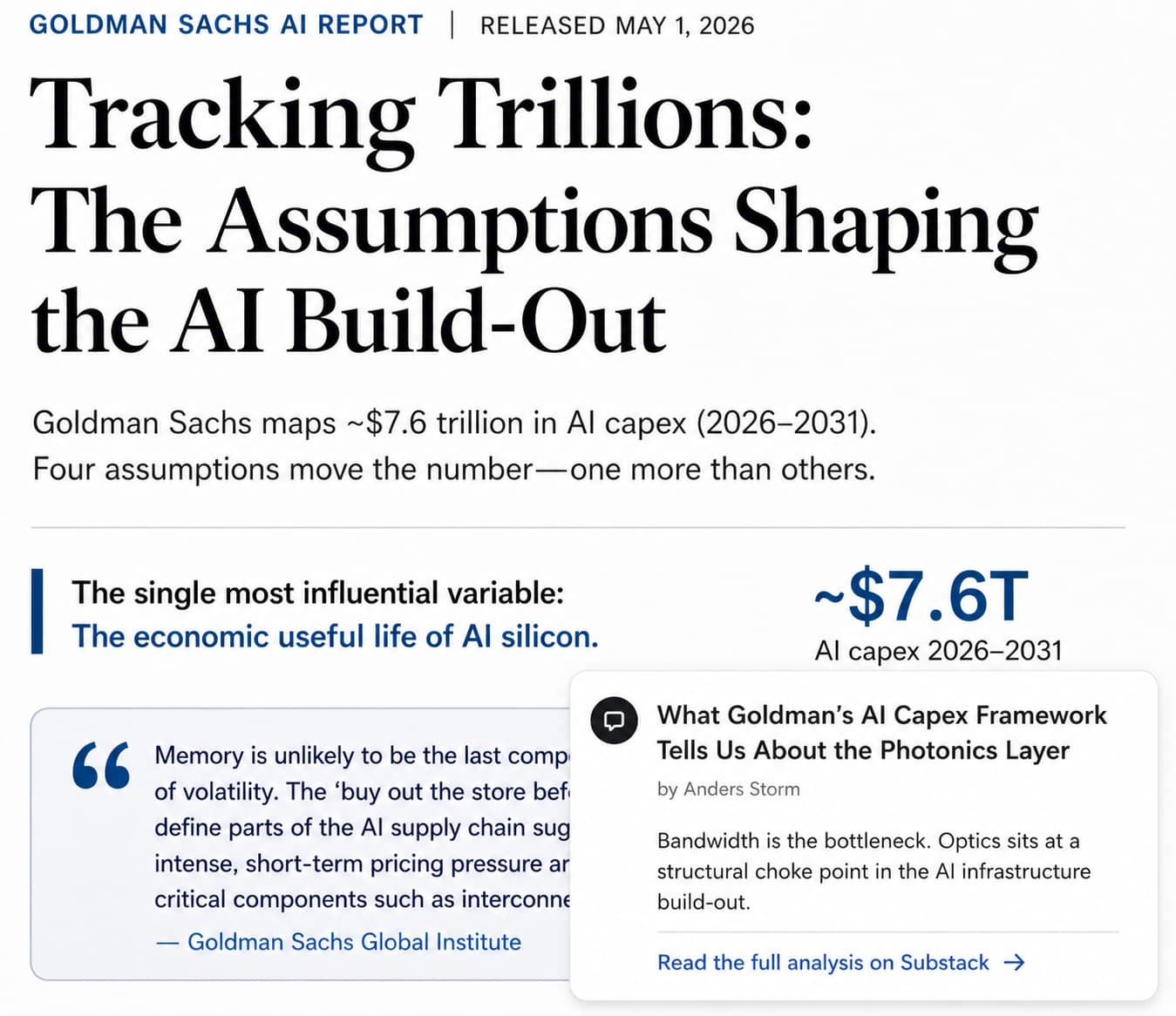
Goldman Sachs Research is making a pointed bet that the next phase of the AI build-out will not be won only by chipmakers or cloud platforms. Its case is that optical networking is what unlocks the computing power of individual AI chips by connecting many chips, enabling low-latency data exchange, and letting systems scale to heavier AI workloads.
That is why the firm’s report, titled “Optical Networking: The Next Mega Trend in AI Infrastructure,” lands as more than a niche hardware note. Goldman says the total addressable market for AI networking could rise ninefold to $154 billion, and it frames that expansion as a broad infrastructure story, not a single-product story. For Goldman employees, the practical takeaway is that the AI trade is moving deeper into the supply chain, which matters for anyone covering semis, networking, data centers, or industrial suppliers, and for anyone trying to understand where the next wave of capital spending will land.
Why this matters for the next AI investment cycle
Goldman’s view is that the market still tends to think about AI through the obvious winners first: GPUs, hyperscalers, and the companies directly selling compute. The bank is arguing that the more consequential constraint is the transport layer, because once compute density rises, the network has to keep up or the whole stack slows down. That makes optical networking a central enabler rather than a sidecar component.
The report says growth should show up across both scale-out and scale-up networking, and across copper cables, pluggable optical modules, co-packaged optics, and PCB midplanes. Goldman also said the broader AI infrastructure ramp-up, plus rising computing power per rack, should lift demand across all configurations. That matters inside Goldman because the highest-value thematic calls are the ones that change where clients want to put risk, and that in turn changes which analysts and associates become useful in coverage conversations, pitch meetings, and internal debates that feed into bonus season and longer-term mobility.
What OFC 2026 showed about the shift
The optical industry was already signaling that 2026 would be a breakout year for AI-driven demand, and the annual Optical Fiber Communications Conference and Exhibition gave that view more weight. OFC 2026 drew nearly 18,000 attendees in March, a strong sign that the industry sees AI infrastructure and optical networking as a live commercial opportunity, not a speculative future theme. The event’s scale matters because it shows this is no longer a small circle of engineers talking to one another.
The technical direction was also clear. Vendors emphasized 1.6T optics, 400G-per-lane roadmaps, and eventual 3.2T platforms, all aimed at faster and more power-efficient links for AI data centers. NVIDIA has been pushing co-packaged optics and silicon photonics for what it calls agentic AI networking, saying the approach delivers 5x better power efficiency and 10x higher network resiliency. Broadcom added another signal by showcasing a 102.4T Ethernet switch with co-packaged optics at OFC 2026. Taken together, the message is that bandwidth, latency, and power use have become strategic constraints, not just engineering specs.

How Goldman is shaping the next AI narrative
The reason this report matters is not only that Goldman is bullish on a slice of infrastructure. It is that the bank is helping define where the next trade begins after the market has already crowded into the most obvious AI beneficiaries. By calling optical networking a mega trend, Goldman is telling clients that the AI build-out is now a story about plumbing, not just performance.
Secondary coverage sharpened that view with specific numbers. One note said Goldman raised its price target on Zhongji Innolight to 1,187 yuan from 791 yuan while keeping a Buy rating. The same reporting said Goldman projected the optical networking market to grow from about $15 billion to about $154 billion by 2027 and 2028, and estimated co-packaged optics could become a $91 billion opportunity by 2028. Those figures point to a simple conclusion: the biggest upside may not be in the broad data-center layer alone, but in intra-rack and near-rack networking where the fight over bandwidth and power efficiency is most intense.
That is also why the comparison with older optical cycles matters. The sector has seen booms before, but this one is being pulled by AI compute rather than by legacy telecom upgrades. Companies such as Coherent Corp. are positioning co-packaged optics as a response to rapidly rising bandwidth demand from AI and high-performance computing infrastructure, which is a different demand profile from the slower carrier-led cycles that shaped the industry before. In other words, this is not just another rotation within semiconductors. It is a sign that AI capex is broadening into the systems that make large models usable at scale.
What it means if you work inside Goldman
For bankers, strategists, and traders, the shift is straightforward: if optical networking is the next bottleneck, then client conversations will move there quickly. A banker who can explain why the network layer now matters as much as the accelerator layer is better positioned to cover the next wave of financing, M&A, and capital spending. A trader who understands where bandwidth, latency, and power efficiency intersect can read the market’s next reaction before the obvious AI names move.
For junior people, this kind of thematic call is career capital. The analysts and associates who can connect AI compute demand to optical components, rack-level power constraints, and capex timing become the ones seniors pull into meetings because they can explain where the money is likely to go next. In a firm where prestige, promotion trajectory, and seat allocation matter, being early on the second derivative of an AI theme can be as valuable as being right on the first.
Goldman’s message is that the AI infrastructure story is still widening, and the next leg may belong to the firms that move data faster and waste less power. That is the kind of call that changes research coverage, shifts client attention, and redraws the map of who looks smartest when the next capital cycle begins.
This article was produced by Prism’s automated news system from verified source data, official records, and press releases, then run through automated quality and moderation checks before publishing. The system is built and supervised by the people who set the standards it runs under. Read our full AI policy.
Did this article answer your question?