Goldman Sachs says global tensions now exceed Cuban Missile Crisis levels
Goldman is using the Fed’s news-based risk index to argue today’s tensions top the Cuban Missile Crisis, a signal for clients and hedging desks.
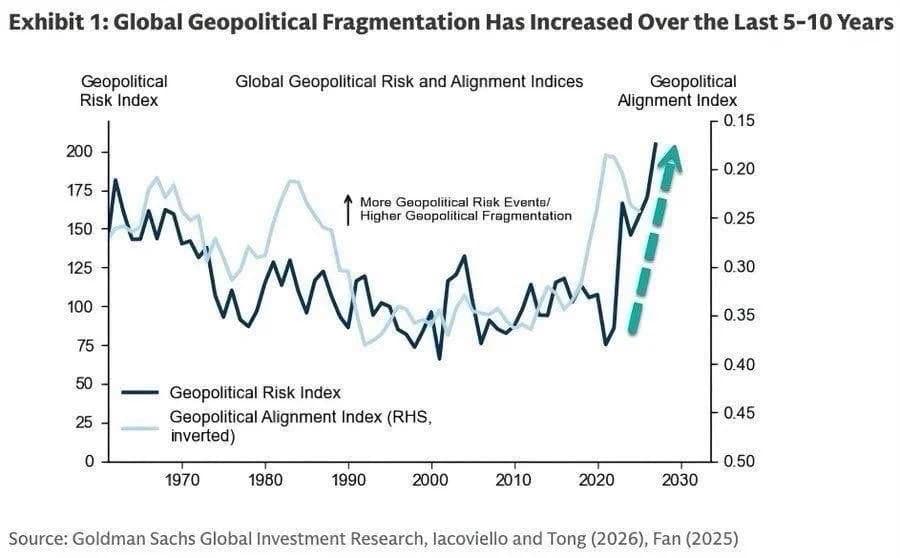
Goldman Sachs analysts are using the Federal Reserve’s news-based Geopolitical Risk Index to argue that current global tensions have moved above the 1962 Cuban Missile Crisis benchmark. The measure, developed by Dario Caldara and Matteo Iacoviello from newspaper coverage of geopolitical shocks, is built to track risk across more than a century of headlines, with spikes around the two world wars, the start of the Korean War, the Cuban Missile Crisis and after 9/11.
That comparison matters because the Cuban Missile Crisis was not just a dramatic historical reference. In October 1962, the United States and the Soviet Union entered a direct and dangerous confrontation that lasted about two weeks, under John F. Kennedy and Nikita Khrushchev, and is widely treated as the moment the two superpowers came closest to nuclear conflict. Goldman’s use of that benchmark turns a geopolitical headline into a market variable.

The bank has been pushing that logic into client conversation for some time. Goldman strategists have said geopolitical risk premia can rise further when tensions flare, and Goldman’s client survey found geopolitics was the biggest risk to markets and the global economy in 2024, ahead of inflation. For analysts, associates and desk heads, that kind of framing matters because it can change how clients think about hedging costs, positioning, and whether to lean into or delay capital deployment when headlines turn.
Goldman has also tied the risk to the Middle East. Its Middle East risks work linked Hamas’ Oct. 7 attacks on Israel and Israel’s response to concern about a wider regional, or broader, war. That is the practical side of the firm’s geopolitical lens: translating instability into scenario analysis, asset-price risk and portfolio construction rather than leaving it as a political backdrop.
The academic case for watching the index is equally clear. Research associated with the Federal Reserve and Princeton has found that higher geopolitical risk can foreshadow lower investment, stock prices and employment. For Goldman, that means a news-based score can flow quickly into client notes, risk meetings and revenue assumptions, with consequences that reach from trading desks to year-end compensation planning.
This article was produced by Prism’s automated news system from verified source data, official records, and press releases, then run through automated quality and moderation checks before publishing. The system is built and supervised by the people who set the standards it runs under. Read our full AI policy.
Did this article answer your question?