Goldman sees Turkey tolerating faster lira weakening to support external balance
Goldman's economists see Turkey accepting 20% to 25% annualized lira weakening to protect its external balance, even as inflation cools more slowly.
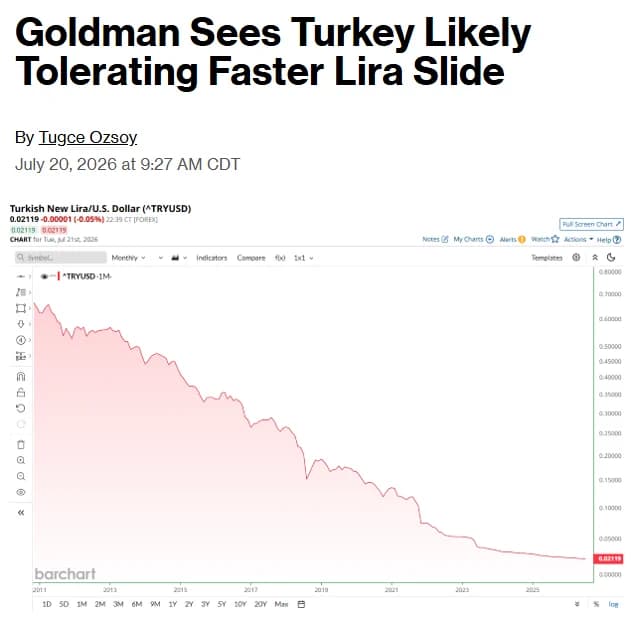
Goldman Sachs economists expect Turkey to tolerate faster lira depreciation, roughly 20% to 25% annualized, so officials can support the external balance even if disinflation slows. For Goldman bankers, analysts and traders who cover emerging markets, that is a clear signal that FX volatility, sovereign-risk pricing and client hedging demand are likely to stay elevated.
The lira has already fallen about 9% against the dollar this year, while consumer prices rose more than 17% in the first six months. Trading Economics said USD/TRY reached 47.1825 on July 20, 2026, an all-time high, and the currency was still down 16.85% over the previous 12 months. Goldman has warned on Turkey before: in June 2023 it saw the lira slipping to 28.00 versus the dollar over 12 months, and another 2023 call for a three-month plunge was met in just three days.

The policy trade-off matters because it shows how Goldman reads emerging-market priorities when inflation control and external stability are pulling in different directions. The Central Bank of the Republic of Turkey says its primary objective is to achieve and maintain price stability, but the latest Goldman view suggests policymakers may accept a weaker currency if it helps preserve competitiveness and stabilize the external account. That leaves corporate treasury teams, sovereign desks and FX salespeople facing a market where slower inflation progress can coexist with a sharper currency move.
Turkey’s inflation problem has been stubborn enough to bleed into company accounts for years. In October 2023, officials said company balance sheets would remain inflation-adjusted until 2026, a reminder that the price level was still distorting the way businesses reported earnings and capital. Academic research cited in Economic Policy found that by September 2021 the lira had depreciated about 420% versus 2003, compared with roughly 30% for other emerging-market currencies, a long slide that still shapes how investors and Goldman clients price policy risk under Tayyip Erdoğan’s government.
This article was produced by Prism’s automated news system from verified source data, official records, and press releases, then run through automated quality and moderation checks before publishing. The system is built and supervised by the people who set the standards it runs under. Read our full AI policy.
Did this article answer your question?