Goldman Sachs sees $415 billion robotaxi market by 2035
Robotaxis could reach $415 billion by 2035, but Goldman says the real test is whether rules, road networks and rider habits can scale first.
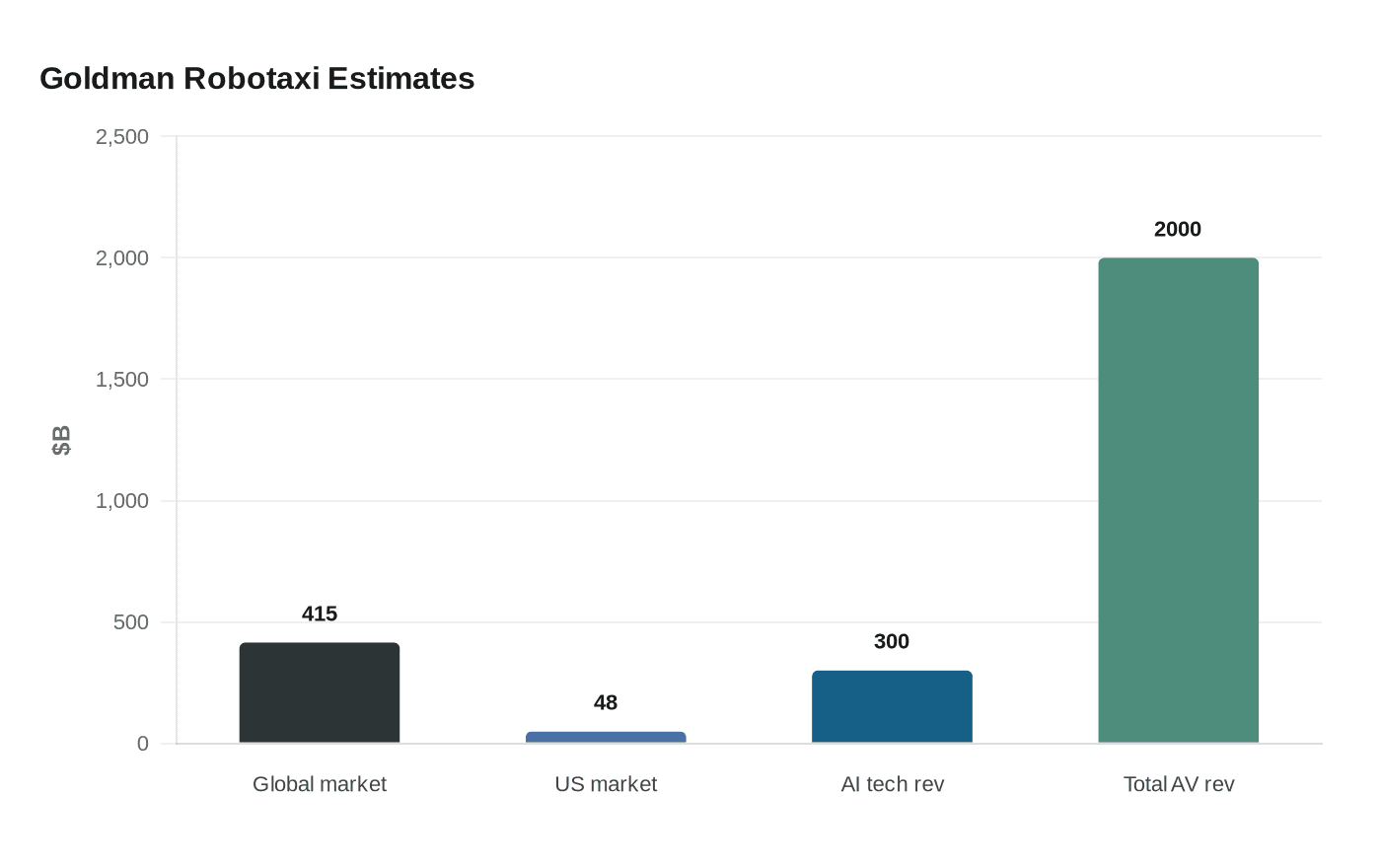
A robotaxi market that barely existed a few years ago could be worth about $415 billion by 2035, and Goldman Sachs Research is now treating it as a business with operating metrics, not just AI spectacle. Goldman also sees the US robotaxi market reaching $48 billion by 2035, with the global commercial fleet rising from roughly 7,000 vehicles last year to about 6 million.
That scale only works if the economics keep improving. Goldman says a vertically integrated operator could reach gross margins of 30% to 50% in 2035, while cumulative gross profits from robotaxis alone could total about $440 billion over the next decade. It also says the total cost of goods sold per mile for a vertically integrated AV rideshare operator could fall below $1 in the US by 2035, helped by lower depreciation, insurance and remote-operator costs. The number of vehicles per human supervisor could improve from 6-to-1 today to 26-to-1 by 2035, and revenue tied to AI technology, including virtual driver software and consumer autonomy subscriptions, could rise to $300 billion in 2035.
Goldman’s view has moved quickly. In July 2025, the firm said more than 1,500 robotaxis were already operating commercially in five US cities and projected that number would rise to about 35,000 across the country by 2030, with $7 billion in annual revenue and roughly 8% of the US rideshare market. Mark Delaney, in that earlier work, said the key question for investors was no longer whether the technology works, but how fast the market scales. That question now sits at the center of Goldman’s broader AV estimate, which puts total revenue across hardware, software, trucking and delivery robots at about $2 trillion by 2035.
The public signals are more concrete than they were even a year ago. Waymo said in February 2026 that it had launched public robotaxi rides in Dallas, Houston, San Antonio and Orlando, bringing its commercial footprint to 10 metro areas. The company said it was on track to serve more than one million rides per week by the end of 2026 and was laying groundwork for service in more than 20 cities. California DMV records show Waymo’s drivered testing authorization dating to September 2014, with driverless testing approved in October 2018 and deployment authorization in September 2021, followed by later geographic expansions.
Tesla has also entered the real-world race, saying autonomous Robotaxi rides are currently offered in Austin, Dallas and Houston, starting with Model Y vehicles while Cybercab remains a future product. That puts the next phase of the market on a short list of milestones: wider city approvals, sturdier safety records, cheaper miles, and riders who treat a driverless trip to work, dinner or the airport as normal. For Goldman employees covering clients in transportation, software, insurance and capital markets, the most useful signal will not be the headline valuation alone. It will be whether the sector keeps turning pilot programs into repeatable operations, and repeatable operations into a durable commercial market.
Know something we missed? Have a correction or additional information?
Submit a Tip