Goldman Sachs sees S&P 500 rising 6% on stronger earnings and AI spending
Goldman’s 6% S&P call hinges on one question: can AI capex keep turning into earnings, or is the market already close to fair value?
Goldman Sachs is betting the S&P 500 can still climb 6% by year-end to 7,600, but the firm is not leaning on a bigger valuation multiple to get there. Its case rests on stronger earnings, with 12% EPS growth projected for 2026 and another 10% in 2027, and on AI spending that Goldman says will account for roughly 40% of this year’s index earnings growth.
That matters because the bank says the market is not obviously stretched on price alone. As of April 24, the S&P 500 was trading at about 21 times earnings, slightly below the 22 times reached in January and close to Goldman’s five-year average. The message is clear: the rally can still run if profits keep rising, but the upside looks more like an earnings story than a multiple-expansion story.
The firm’s backdrop is built around a very large capital-spending cycle. Goldman said the largest cloud-computing companies plan to spend an estimated $670 billion in 2026, underscoring how much of the market’s profit outlook now depends on AI infrastructure, cloud buildouts, and the companies selling into that stack. Goldman has also argued in separate 2026 materials that investors are rotating toward AI platform stocks and productivity beneficiaries as investment starts to show up in returns.
For Goldman employees, that is more than a market call. It shapes the tone of client conversations across equity sales and trading, wealth management, and corporate finance. A market grinding higher on earnings rather than pure enthusiasm tends to support primary issuance, derivatives activity, share repurchases, hedging, and portfolio rebalancing. It also gives bankers more room to pitch financing and strategic finance work without having to explain away a speculative bubble narrative.
The timing of the call also reflects a sharp turn in sentiment. Goldman said investor confidence improved after late-March volatility. The S&P 500 then hit a fresh record high on April 15, its first since the United States-Iran conflict began, and closed above 7,100 for the first time on April 16. By April 30, Bloomberg reported that the index was posting its best month since November 2020.
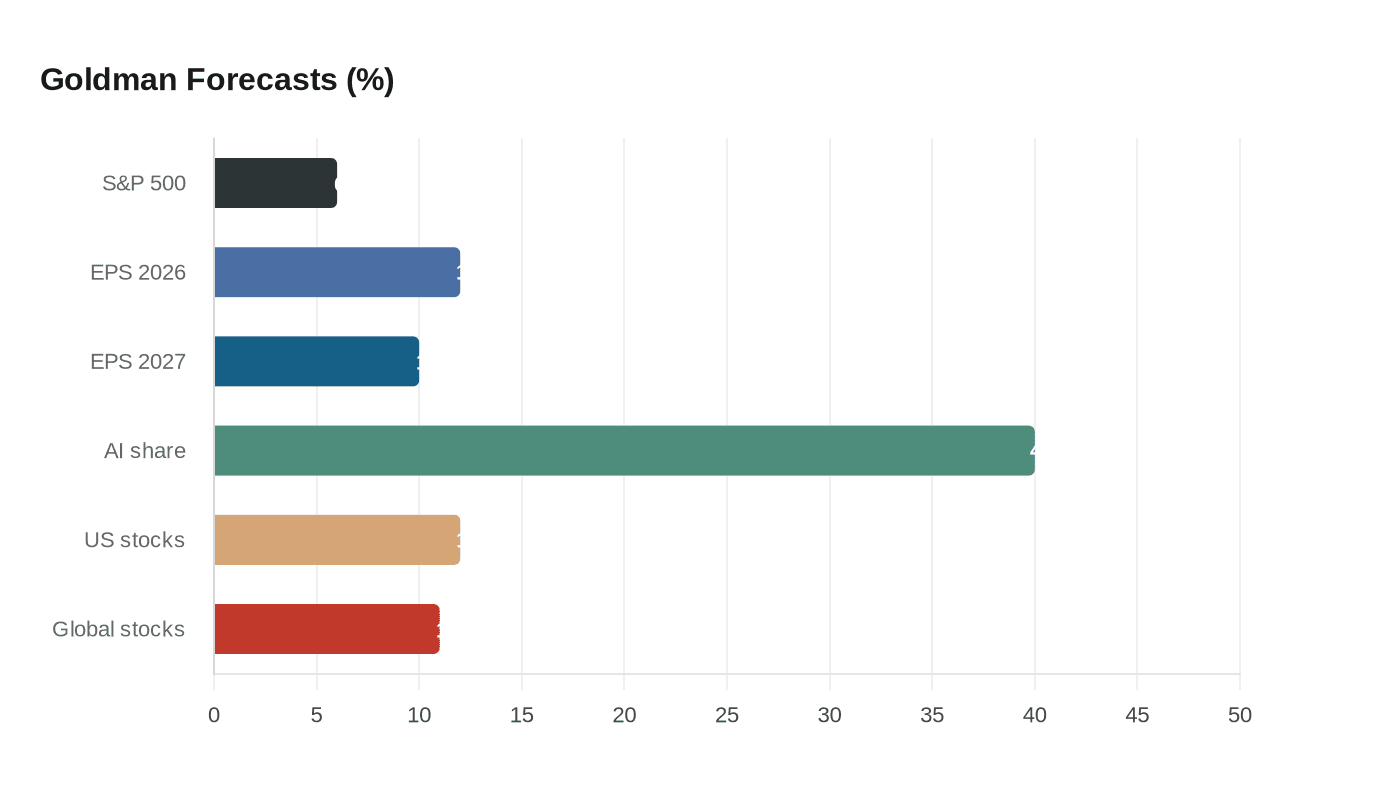
Goldman’s broader 2026 outlook is still constructive, with U.S. stocks forecast to deliver a 12% total return this year and global stocks projected to return 11% over the next 12 months. But the practical test for the call is narrow: if AI spending keeps translating into earnings, the market can justify further gains even with valuations near fair value. If that conversion weakens, the argument for more upside gets harder fast.
Know something we missed? Have a correction or additional information?
Submit a Tip