Goldman Sachs Warns AI Could Automate 25% Hours, Displace 6-7% Jobs
Goldman Sachs analysts estimated AI could automate about 25% of work hours and displace 6-7% of jobs, signaling major reskilling and workforce planning needs.

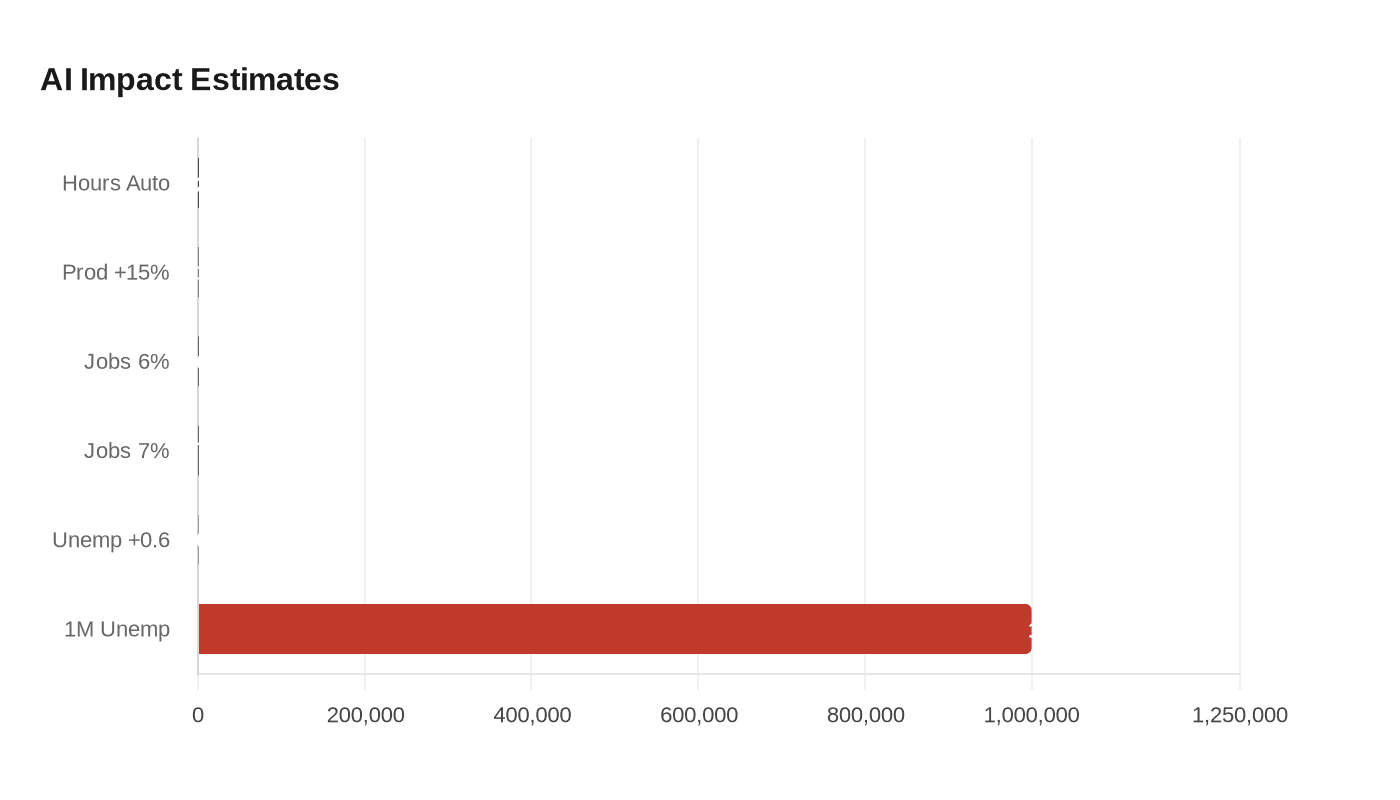
Goldman Sachs analysts Joseph Briggs and Sarah Dong estimated that artificial intelligence could automate roughly 25% of all work hours, but warned that automation of hours would not translate into a one-for-one loss of jobs. Using U.S. Department of Labor job data, the analysts modeled a baseline scenario that assumes a 15% uplift in AI-driven labor productivity and drew on historical relationships between productivity gains and employment shifts to project job impacts.
Under that baseline, Briggs and Dong estimated 6-7% of jobs could be displaced over the adoption period. They also projected a peak increase in the gross unemployment rate of about 0.6 percentage points, which the analysts translated to roughly 1 million additional unemployed at the peak of transition. Those figures reflect gross displacement rather than a permanent headcount decline, and the note emphasized the potential for new roles to emerge as firms adapt work flows and allocate remaining human labor to higher-value tasks.
The analysts flagged uneven effects across industries and occupations. White-collar tasks are particularly exposed, with office-based workflows that involve repeatable information processing most vulnerable to automation. That pattern suggests material implications for front-office, middle-office and back-office functions across finance and corporate sectors, while occupations requiring bespoke human judgment or complex interpersonal skills are likely to be less exposed.
For workers the immediate risks are concentrated in task-level substitution and hour reductions. Firms may compress hours, shift responsibilities, or redeploy staff into different functions rather than simply cutting headcount one-for-one. The note singled out reskilling and workforce planning as central to managing the transition, calling for investments in training and policy attention to smooth labor-market frictions during adoption.
For managers and HR leaders the findings underscore the need to map tasks rather than titles, quantify where AI can augment versus replace work, and design pathways for internal mobility. For employees, the likely playbook will include upskilling in complementary skills, gaining fluency in AI-assisted workflows, and demonstrating value in areas where human judgment and client relationships remain central.
The long-term labor picture remains uncertain. Productivity uplifts could spur new business and roles that offset some displacement, but timing and sectoral balance will matter. For Goldman Sachs staff and workplace leaders across finance, the immediate takeaway is clear: prepare for material changes in how work is allocated, invest in reskilling and workforce analytics, and plan for a period of uneven disruption as AI adoption accelerates.
This article was produced by Prism’s automated news system from verified source data, official records, and press releases, then run through automated quality and moderation checks before publishing. The system is built and supervised by the people who set the standards it runs under. Read our full AI policy.
Did this article answer your question?