Goldman Sachs warns record risk appetite does not guarantee a straight-line rally
Goldman’s risk gauge hit 1.09, its highest since 2021, but the bank said that kind of heat can still coexist with a selective, earnings-led rally.
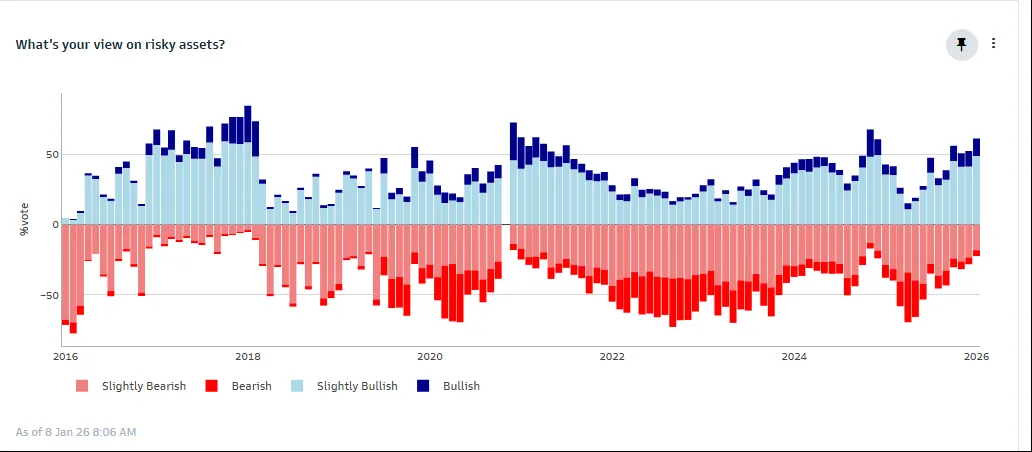
Goldman Sachs pushed back against the easy reading of its own market signal: a record-like surge in risk appetite did not mean investors should expect a smooth, all-in rally from here.
The bank’s Risk Appetite Indicator rose to 1.09 in January 2026, a level Bloomberg said was the highest since 2021 and in the 98th percentile of readings back to 1991. Other reporting later said the gauge moved above 1.1 and into the 99th percentile, underscoring how stretched sentiment had become. Goldman said there had been only six other occasions when the indicator was above 1.0, but it stopped short of treating that as a sell signal.
That nuance matters for anyone inside Goldman trying to turn a top-down call into a client conversation. The research desk’s message was not that the market was overheated in a way that automatically doomed equities. It was that elevated risk appetite is rare, powerful and often messy. Stocks can keep climbing when macro conditions are supportive and risk-on positioning is broad, even if the path gets narrower and more crowded.
That is the real shift inside the bull case. Goldman’s Global Equity Strategy outlook for 2026 said the firm remained constructive on equities, but expected lower index returns than in 2025 as the bull market broadened. In its Jan. 8, 2026 outlook, Goldman projected global stocks would return 11% over the next 12 months, including dividends, with gains driven more by earnings growth than by rising valuations. The bank also warned that valuations were historically high, while arguing that a bear market looked unlikely without a recession.
For sales and trading teams, that means the conversation is less about whether to be positive and more about where the rally can still work. If the market is rich but not exhausted, clients will want to know which trades still have follow-through and which names are already fully priced. Wealth and asset management teams can use the same setup to explain why diversification still matters even when the headline tape looks strong. Investment bankers can read it as support for financing windows, but not a blanket endorsement for every deal at every multiple.
Goldman Sachs Asset Management sounded the same note in its 2026 outlook, titled Seeking Catalysts Amid Complexity. AI-powered innovation was helping sentiment, while central banks, trade shifts, fiscal risks and geopolitics were making the backdrop more selective than simple. That is the core of Goldman’s current bull case: still constructive, just far less willing to confuse momentum with a straight line.
This article was produced by Prism’s automated news system from verified source data, official records, and press releases, then run through automated quality and moderation checks before publishing. The system is built and supervised by the people who set the standards it runs under. Read our full AI policy.
Did this article answer your question?