Richard Menschel, Goldman Sachs Partner Since 1959, Dies at 92
Menschel joined Goldman Sachs in 1959 when the firm had 500 employees; he built the equity sales franchise, shaped pay culture, and earned $20 million in the 1999 IPO.
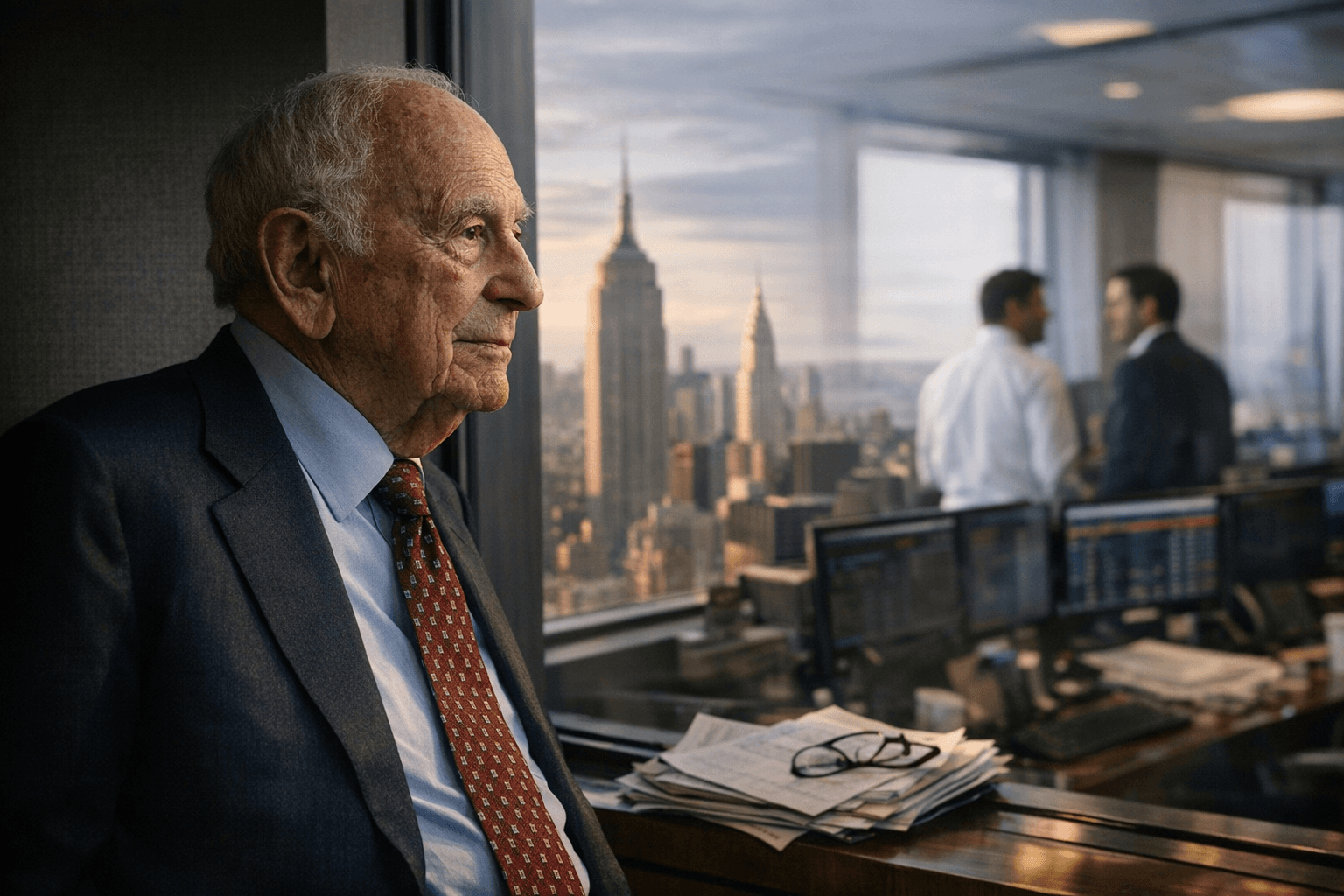
Richard Menschel arrived at Goldman Sachs in 1959, the same year he graduated from Harvard Business School, joining a firm that then employed roughly 500 people. By the time he stepped off the management committee in 1988, he had built the institutional equity sales operation from the ground up, helped install a compensation framework that still shapes how the firm credits its front office, and established a philanthropic footprint that Goldman has leveraged as reputation capital for decades. Menschel died March 4 from brain cancer. He was 92.
CEO David Solomon confirmed the death in a firm-wide memo, writing that Menschel "will be remembered not only for the business he helped build, but for the example he set and the people he uplifted along the way."
Charles Ellis, in his 2008 history "The Partnership: The Making of Goldman Sachs," identified Menschel as head of equity sales and as representative of the standard-bearers in Gus Levy's Goldman: leaders who treated client development as a continuous obligation rather than a transactional event. The institutional sales infrastructure Menschel built was designed around that premise. He tailored coverage models for major institutional accounts and, by the early 1980s, deliberately recruited foreign nationals into the division to navigate local market dynamics as Goldman expanded its international equities business. That structure, counterintuitive for a firm that had long drawn from a tight domestic network, gave Goldman a durable edge in cross-border block trades and IPO allocations.
Inside the firm, Menschel's name is attached to a shift in how sales performance was credited. The "going joint" model, in which salespeople pooled commissions rather than competing over individual books, was applied directly to the high-net-worth group he led. Ellis recorded that Menschel himself described the result as redirecting the entire group's attention toward one shared metric: total gross credits. The principle, meritocratic rather than territorial, became embedded in how Goldman structured compensation firm-wide. For any associate or VP currently navigating year-end reviews and cross-divisional deal credit, the framework traces back to decisions made in Menschel's era.
The third dimension of his legacy is less visible on a trading floor but shows up in board rosters and donor lists across New York. Menschel and his brother Robert, who also spent decades at the firm, received the 2015 Carnegie Medal of Philanthropy. Richard's giving ran through the Museum of Modern Art, the Morgan Library and Museum, the Jewish Museum, Rockefeller University, Cooper Union, and the Hospital for Special Surgery, where he served as chairman emeritus. That civic portfolio was not incidental to his Goldman career. It was how he, and the firm alongside him, cultivated the kind of institutional trust that no deal mandate alone can purchase.
Menschel was born January 6, 1934, and raised on Riverside Drive in Manhattan, attending the Bronx High School of Science before graduating from Syracuse University in 1955. He served as a Second Lieutenant in the Air Force, contracting polio while stationed in Turkey, a condition that restricted his mobility without interrupting his ascent. When Goldman went public in 1999, his senior director standing entitled him to $20 million in shares. He is survived by his wife, Ronay Arlt Menschel, former Deputy Mayor of New York City, and their three daughters.
Goldman's alumni page lists him simply as an Equities, New York employee from 1959 to 1999. For the managing directors now responsible for mentoring junior bankers, structuring cross-divisional credit allocation, and maintaining the civic relationships that protect a firm's standing, that 40-year span is not biography. It is the operating manual.
This article was produced by Prism’s automated news system from verified source data, official records, and press releases, then run through automated quality and moderation checks before publishing. The system is built and supervised by the people who set the standards it runs under. Read our full AI policy.
Did this article answer your question?