Harvard forecast signals slower renovation growth, but spending stays huge
Homeowners are still on track to spend about $518 billion on repairs and upgrades, but slower growth points to more phased projects and tighter budgets.

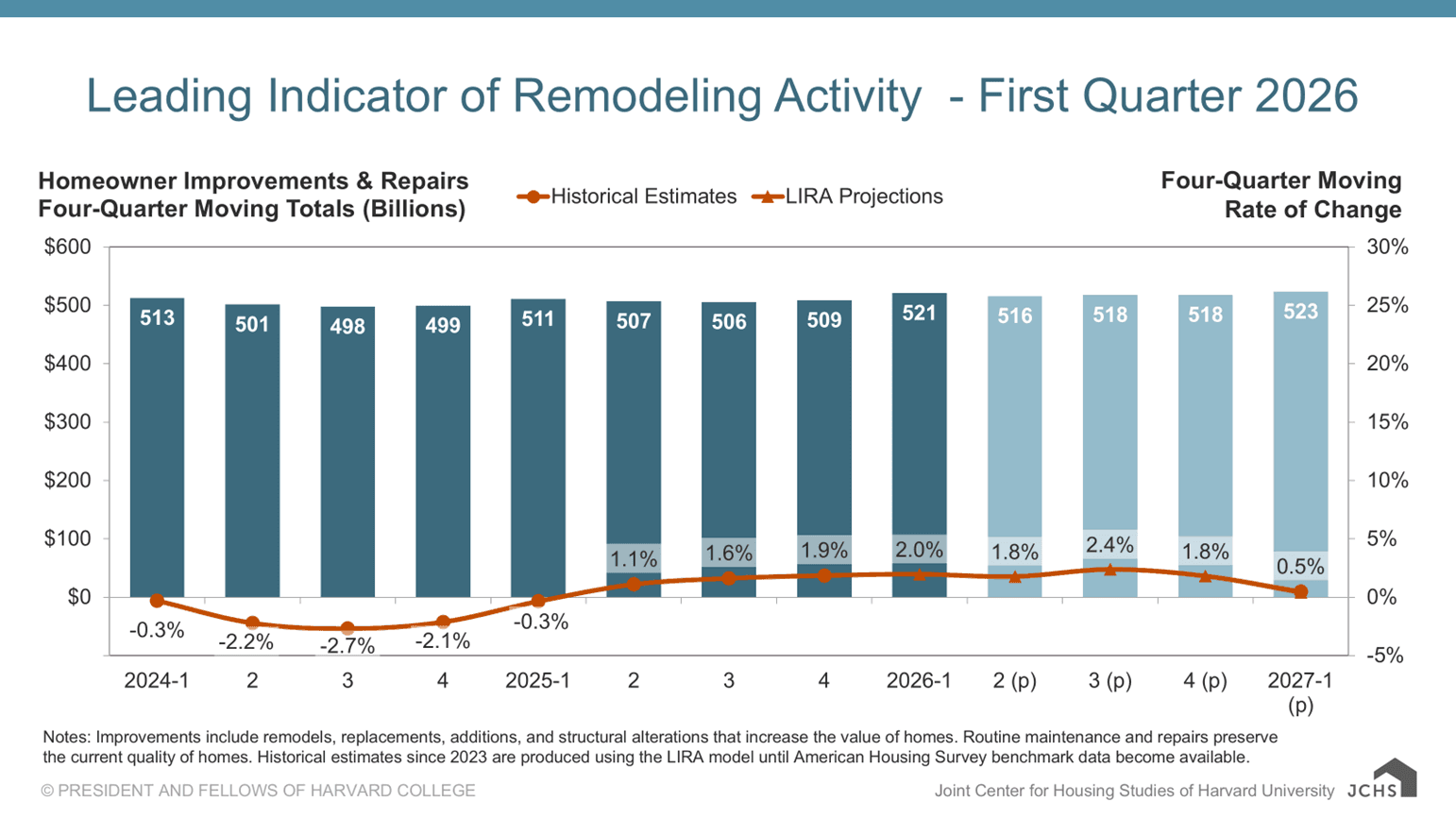
Homeowners are still pouring money into repairs and upgrades, but the pace is cooling enough to change how a Home Depot floor reads demand. Harvard’s Joint Center for Housing Studies expects growth in renovation spending to slow to 2.1% by mid-2026 and 1.6% by year-end, with annual spending on improvements and maintenance to owner-occupied homes reaching $518 billion.
That is a slowdown, not a retreat. Harvard says the U.S. spends more than $600 billion a year on home maintenance and improvement, and its remodeling forecast is built on the Leading Indicator of Remodeling Activity, a model the center uses to project annualized repair and improvement spending for the current quarter and the next four quarters. The Remodeling Futures Program began in 1995, the LIRA was developed in 2007, and Harvard re-benchmarked it in April 2016 to a broader market measure tied to the American Housing Survey. The January 2026 reading was revised on April 15 after a formula error and data issues tied to the 2025 federal government shutdown forced methodological changes.
For associates, the practical read is straightforward: customers are still spending, but they are more likely to split jobs into stages, delay the cosmetic finish, or hunt for a cheaper substitute that keeps the project moving. That tends to favor essentials, maintenance and replacement items over discretionary upgrades. In the aisle, that means stronger pull for repair parts, paint, plumbing fixes, electrical components, fasteners and other need-it-now products, while bigger remodel packages and high-ticket wish-list purchases may face more hesitation. A customer who walks in saying a kitchen, bath or outdoor project is now a “later” job is not necessarily leaving empty-handed; that customer may be looking for the next phase, not the whole renovation.
Home Depot has already described that shift in its own results. On August 19, 2025, the company said customers were engaging more broadly in smaller home improvement projects, even as second-quarter fiscal 2025 sales reached $45.3 billion and comparable sales rose 1.0%. In the third quarter, sales were $41.4 billion and comparable sales rose 0.2%, including about $900 million from the acquisition of GMS Inc. In its February 24, 2026 earnings release, Home Depot said customers had raised concerns about housing affordability and job losses, and its fiscal 2025 annual report said elevated interest rates and economic uncertainty were still weighing on demand.

The company is leaning harder into the Pro side even as consumer remodeling cools. Home Depot’s fiscal 2025 annual report says its growth strategy is to drive its core and culture, deliver a frictionless interconnected experience and win with the Pro. On June 30, 2025, SRS Distribution said it would acquire GMS Inc. to expand distribution offerings and capabilities for Pro customers. Home Depot said it operated 2,353 retail stores and more than 800 branches at the end of the second quarter of fiscal 2025, a network built to capture the customer who may spend less all at once but still needs the job done.
This article was produced by Prism’s automated news system from verified source data, official records, and press releases, then run through automated quality and moderation checks before publishing. The system is built and supervised by the people who set the standards it runs under. Read our full AI policy.
Did this article answer your question?