Home Depot stores adapt as online orders, aisle pickups blend together
The online order is really store work in disguise, and the weakest handoff can turn a smooth promise into floor-level chaos.
The store is the fulfillment network
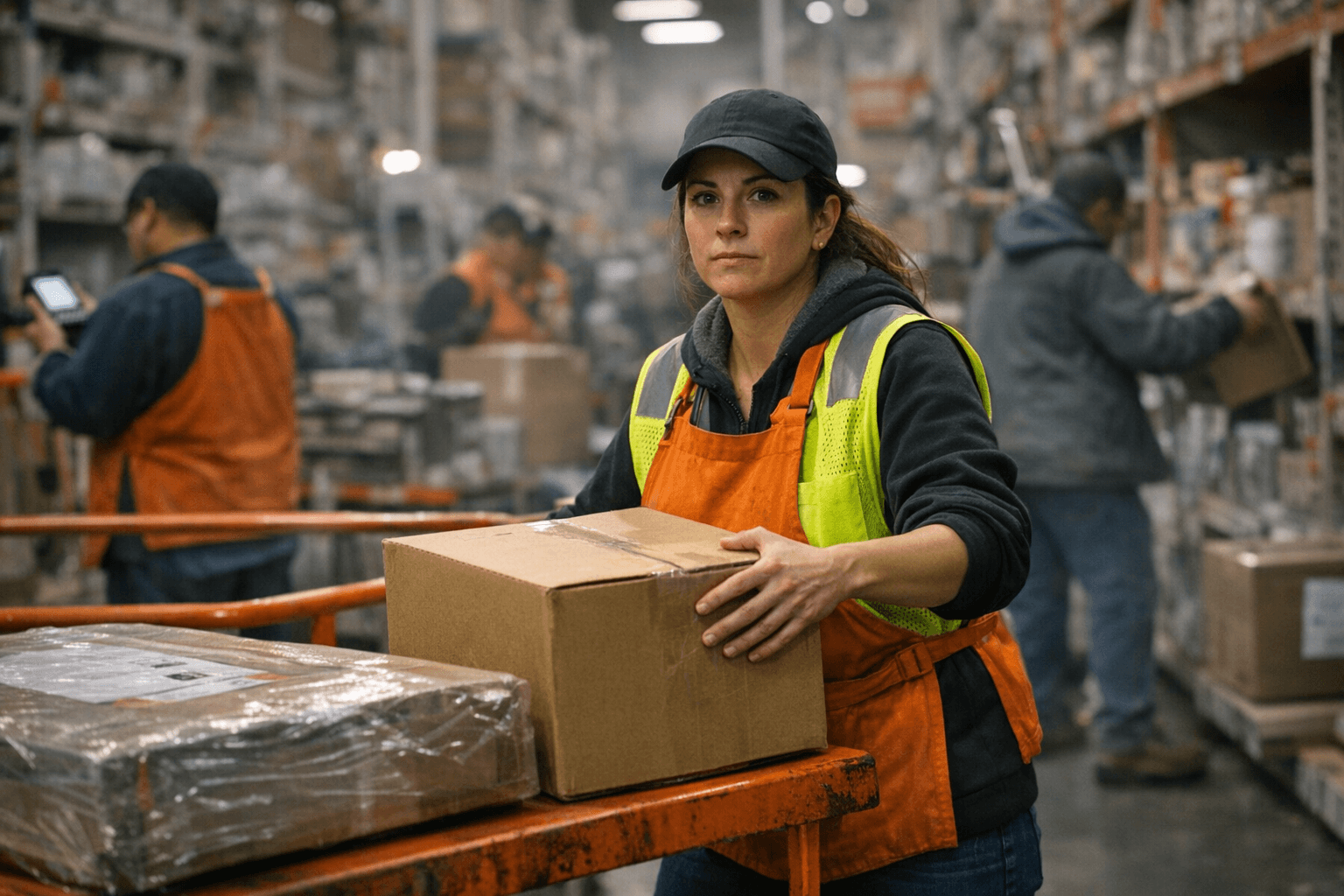
The order on the app is not finished when the customer taps buy. At Home Depot, that order can turn into picking in the aisle, staging in the back, a curbside handoff, a delivery dispatch, or a return that lands at the service desk the next day. More than half of the company’s online orders are fulfilled through stores, which means the sales floor is also a working part of the logistics chain.
That shift matters because Home Depot is not treating stores as a side channel. The company says its stores remain the core of the business, and it operates more than 2,300 locations across the United States, Canada, and Mexico. In the same system, it also uses 19 direct fulfillment centers and third-party last-mile providers to move goods faster and cut lead times. For associates, that means omnichannel is not a slogan. It is the daily reality of making the store behave like a pickup point, a mini warehouse, and a customer service desk at the same time.
Where the handoffs happen
The fragile part of the process is not the online cart. It is the handoff. Someone has to pick the right item, confirm substitutions when the exact product is missing, and decide what to do with heavy or bulky merchandise that cannot be handled like a bag of screws. Then the order has to be staged correctly so the next associate can find it quickly, and the customer can get in and out without waiting for a scavenger hunt.
That is why the best stores treat online orders as real traffic, not extra traffic. If the pick is wrong, the staging area gets messy, or the pickup team does not know whether an order is headed to a service desk, a locker, or curbside in some markets, the promise breaks down fast. The customer does not experience a “channel.” They experience delay, a missing item, or a worker forced to improvise at the counter.
What associates are actually carrying
On the floor, omnichannel work shows up in small but relentless tasks. Associates are not only selling product; they are finding it, confirming it, moving it, and sometimes rescuing it after the system has already made a promise. A shopper may come in to grab an online order and then ask for one missing piece from a project cart. Another may expect a return to be painless because the item was bought online yesterday. Both situations land on store teams, not the website.
The pressure is especially sharp on bulky orders and same-day promises. Home Depot says it offers same-day and next-day delivery, and it has said it achieved the fastest delivery speeds in its history. It also launched real-time tracking for big and bulky deliveries, which is a meaningful change for both customers and store teams because large-item delivery has long been one of the easiest places for frustration to build. When a refrigerator, washer, or palletized building material is involved, the customer wants certainty and the store needs clean communication between the selling side and the delivery side.
Why the shelf is only part of the promise
The old retail logic was simple: if the item is on the shelf, the store is ready. That logic no longer holds by itself. At Home Depot, the shelf is only one stop in a larger promise that can begin online, move through pickup, and end at a jobsite or front door. Customers can now order select products through Uber Eats and DoorDash, which adds another layer of handoff pressure because the store has to coordinate with outside delivery networks as well as its own teams.
This is where execution becomes visible to workers. If the aisle team, service desk, receiving, and delivery coordination are not aligned, duplicate work piles up. One associate may be trying to pull the same order another associate already staged. Another may be explaining a substitution that never got relayed. The store can still look busy and still be failing the customer, because omnichannel punishes unclear ownership more than visible chaos.
What managers have to watch
For managers, the hard part is not just volume. It is control. Home Depot’s own framing makes clear that stores are functioning as pickup, return, and delivery fulfillment locations, which means managers have to watch how long orders sit, whether staging areas stay organized, and whether departments are communicating before a problem reaches the customer. A clean process depends on clear ownership at each step: who picks, who stages, who hands off, and who fixes the exception.
That also means the metric that matters is not just sales per square foot. It is whether a customer can move from app to aisle to car without friction. The store that wins is the one that makes the channel boundaries disappear. A customer should not have to know which system touched the order last. If the order is ready when promised, the pickup lane moves, and the return is accepted without drama, the store has done more than complete a transaction. It has protected trust.
The business reason Home Depot keeps pushing this model
The scale behind this shift is hard to miss. Home Depot reported fiscal 2025 net sales of $164.7 billion, and it is using its store base, fulfillment centers, and last-mile partners to keep that engine moving. That is the clearest sign yet that the company sees stores not just as selling spaces, but as logistics nodes inside a larger network.
For associates, that is both the challenge and the opportunity. Omnichannel can turn one-item visits into larger baskets, keep customers loyal after hours, and make the store feel easier to use than a competitor’s. But that only happens when the execution is tight enough that picking, staging, curbside, returns, and delivery all feel like one operation. At Home Depot, the store is no longer the end of the order. It is where the order becomes real.
This article was produced by Prism’s automated news system from verified source data, official records, and press releases, then run through automated quality and moderation checks before publishing. The system is built and supervised by the people who set the standards it runs under. Read our full AI policy.
Did this article answer your question?