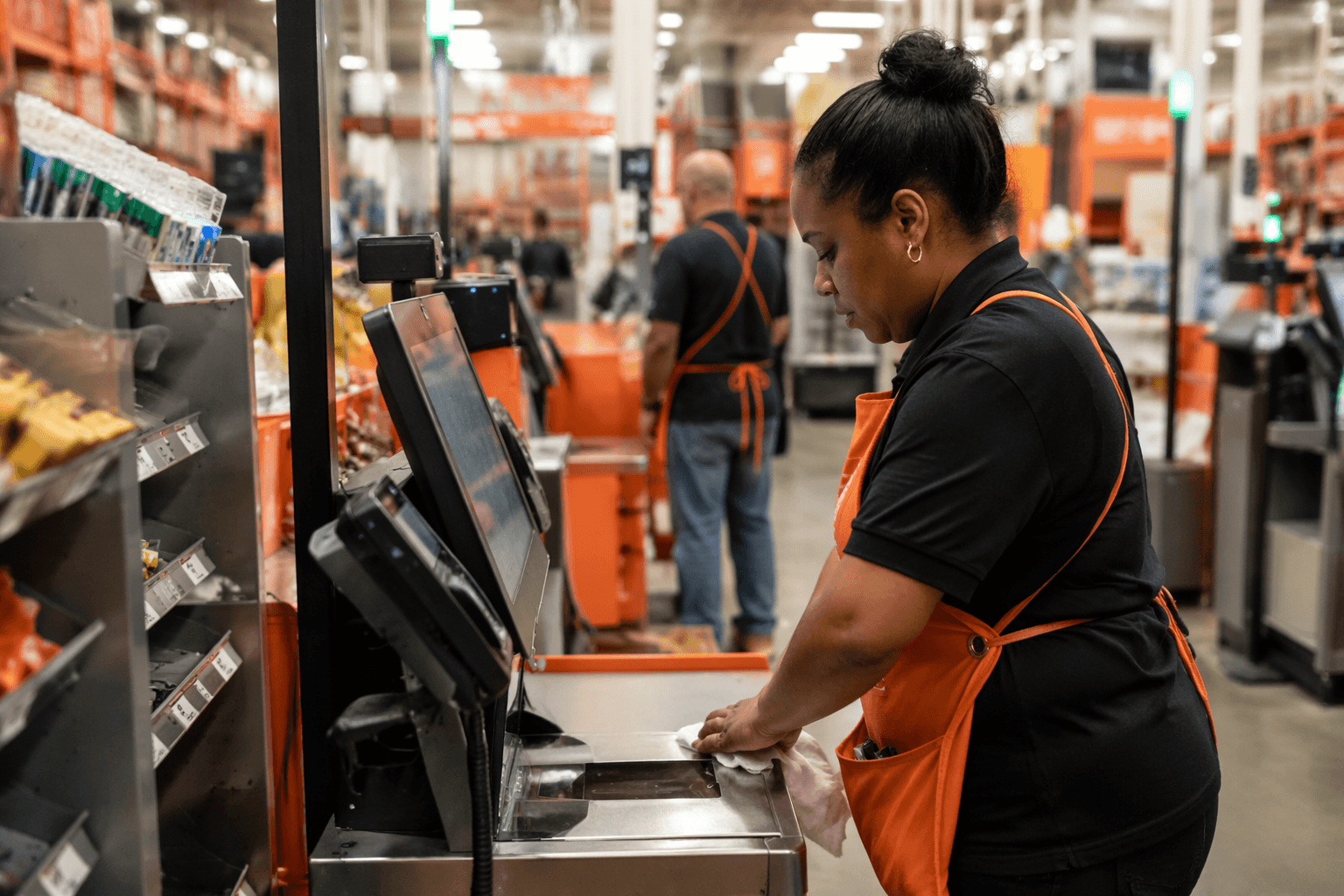
Home Depot tightens hazardous-material handling rules across stores
A spill in receiving or garden can shut down aisles fast. Home Depot’s handling rules spell out who checks, labels, patches, cleans and disposes before customers ever see a mess.

The highest-risk moments at Home Depot are not the obvious ones. They are the routine handoffs, a damaged jug in receiving, a torn fertilizer bag in garden, a leaking oil container in tool rental, or a spill that reaches a customer aisle before anyone stops it. That is why the company says hazardous-material handling is built into its standard operating procedures, with steps that affect OSHA exposure, shopper safety, product merchandising, and whether stock stays usable.
Where the breakdowns happen
Home Depot’s policy frames hazardous-material control as an operations issue first and a compliance issue second. The standards are meant to prevent spills and contamination, address damaged containers, and set out cleanup countermeasures, all while keeping fire-code compliance, product incompatibilities, store safety, and environmental protection in view. In practical terms, that means the bad day starts long before a spill reaches the floor, because a mislabeled return, a crushed case, or a container stored next to the wrong product can trigger the kind of problem that slows down a department and creates cleanup work across the store.
That scale matters because the company says it operated 2,000-plus stores across North America in fiscal 2024. A small lapse in one bay can become a chain reaction when the same process repeats across a vast retail network, especially in a business that depends on fast turns, contractor traffic, and seasonal rushes that leave little margin for blocked aisles or unsafe stock.
Receiving and central storage are the first control points
Receiving is where many hazardous-material mistakes begin, because that is where damaged goods enter the building and where separation, labeling, and inventory controls matter most. Home Depot’s policy specifically calls out receiving and central storage for those requirements, which is a signal to associates and leaders that waste cannot simply be stacked wherever there is room. If a container is leaking, mislabeled, or mixed with incompatible product, the issue is not just housekeeping. It can become a storage, disposal, and safety problem all at once.
Central storage is where the paperwork and the physical product have to match. Waste has to be separated and labeled correctly, and the department has to know what is on hand, what needs cleanup, and what is headed for disposal. For store leaders, that means the control point is not only the sales floor. It is also the backroom system that keeps hazardous material from disappearing into general inventory or sitting long enough to create a bigger problem.
Department-specific rules are where associates feel the policy
The policy gets more specific in the departments that handle the most common risks. Garden Center associates are responsible for fertilizer and pesticide bags, which makes bag condition and contamination prevention especially important. Home Depot says it also has a bag-patching program in partnership with the U.S. Environmental Protection Agency for bagged products such as fertilizers containing pesticides, a detail that shows how even a torn sack can become an environmental and disposal issue if it is not handled immediately.
Tool rental, paint, and plumbing each have their own version of the same operational challenge. Tool rental has requirements around used oil and fuel, paint has rules for debris and container disposal, and plumbing has guidance around oily rags. Those are not niche examples, because they are the kinds of materials that can leak, ignite, contaminate other stock, or create messy customer-facing conditions if they are left for the next shift to find.
For store managers, the takeaway is clear: the company is expecting department-level judgment, not a one-size-fits-all response. The right move in paint is not the right move in garden, and a used-oil issue in tool rental is not the same as a damaged bag in receiving.
Daily checks, spill kits, and quick escalation are the operational backbone
Home Depot says associates complete detailed checklists several times a week, with daily walks and routine inspections covering key outdoor and store-adjacent areas. That matters because hazardous-material problems are often visible before they become official incidents. A broken seal, a wet pallet, a torn bag, or residue near a bay can all be early warning signs that demand attention before a customer wanders into the area or a product display becomes unsellable.
Spill kits in key areas are part of that same discipline. They only work if associates know where they are, know when to use them, and know how to escalate when the spill is beyond a simple cleanup. The policy’s emphasis on prevention, damaged-container procedures, and cleanup countermeasures shows the company is trying to keep minor incidents from turning into larger shutdowns that pull labor away from the floor and disrupt merchandising during the busiest shifts.
Training is supposed to match the risk
Home Depot says all associates receive training on recognizing hazardous materials, while designated associates get deeper environmental-compliance training. That two-tier approach reflects how the work actually runs in a store or supply-chain facility. Most associates need to know how to spot a problem and avoid making it worse. A smaller group needs the deeper compliance knowledge to handle disposal, labeling, and other environmental requirements correctly.
That training push also sits inside a broader company commitment. In July 2023, Home Depot said it planned to provide 10 million hours of skill-development training for frontline associates and 2.5 million hours of training for leaders by 2028. The company has tied that investment to safety and training in its reporting, which suggests hazardous-material handling is part of a wider effort to build stronger floor leadership, not just satisfy a checklist.
The rules sit inside a larger federal and safety backdrop
The federal hazardous-waste framework is broad, covering generators, permits, corrective action, land-disposal restrictions, transporters, treatment, storage and disposal facilities, and universal waste. That is one reason a retailer with garden, paint, tool-rental, receiving and storage operations has to treat hazardous-material handling as a system, not a side task. When a store generates waste, moves it, stores it, or sends it out, each step can carry its own compliance exposure.
Home Depot’s recent environmental reporting also shows the company wants to be seen as part of that system. In 2024, the U.S. Environmental Protection Agency recognized the company with three awards: Safer Choice Partner of the Year, SmartWay Excellence Award, and WaterSense Sustained Excellence Award. Those honors do not replace store-level controls, but they do fit the company’s stated work on responsible chemistry and safer products, including the bag-patching program tied to EPA efforts.
The warning from the other side of the ledger is just as clear. In 2014, OSHA cited Home Depot USA Inc. for six violations at a Chicago store, including repeat and willful violations involving powered industrial vehicles and serious violations tied to chemical burns from sulfuric acid and eyewash protection for industrial batteries. That history is a reminder that hazardous-material controls are not abstract policy language. When procedures break down, the result can be an enforcement case, an injury risk, and an operational mess that ripples from the backroom to the sales floor.
At Home Depot, hazardous-material handling is really about keeping the building functional. If receiving, storage, department routines, cleanup, and disposal all work the way the policy says they should, the store stays safer, the merchandise stays sellable, and customers never have to see how close a routine shift came to becoming a compliance problem.
This article was produced by Prism’s automated news system from verified source data, official records, and press releases, then run through automated quality and moderation checks before publishing. The system is built and supervised by the people who set the standards it runs under. Read our full AI policy.
Know something we missed? Have a correction or additional information?
Submit a Tip