RFID gains make inventory accuracy more critical at Home Depot
Cheaper tags and better readers are making RFID a practical fix for store-level inventory misses, and Home Depot associates will feel it first in counts and pickup accuracy.
Why RFID is moving from experiment to everyday operations
Cheaper tags, sharper readers, and better data tools have changed RFID from a retail science project into a practical fix for the problems that eat time on the sales floor. When tags can cost under a nickel and well-run systems can push inventory tracking rates as high as 99 percent, the old argument that RFID is too expensive or too clunky starts to lose force.
That matters at The Home Depot because inventory accuracy is not an abstract systems issue. It determines whether the app’s store map points a customer to the right aisle, whether a Pro can trust a pickup promise, and whether an associate solves a problem in one trip instead of three. In a business with more than 2,300 stores across the United States, Canada, Mexico, Puerto Rico, the U.S. Virgin Islands and Guam, small improvements in accuracy scale quickly into real time saved and fewer missed sales.
What RFID actually changes for associates
The most immediate change is not flashy. It is fewer wasted steps. NRF’s research shows RFID can reduce stockouts, speed cycle counts, and help associates spend less time hunting for products and more time serving customers. That is the kind of operational relief store teams notice first, especially during seasonal rushes when power tools, outdoor, and project-driven demand can swing hard from one day to the next.
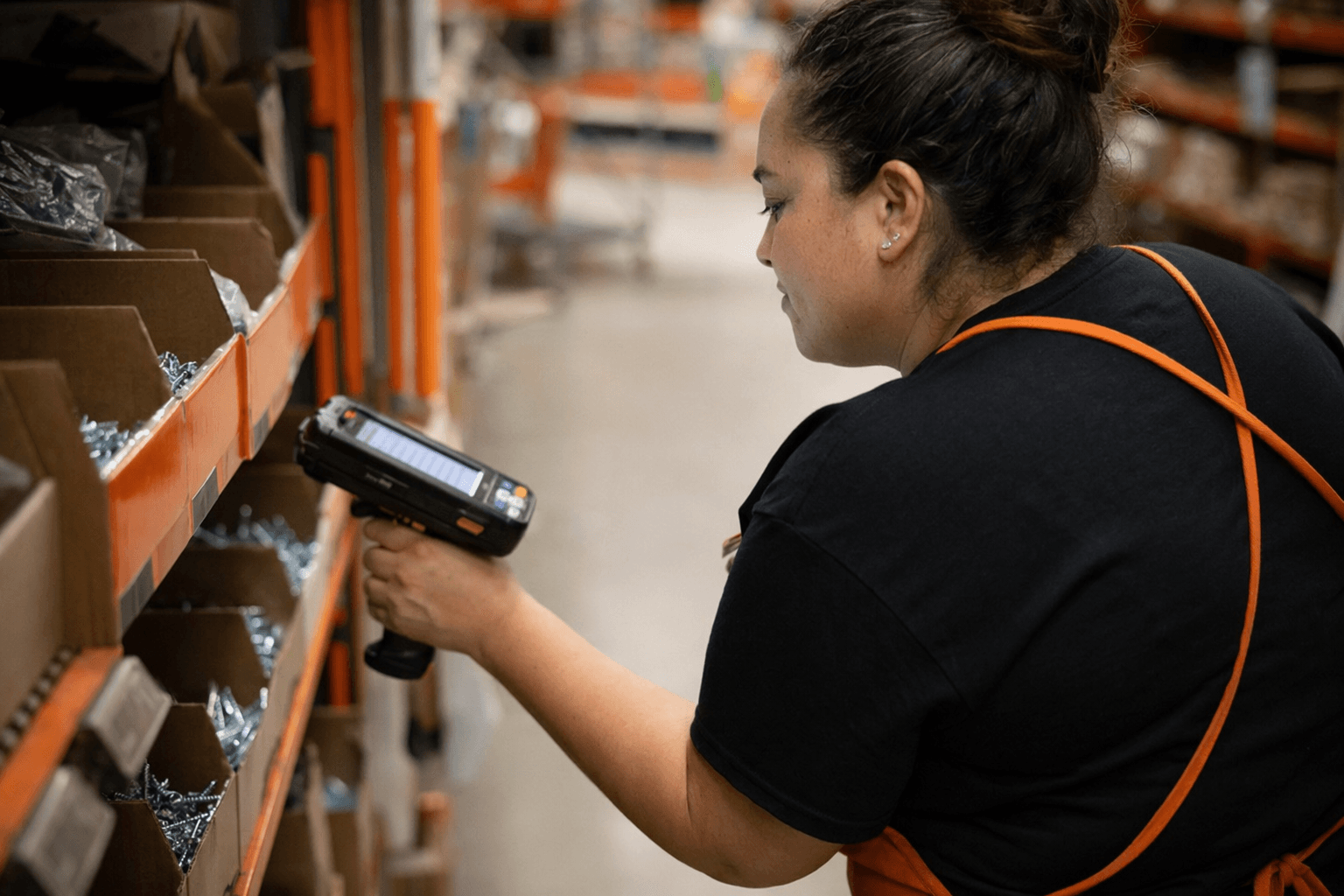
RFID also improves the back-room work that no customer sees but every store depends on. Faster cycle counts mean teams can verify stock more often without turning the process into a full-day disruption. Better counts make replenishment decisions cleaner, and cleaner replenishment means fewer empty pegs, fewer phantom on-hands, and less apologizing at the shelf when the system said the item was there and it wasn’t.
NRF also points to broader retail uses such as buy-online-pick-up-in-store, frictionless checkout, and smart-fitting-room experiences in other formats. Home Depot does not run fitting rooms, but the lesson transfers cleanly: once inventory data gets reliable enough, the same system can support customer convenience and labor efficiency at the same time.
Why the timing matters now
RFID itself is not new. NRF traces the technology back to the 1970s. What has changed is the practical environment around it. Readers now have greater sensitivity, faster read rates, and better connectivity, which makes the technology easier to use at retail scale than it was a decade ago.
That timing matters because the cost of getting inventory wrong is still enormous. NRF says stockouts cost retailers nearly $1 trillion worldwide annually. In a store environment, that number shows up as canceled orders, lost add-on sales, frustrated contractors, and associates burning time on detective work instead of customer service. For Home Depot, where the customer often arrives with a list, a deadline, and a truck, the cost of a bad count is bigger than a missed basket. It can derail a project.
RFID also now feeds something retailers care about more than ever: clean data. Accurate inventory is becoming the ground truth behind sales forecasting, marketing decisions, and AI tools. Once the system trusts what is actually on hand, the rest of the operation can make better calls about what to order, where to stage it, and how to promise it to the customer.
The Home Depot connection is already visible
Home Depot has been building toward this kind of real-time inventory model for years. The company says it is the world’s largest home improvement specialty retailer, and its fiscal 2024 annual report said it invested more inventory, stocked more of its high-velocity products in its network of 19 direct fulfillment centers, and made technology improvements across its 2,000-plus stores. Its 2025 annual report went further, saying knowledgeable associates and on-shelf availability are critical to the store experience and that the company is empowering associates by optimizing processes, simplifying tasks, and leveraging technology.
That language lines up closely with the RFID playbook. The retailer is not just trying to own more inventory. It is trying to know what inventory it has, where it is, and how fast it can be turned into a customer handoff. For associates, that means the job is increasingly about precision. For managers, it means inventory discipline is now a frontline service issue, not just a back-office metric.
Home Depot’s own tools show how this shift has already reached the store level. The company launched Sidekick, its homegrown store associate app, in January 2023 and said it was installed in more than 600 stores. It also upgraded mobile devices so associates can check pricing and inventory availability and locate products from more than 40 feet away. That is the practical side of an RFID-style mindset: less guessing, more verification, faster action.
Where associates will feel the pressure first
If RFID adoption keeps spreading, the first places to watch are the routines tied to inventory accuracy.
- Cycle counts become more frequent and less disruptive.
- BOPIS promises become more trustworthy, which reduces customer friction at pickup.
- Shelf recovery gets faster because associates can find the item before they start retracing steps.
- Pro desk and delivery workflows get cleaner because the handoff starts with better data.
- Asset protection teams gain another layer of visibility for proactive protection and investigations tied to organized retail crime.
That last point matters too. NRF says RFID can improve inventory management, proactive asset protection, and investigation of organized retail crime. In retail, those systems are often separated on paper but tightly linked in practice. When product vanishes from the system, teams lose time trying to decide whether it was mis-picked, miscounted, misplaced, or stolen. Better visibility narrows that gap.
At Home Depot, where roughly 500,000 associates support a huge and complicated store and supply chain network, even modest gains can add up fast. If an associate spends less time walking the building to confirm a count, that is time returned to a customer with a project deadline. If a department lead can trust the shelf count, replenishment becomes less reactive. If a store manager can reduce phantom inventory, the whole operation gets steadier.
RFID fits into a bigger Home Depot push
The RFID story does not sit alone. It fits into a broader move toward interconnected retail, real-time inventory, and AI-assisted operations. Home Depot and Google Cloud expanded agentic AI tools at NRF 2026 in January 2026, and in March 2026 the company expanded its Pro digital experience to give professional customers more visibility and control in one workspace. Those moves point in the same direction as RFID: faster answers, better data, and fewer handoffs that depend on memory or manual workarounds.
For associates, the takeaway is straightforward. Inventory accuracy is becoming the foundation under everything else, from the shelf to the app to the pickup desk. The technology is not replacing store knowledge. It is making that knowledge easier to act on, which is exactly what a busy Home Depot floor needs when the customer is standing there waiting for the right part, the right count, and the right answer.
This article was produced by Prism’s automated news system from verified source data, official records, and press releases, then run through automated quality and moderation checks before publishing. The system is built and supervised by the people who set the standards it runs under. Read our full AI policy.
Did this article answer your question?