How to build a stronger promotion case at KPMG
Strong promotion cases at KPMG are built long before review season, with proof of impact, sponsor backing, and a clear argument that you are already working at the next level.
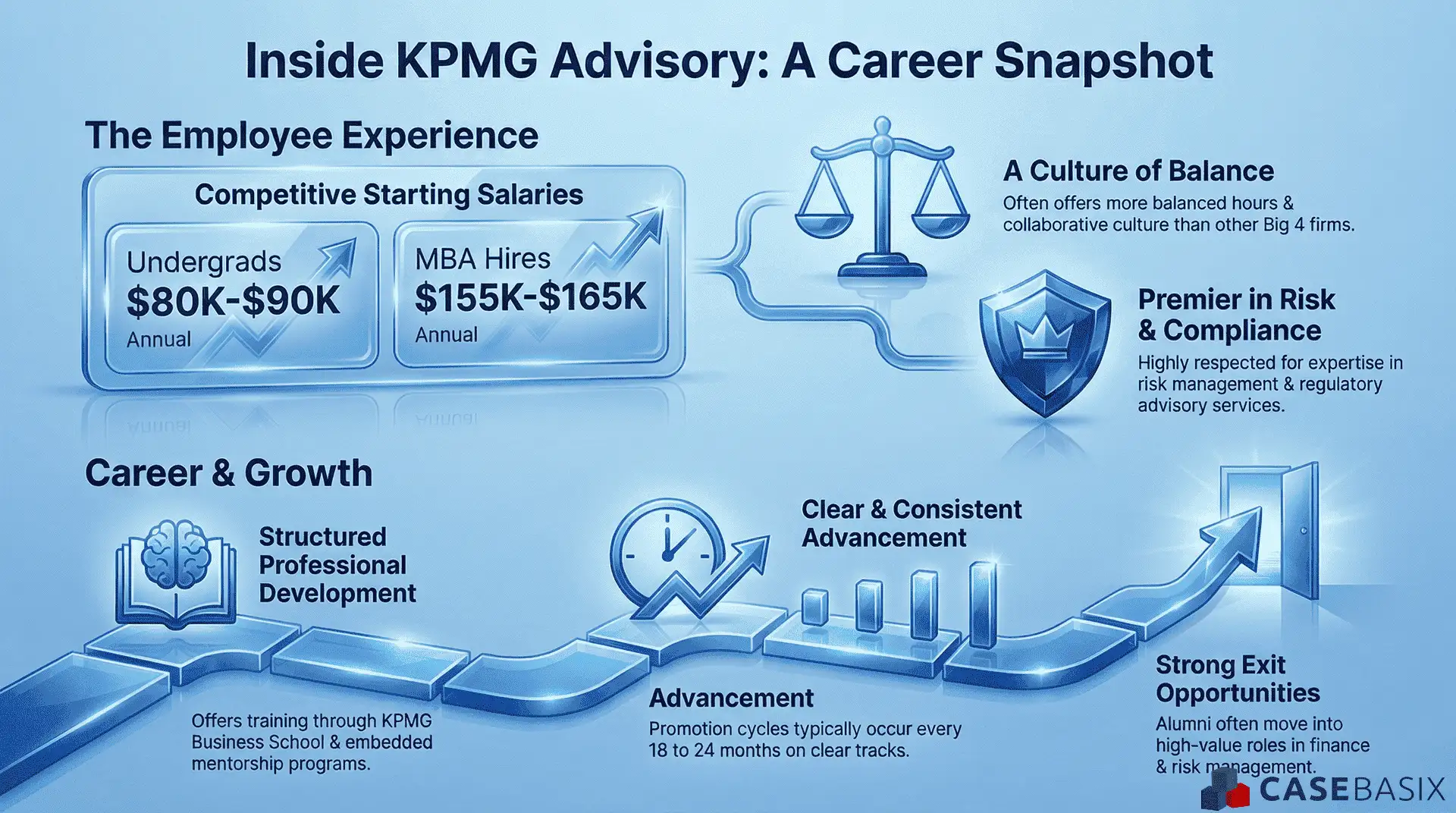
The promotion case starts long before the meeting
At KPMG, the strongest promotion case is rarely the person who simply stayed busiest. It is the person who can show, with evidence, that their work changed outcomes for clients, lifted the team, and matched the next level of responsibility. That matters in consulting, audit, and tax alike, where a promotion discussion is about more than technical competence. Leadership, collaboration, client impact, and whether you are already operating like the next role all weigh heavily.
KPMG’s own career-development language points in that direction. The firm says employees should discuss ambitions and goals with a performance manager and use its global performance development system to set career aspirations and performance goals. In practice, that means promotion is not a surprise verdict at year-end. It is supposed to be the result of an ongoing conversation about where you are headed and what you are doing to get there.
Document impact like you would document client work
If you want a stronger case, start collecting proof now. The basic question is not whether you worked hard. It is whether you can explain what changed because you were on the engagement. That could mean leading a workstream, improving quality, catching a risk early, speeding up delivery, or helping the team avoid rework.
A useful rule is to record your accomplishments in the same disciplined way you track client deliverables. Keep a running file with project names, dates, your role, the problem you solved, and the result. When review season arrives, you should be able to point to specific engagements and say: this is what I led, this is how I solved it, and this is the business value it created.
That approach matters even more in a Big Four environment, where people are often evaluated on whether they do more than their own tasks. Strong candidates help others perform better, mentor junior colleagues, anticipate issues before they become problems, and represent the firm well in front of clients. Those are the signals that say you are not only reliable, but ready for broader responsibility.
Translate good work into promotion language
A common mistake is to describe effort instead of impact. Review conversations go better when you can connect your work to the criteria that matter at KPMG: leadership, client service, collaboration, and readiness for the next level. The trick is to turn “I was involved” into “I owned,” “I improved,” or “I influenced.”
That is especially important because KPMG frames career development as part of an ongoing performance process, not just a once-a-year evaluation. The firm says its system is meant to help people set goals and discuss how to achieve them. That gives you room to ask a sharper question in your review: what specific evidence would show I am operating at the next level, and what should I be doing now to close that gap?
You should also be ready to name the broader responsibilities you are prepared to take on. If you want to move toward manager, senior manager, or partner track, say so directly. If your goal is deep technical expertise, industry specialization, or a long-term assignment abroad, those are also valid progression paths at KPMG. The key is to tie your recent work to the path you actually want.
Build sponsor support, not just manager awareness
Good feedback is not the same as sponsorship. At KPMG, where performance managers are central to the development process, you need people who can explain your value when you are not in the room. That means keeping your manager informed, but it also means making your impact visible to senior professionals who see how you operate across teams and engagements.
This is where consistency matters. If a partner, director, or senior manager has seen you lead clients well, smooth out problems, or raise the quality of an engagement, they are more likely to advocate for you when promotion decisions get discussed. The best promotion cases usually have a pattern behind them: a few people can independently say you are already taking on more than the title suggests.

KPMG’s U.S. development offering gives employees a lot of tools to strengthen that case, including technical, leadership, and business-skills training, coaching, mentoring, and rotational assignments. Use those opportunities strategically. Training alone will not get you promoted, but it can help you build the specific capabilities that support your next-level story, especially if you can show that you applied them on real work.
Handle review conversations like a business case
Review meetings should feel like a prepared client discussion, not a vague check-in. Come in with examples, outcomes, and a clear ask. You want to explain which engagements you led, how you improved efficiency or quality, and what broader scope you are ready to take on next.
That also means being specific about the gap you are trying to close. If your manager says you are strong on execution but need more evidence of leadership, ask what leadership looks like in your group. Is it running meetings? Coaching juniors? Owning client relationships? Driving cross-functional work? The more concrete the answer, the easier it is to build a promotion-ready record before the next cycle.
A review is also the right moment to talk openly about strengths and areas for improvement. Indeed’s promotion guidance is useful here: employees who have delivered strong results still need to show why they deserve promotion by taking on additional responsibilities, motivating teammates, and recording accomplishments. That is exactly the kind of framing that works inside a professional-services firm, where the jump in title usually comes with a jump in scope.
What it looks like in consulting, audit, and tax
The same promotion logic plays out differently depending on your practice. In consulting, the clearest signal is often whether you can own a workstream, lead client conversations, and help shape the solution instead of just delivering pieces of it. If you are aiming higher, your file should show moments when you drove the project forward, resolved ambiguity, or helped a client make a decision.
In audit, the case usually rests on judgment, quality, and team leadership. It is not enough to close files on time during busy season. Strong candidates show that they improved review quality, flagged issues before they became larger problems, coached newer staff, and helped the engagement run more smoothly under pressure.
In tax, promotion cases often turn on technical credibility paired with client service. You need to show that you handled complexity accurately, communicated clearly, and helped clients or teams navigate changing requirements. The strongest tax professionals can explain not just what they prepared, but how they reduced risk, answered questions faster, or made the work easier for everyone else involved.
Why the timing matters at KPMG
Timing matters because KPMG has been signaling a firmwide focus on capability-building. When KPMG LLP announced its next U.S. Management Committee, effective July 1, 2025, CEO-elect Tim Walsh said the leadership team had driven “sustained investments in technology and talent” over the prior five years. That kind of message matters to employees because it shows where the firm wants people to grow: stronger technical capability, stronger leadership, and stronger use of technology.
For people trying to move up, that means the promotion case should reflect more than individual output. It should show that you are aligned with the firm’s broader direction, able to work across technology and talent priorities, and ready for a larger role in how the business serves clients. KPMG’s career pages also make clear that progression can mean partner, deep specialist, industry roles, or an overseas assignment, so the best case is the one that fits your actual path, not a generic template.
At KPMG, promotions do not go to the hardest worker in the room. They go to the person who can prove, with concrete examples, that they are already doing the work of the next role and doing it in a way the firm can see, reward, and scale.
This article was produced by Prism’s automated news system from verified source data, official records, and press releases, then run through automated quality and moderation checks before publishing. The system is built and supervised by the people who set the standards it runs under. Read our full AI policy.
Did this article answer your question?


.pdf%2F_jcr_content%2Frenditions%2Fcq5dam.thumbnail.319.319.png&w=1920&q=75)