KPMG interns see AI skills becoming baseline for entry-level jobs
KPMG’s interns are treating AI fluency as table stakes, with hands-on learning, peer sharing and judgment now sitting at the center of entry-level readiness.

At KPMG, the entry-level job is being redrawn around AI from day one. The firm’s winter interns say a third of their future roles will be automated or AI-enhanced, and they already see strong AI skills as part of the price of admission for moving ahead.
AI fluency is becoming the new floor
KPMG LLP fielded its 2026 Winter Intern Pulse Survey in February and March among 361 U.S. winter interns, and the results point to a workforce that is adapting faster than many managers may expect. The respondent pool was overwhelmingly Gen Z, at 94%, with Millennials making up the other 6%, so the answers read less like a broad labor-market abstraction and more like the outlook of the next class moving toward full-time roles.
The clearest signal is that AI is no longer treated as a specialty skill. Interns said 33% of their future full-time roles will be automated or AI-enhanced, and 78% already feel at least somewhat prepared to work alongside AI. That combination matters inside a firm like KPMG, where the early-career pipeline runs directly into audit, tax and advisory teams that are already using tools to take friction out of repetitive work.
There is also an expectation of compensation uplift. Interns said strong AI skills should command a 9% premium in entry-level pay, which shows how quickly digital fluency is being converted into a market value signal. For students looking at KPMG, that is a practical clue about where advancement pressure is heading: the people who can use AI well are starting to view that ability as part of their base case, not a side project.
Fear is present, but curiosity is winning
The interns are not naïve about what AI could do to first jobs. KPMG said 81% were at least moderately concerned that AI agents will significantly change or replace entry-level work within five years, while 47% believed AI would not result in net job creation and 17% expected net job growth. That gap shows a generation that is preparing for disruption without assuming the disruption will be benign.
Even so, the dominant emotional response was not anxiety. Curiosity led at 54%, followed by excitement at 27%, which suggests the class entering KPMG is more interested in learning the new rules than resisting them. Derek Thomas, KPMG LLP’s national partner-in-charge of university talent acquisition, captured that mindset by saying Gen Z is “doubling down on judgment, creativity and adaptability” rather than pushing back against the shift.
That framing is important for managers because it puts the burden on the firm to define what good looks like in an AI-heavy environment. Thomas said the real question for organizations is whether they are equipping this generation with the tools and skills to navigate the next era of work, which turns internship design into a training problem as much as a staffing one.
What interns want from KPMG is practical, not cosmetic
The survey makes clear that younger hires are not coming in mainly to collect titles or ceremonial access. Interns ranked hands-on, practical experience as the most valuable thing they hoped to gain from the internship, ahead of mentoring relationships and network-building. For a Big 4 firm where early-career work can easily become presentation formatting, review cycles and process support, that preference is a signal to staff the class with real work that builds judgment.
The pressure is already showing up in behavior. Forty percent of interns said they feel pressure to use AI at a high level to stay competitive with peers, and 66% said they actively collaborate with classmates to share AI learnings and best practices. That peer dynamic matters inside KPMG because it suggests AI habits are spreading horizontally across the internship class, not just top-down through formal training.
In practice, that means the next generation is likely to measure a KPMG experience by whether it teaches them how to combine technology with discretion. Firms can hand out tools, but interns are clearly looking for supervised use, examples of when AI helps and when it should be checked, and a workplace where judgment still counts.
Hybrid work still shapes the entry-level deal
The survey also shows that work location expectations have not reset back to fully remote norms. Eighty-three percent of Gen Z interns preferred a hybrid schedule of three to four days in the office per week, which is a useful benchmark for managers trying to calibrate attendance requirements without undercutting recruiting appeal.
That preference lines up with what interns said they want most from the experience: practical exposure, not just proximity. In a professional-services environment, that likely means in-person time still has to pay off in coaching, client context and real workflow access, rather than becoming a compliance exercise. If KPMG wants to use office days to build early-career readiness, it will need to connect the commute to visible skill development.
The trend did not appear overnight
KPMG’s latest intern findings fit a steady progression. In the firm’s 2025 Intern Pulse Survey, half of Gen Z interns expected 20% of their jobs to be automated by AI when they started full-time roles, and 92% said they were confident in their ability to adapt to AI advancements. Back in May 2024, nearly half of respondents already believed 20% of their future full-time job would be automated by AI, while 88% said access to soft-skills or professional-skills training was important when evaluating an employer.
That earlier survey also showed how strongly this cohort wanted to be seen as hard-working rather than stereotyped. Ninety percent said the biggest misconception about their generation was that they are lazy and do not want to work hard, and 34% said they planned to stay with their first employer. Taken together, those results show a group that is not looking for less effort, but for better tools, clearer development and a faster path to relevance.
KPMG’s investment backdrop helps explain the shift
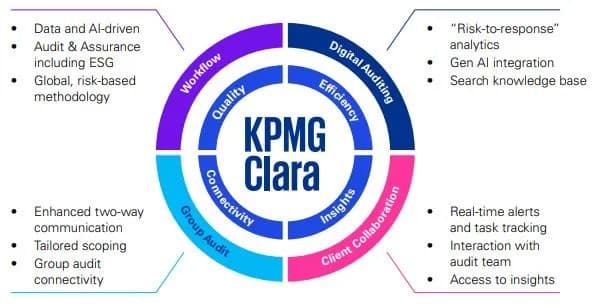
The intern data also sits inside a much larger firm strategy. KPMG International said its globally aggregated revenues for FY25 reached $39.8 billion, up 5.1% from FY24, and a related report said the firm invested more than $1.7 billion across the network in FY24 with a focus on technology and AI, talent and ESG. That is the kind of capital allocation that tells employees the firm is not treating AI as a pilot or a side initiative.
For people in audit, tax and advisory, the message is straightforward. KPMG is building a business where AI competence, human judgment and speed of learning are increasingly intertwined, and the interns coming in now already understand that the first rung of the ladder will look different from the one their predecessors climbed. The firms that advance these hires fastest will be the ones that treat AI fluency as the starting line, not the finish line.
This article was produced by Prism’s automated news system from verified source data, official records, and press releases, then run through automated quality and moderation checks before publishing. The system is built and supervised by the people who set the standards it runs under. Read our full AI policy.
Did this article answer your question?