KPMG paper maps AI opportunities in government services
AI in government is moving from pilots to funded service redesign, and KPMG’s paper shows trust, controls and delivery skills now decide who wins.
Leaders of a federal agency knew they needed AI and process automation to meet their missions on time and budget, but when they tried to match each need with the right solution, the projects stalled. KPMG’s AI in Government Sector paper treats public-sector AI as a delivery question, not a lab exercise. Governments want citizen-centric digital public services that move from simple online forms to end-to-end, life-event-based journeys, but the work still gets blocked by trust, inclusion, security and governance concerns. For KPMG consultants, auditors, cyber specialists and digital transformation teams, that means the real market is no longer just digitization. It is redesigning services, controls and operating models so they can survive public scrutiny.
The shift in government demand
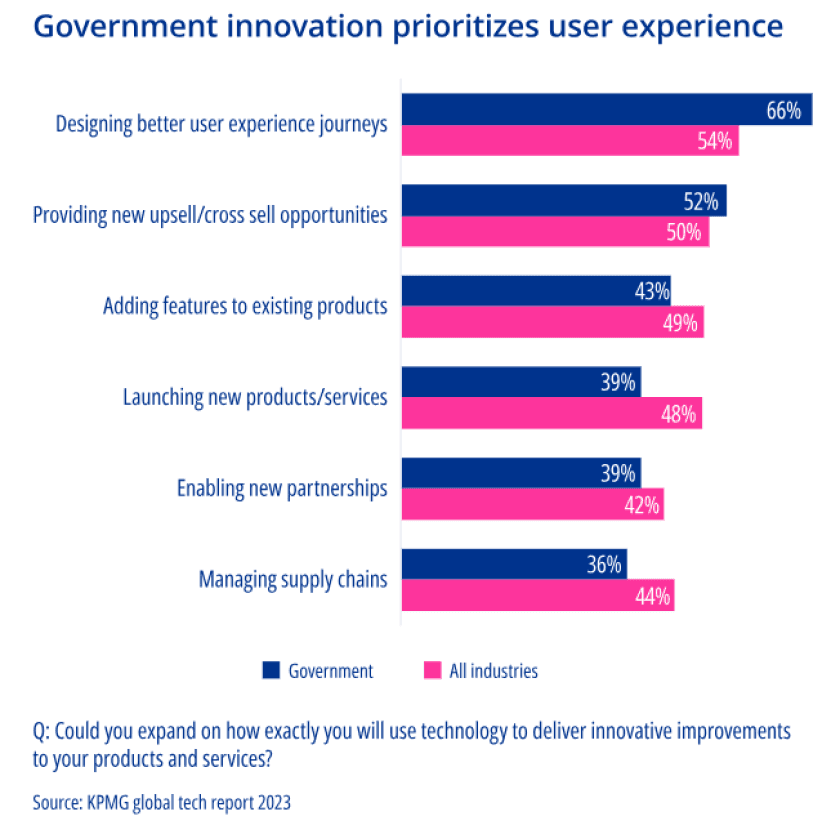
The market is moving from modernization to mission-driven transformation. The buyer is not asking only for a faster portal or a cleaner interface. Ministries, agencies and state-linked institutions are increasingly looking for user-centric services and stronger citizen engagement, which pulls in service design, data sharing, identity, accessibility and cross-agency operating models.
Its public-sector digital transformation report drew on a proprietary survey of almost 120 public sector and technology leaders worldwide, and KPMG’s October 2024 public-sector press release put the emerging-technology survey at 120 public sector technology leaders. Those leaders remained positive about the value of digital transformation even as talent shortages, regulation and trust stayed front of mind.
Where AI is most likely to get funded
The practical AI use cases in government are the ones that sit closest to high-volume public service work: service triage, document processing, case prioritization and predictive resource allocation. Those are not abstract innovation ideas. They are the places where agencies can show faster response times, more consistent decision flows and better use of scarce staff.
Cloud-led public services keep showing up in the same conversation. The promise is scale and responsiveness, but scale only sticks when the solution is explainable, data is protected and the impact on vulnerable populations has been tested. In practice, that creates work for policy teams, model governance specialists, cyber advisers and delivery leads who can translate AI into operating rules instead of just software features.
Why government AI projects stall
KPMG’s 2024 paper, AI’s role in a modern government, uses that federal-agency example as a blunt illustration of the adoption problem. That kind of stall is common across federal, state and local government, and it is usually a prioritization and implementation problem rather than a lack of enthusiasm.
Client demand can get stuck before a contract is even signed. Agencies often know they need better case handling, faster document review or smarter resource allocation, but they cannot sort through vendors, architecture choices and governance requirements quickly enough to move. For KPMG practitioners, the opening is in helping clients narrow the field, sequence the work and build the control environment before a pilot turns into a dead-end.
The same stalled-project example also appeared in KPMG’s 2023 Re-boot efficiency briefing. The repeated use of that case suggests the bottleneck is structural: too many options, too little clarity and not enough discipline around implementation.
What this means for consulting, risk and cyber teams
For KPMG employees, the strongest message in the paper is that government AI work is becoming interdisciplinary. Public-sector teams now need policy fluency, data literacy, privacy awareness and the ability to explain technology choices to skeptical stakeholders who may worry about bias, exclusion or surveillance. That pushes engagements away from a narrow technology lens and toward a broader service-design and control lens.
The paper’s emphasis on trust changes the role of risk and audit specialists as well. If an agency deploys AI without clear oversight, KPMG professionals may be asked to help design the control environment after the fact, which is usually more expensive and more politically difficult. That makes explainability, audit trails, fairness testing and data protection part of the sales conversation, not just the implementation checklist.
The cyber piece is equally important. Cloud-led public services widen the surface area for identity, access and data-sharing issues, especially when agencies are trying to connect multiple systems around a life event rather than a single transaction.
The broader KPMG pattern behind the paper
This paper fits a longer KPMG line on digital government. Voices on 2030: Digitalising government in 2022 and Re-boot efficiency in 2023 tracked the push to use technology and automation to improve public services for several years. The newer AI materials sharpen the question: how do you move from digital channels to intelligent, life-event-based services without weakening trust, security, inclusion or accountability?
KPMG’s government digital pulse survey report adds another layer. Client conversations now increasingly revolve around generative AI, workforce questions, customer or constituent experience and employee experience.
This article was produced by Prism’s automated news system from verified source data, official records, and press releases, then run through automated quality and moderation checks before publishing. The system is built and supervised by the people who set the standards it runs under. Read our full AI policy.
Did this article answer your question?