KPMG says Australia’s wealth gap widens as property boom boosts rich
Australia’s wealth boom left median household wealth flat at $700,000 while the middle shrank, squeezing workers’ ability to buy in and stay put. Employers now face sharper pay, retention and mobility pressure.
For Australian employers, the property boom has become a workplace problem, not just a housing story. KPMG says the middle-wealth households that once defined the “average” worker are shrinking fast, while asset owners have pulled further ahead, forcing firms to compete harder on pay, benefits and retention as living costs rise faster than salaries for many staff.
KPMG’s latest analysis found average household wealth rose 23.6% in real terms to $1.56 million in 2024-25 from $1.26 million in 2019-20. But the median barely moved, sitting at $700,000 after $701,000 five years earlier. That gap matters for employers because it shows the gains were concentrated among households that already owned property or were able to buy during the low-rate window, rather than spreading across the broad base of employees trying to build financial security.
The middle-wealth band, households with net wealth between $300,000 and $900,000, has fallen from more than one third of all households in 2014-15 to less than 28% in 2024-25. KPMG says that group has been shrinking by about 0.5% a year over the past five years. At the top, households with net wealth above $1.6 million now make up 22% of all households, up from 15% a decade ago, and their numbers grew 7% a year over five years, far faster than overall household growth of 2.1%.
KPMG urban economist Terry Rawnsley said the asset boom mainly benefited households that already owned property or could get on the ladder during the period, while households without property or investments were largely left standing still, despite superannuation helping the poorest households. For workplaces, that means the pressure points are changing. Early-career professionals trying to enter the partner track, or even stay in a city office through busy season, are more likely to feel the strain of rent, debt and commuting costs. The gap is especially visible in the generations now moving through firms: baby boomers have the highest average net worth at $2.375 million, Gen X are close behind at nearly $2.2 million, while millennials average $905,000.
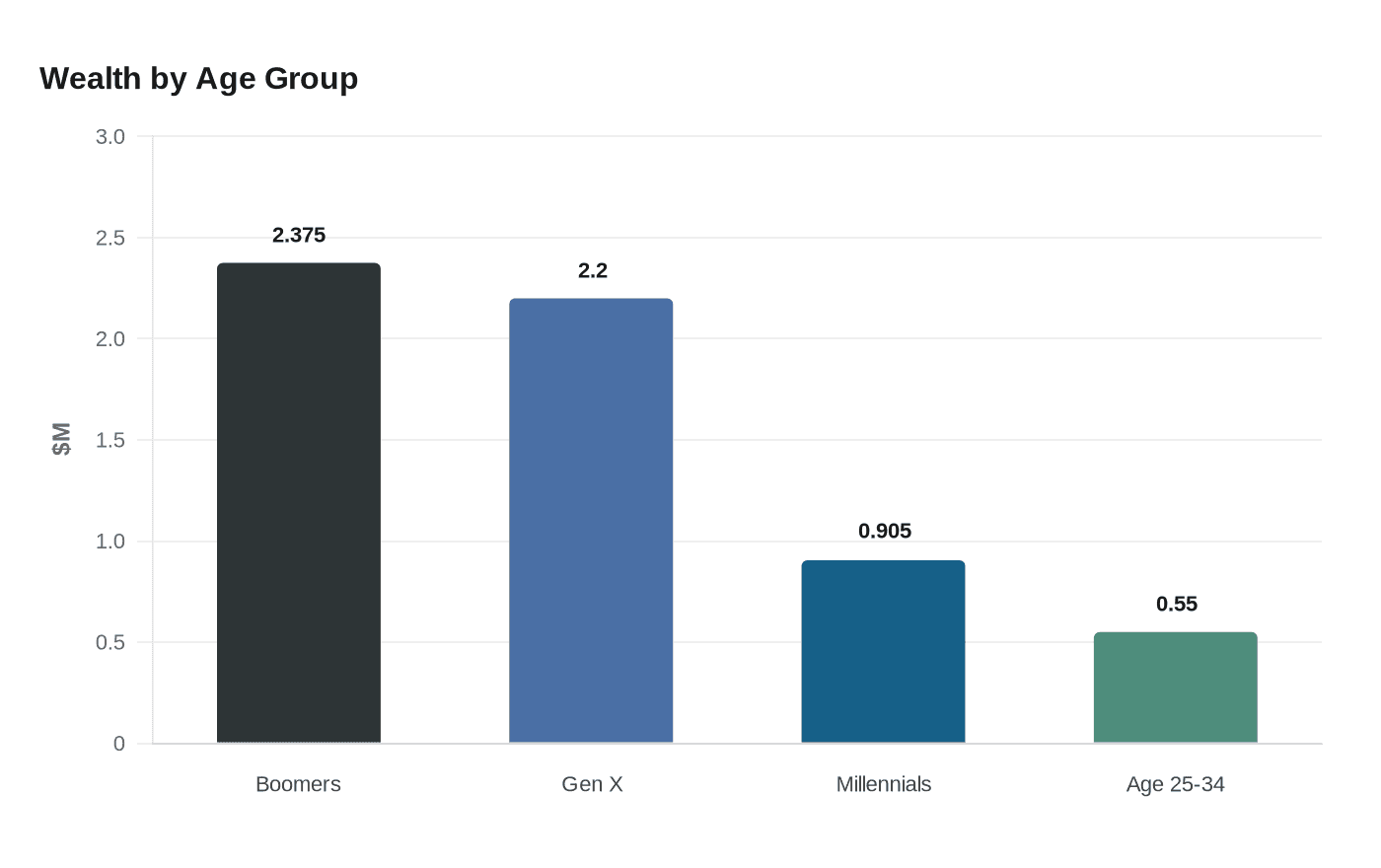
The data also shows how uneven the ladder to wealth has become. Australians aged 25 to 34 saw average household wealth rise 63% to $550,000 from $340,000, largely because some bought property in 2020 and 2021, when rates were ultra-low. That window is now closed. Elsewhere, the richest 10% of households hold about 44% of Australia’s wealth, and ACOSS and UNSW Sydney have shown the top 10% lifted average wealth from $2.8 million to $5.2 million over 20 years, while the lowest 60% rose from $222,000 to $343,000. In the labour market, that kind of divide increasingly shapes who can afford to move for work, who can absorb a pay pause, and who can turn a Big Four job into long-term mobility instead of just a high-pressure paycheck.
This article was produced by Prism’s automated news system from verified source data, official records, and press releases, then run through automated quality and moderation checks before publishing. The system is built and supervised by the people who set the standards it runs under. Read our full AI policy.
Did this article answer your question?


.pdf%2F_jcr_content%2Frenditions%2Fcq5dam.thumbnail.319.319.png&w=1920&q=75)