Australia’s Fair Work Commission lets unions bargain for McDonald’s workers
More than 5,100 McDonald’s workers in South Australia can now bargain together across 18 franchises, a ruling that could reshape pay and conditions store by store.

More than 5,100 McDonald’s workers across South Australia are now in line for coordinated bargaining, after the Fair Work Commission gave the Shop, Distributive and Allied Employees Association the green light to negotiate across 18 franchise employers running 53 restaurants.
That matters because the next round of talks will not be confined to one store or one owner-operator. The decision means the SDA can pursue an enterprise agreement for workers covered by the Fast Food Industry Award and maintenance staff at or in connection with McDonald’s restaurants, bringing pay scales, rosters, training expectations, grievance handling and discipline rules into one bargaining table instead of scattering those fights across separate franchises.
The Commission issued its decision on 30 June 2025 in [2025] FWCFB 130, after the SDA filed the supported bargaining application on 5 August 2024 and the matter was heard in Adelaide on 11 and 12 February 2025. The ruling covers 18 South Australian McDonald’s franchise employers, and the Commission said those franchisees operate every franchised McDonald’s-branded restaurant in the state. McDonald’s Australia Limited also directly operates some restaurants in South Australia.
In finding that the franchisees had clearly identifiable common interests, the Commission pointed to the McDonald’s System itself. It found the restaurants were broadly similar in operation and that the work performed was fundamentally the same, with the franchisees bound by requirements on menu items, ingredients, cleaning standards, opening hours and uniforms. The Commission also noted that low rates of pay prevail in the fast-food industry, a backdrop that has long powered organizing drives at the chain.
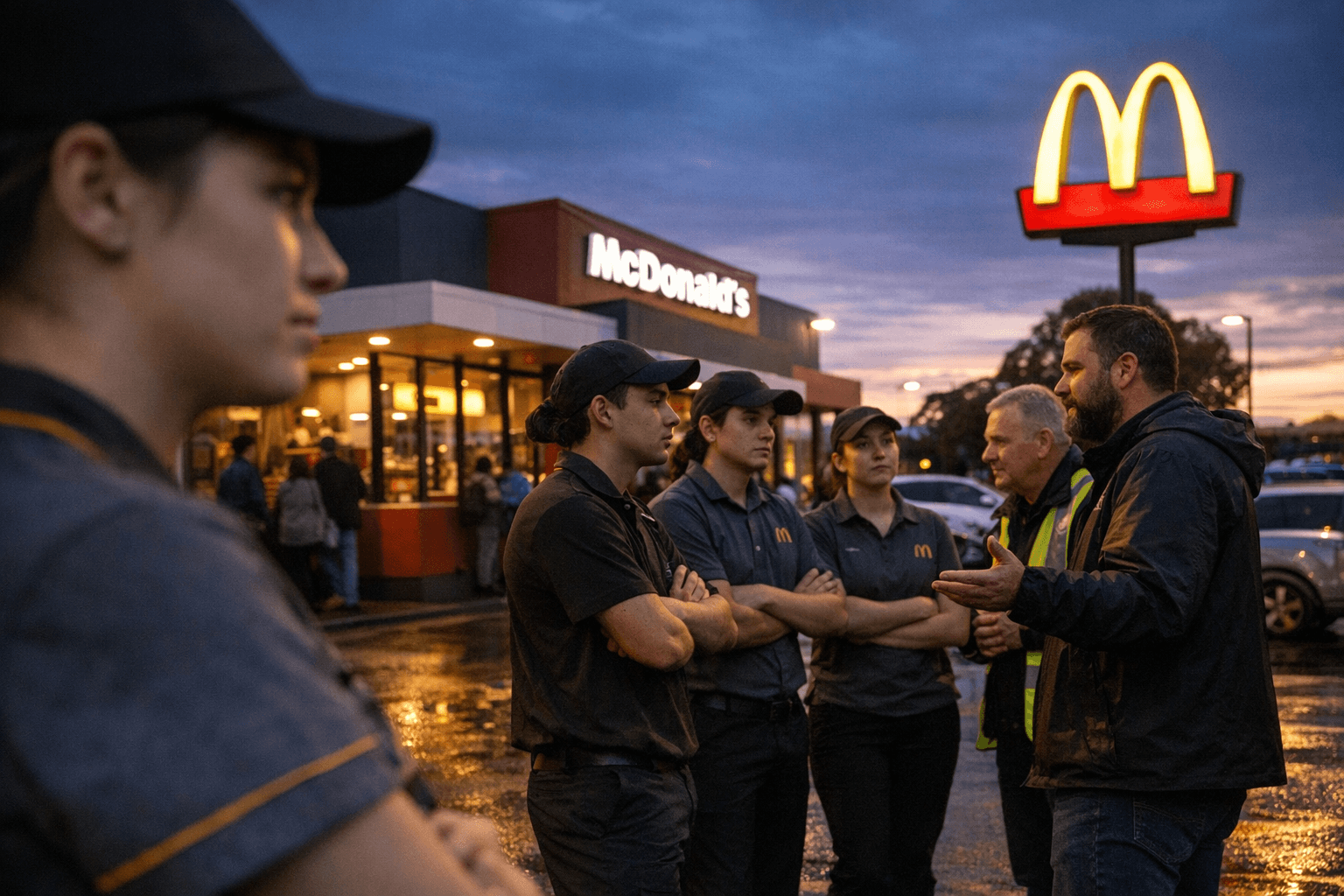
For McDonald’s workers, the practical question now is whether a single bargaining block can produce gains that individual stores rarely win on their own. If the SDA can lock in better pay or more predictable scheduling across 18 franchises, the result could become a template for workers in other franchise systems who want clearer complaint routes, stronger protections around treatment by managers and more consistent conditions from store to store.
The SDA said McDonald’s was the first employer to contest a supported bargaining bid under the federal government’s multi-employer bargaining reform, and that there are no McDonald’s workers covered by an enterprise agreement anywhere in Australia. The union has also lodged applications to expand bargaining to all McDonald’s franchises nationwide, including the Northern Territory and Broken Hill, a sign that this South Australian case may be only the first test of how far collective bargaining can reach inside a brand built on separate ownership.
Employer groups see the stakes just as clearly. The Australian Industry Group called the decision deeply disappointing, said it could affect thousands of employers across fast food, retail, hospitality and other sectors, and urged the federal government to tighten the supported bargaining stream in the Fair Work Act. For franchisees, the ruling raises the cost and complexity of negotiations, but it also creates the possibility of a more uniform system across multiple stores, something that can matter as much to staffing stability as it does to wage bills.
This article was produced by Prism’s automated news system from verified source data, official records, and press releases, then run through automated quality and moderation checks before publishing. The system is built and supervised by the people who set the standards it runs under. Read our full AI policy.
Know something we missed? Have a correction or additional information?
Submit a Tip