McDonald’s tech push aims to turn restaurants into software-defined systems
McDonald’s is wiring restaurants into a centralized software system, and the shift could change scheduling, supervision, and what a “good shift” looks like.
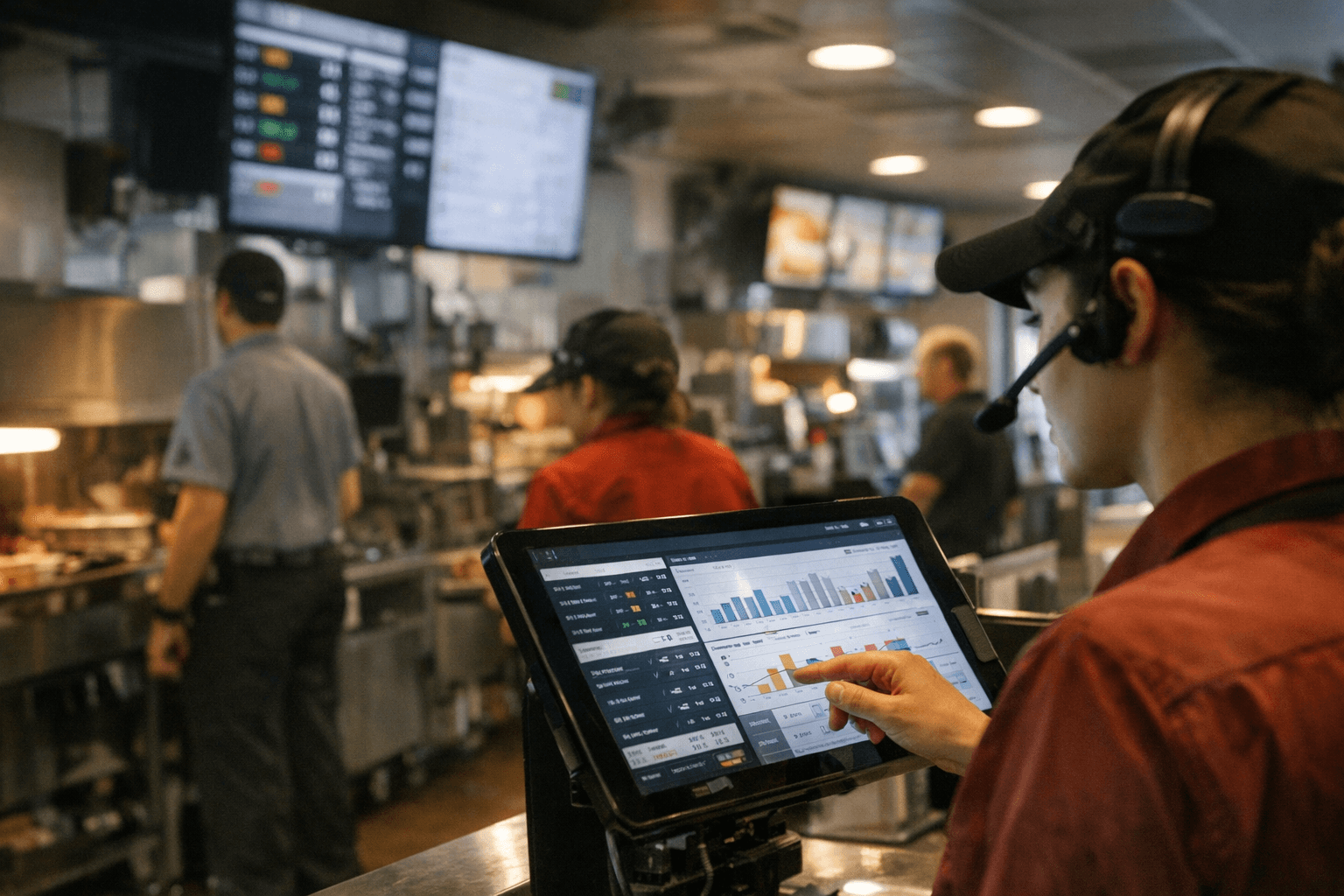
McDonald’s is building a software layer over the whole restaurant
The most important McDonald’s tech story is not a robot at the fry station. It is the company turning restaurants into connected systems that can be tuned from the back office to the front counter.
That shift started getting explicit when McDonald’s and Google Cloud announced a multi-year partnership to connect cloud technology across thousands of restaurants worldwide. McDonald’s called its digital transformation strategy, “Digitizing the Arches,” a “once-in-a-generation transformation.” By August 2025, Brian Rice, the company’s global CIO, said Restaurant Platform Edge was already live in hundreds of U.S. restaurants and expanding globally.
For restaurant workers, that matters because the goal is not just to add tools. It is to make the restaurant behave more like software: more data-driven, more standardized, and more responsive to centralized signals about labor, menu mix, and throughput.
What changes for crew members when the restaurant becomes a system
If McDonald’s is successful, “good shift performance” will mean more than speed and friendliness. It will also mean how cleanly you follow digital workflows, how well you respond to prompts from the tech stack, and how consistently you move orders through a system that is trying to optimize itself.
That has immediate consequences on the floor:
- Scheduling can become more algorithmic, with staffing shaped by traffic patterns, loyalty behavior, and predicted demand.
- Training can become more scripted, because the company will want crew to follow software-guided steps in a more uniform way.
- Manager decision-making can shift toward interpreting dashboards, coaching around exceptions, and keeping human routines aligned with what the system is telling them.
- Productivity can become more visible, which makes it easier to spot bottlenecks but also easier to monitor workers minute by minute.
For crew, some parts of the job may get simpler. Order routing should be faster, pickup timing should be clearer, and the amount of guesswork around what to do next could shrink. But the tradeoff is more measurement. In a software-defined restaurant, it is not just whether the order came out right. It is whether the order came out in the exact way the system expected.
That is where the workplace story gets bigger than McDonald’s. The old labor fights over wages and staffing, including the Fight for $15 era, were about how many people were on the floor and how much they were paid. The next fight is just as likely to be about how software assigns work, tracks performance, and decides who gets stretched thin during a rush.
The back-of-house is changing too
The clearest long-term effect may be in maintenance and technical support. McDonald’s says Restaurant Platform Edge is meant to power AI- and IoT-enabled kitchens that are “smarter, faster, and more reliable,” with better uptime, food quality, and crew experience.
That sounds abstract until you translate it into restaurant reality. A kitchen that depends on connected systems needs more than cooks and cashiers. It needs people who can notice when a device is drifting, when a network hiccup is slowing the line, or when a software update is affecting a piece of equipment. The work does not disappear. It changes shape.
That could raise the value of hybrid skills on the crew and management side. Restaurants may need people who can handle not just hospitality and food safety, but also basic troubleshooting, data hygiene, and comfort with new prompts from the system. Managers, in turn, become part coach, part operations translator, part tech problem-solver.
Why the IBM drive-thru test matters
McDonald’s is not approaching automation from a blank slate. In June 2024, the company ended its IBM AI drive-thru test after using the automated order-taking system in more than 100 U.S. restaurants. The test had already become a public embarrassment after widely shared customer mistakes and viral social-media clips.
That failure matters because it shows McDonald’s is not backing away from AI. It is deciding more carefully where AI belongs. After ending the test, the company said it still believed voice ordering would have a future and would look for a long-term solution. In other words, the company is still committed to automation, but it is moving away from the fantasy that every customer-facing task should be handed to a bot.
That is probably the most useful lesson for workers. The company is not trying to replace the restaurant with software in one swoop. It is trying to place software where it can quietly absorb decisions, reduce friction, and standardize routines without becoming the thing customers complain about on camera.
Ready on Arrival shows the more practical version of automation
Some of McDonald’s most important tech changes are less dramatic than AI drive-thru and more likely to affect an ordinary shift. In late 2024, executives said Ready on Arrival, the mobile pickup system that uses geofencing to alert crews when a customer is nearby, would expand to the six top markets by the end of 2025.
That kind of tool changes the rhythm of work. It can reduce the scramble of guessing when a mobile customer will pull up, and it may make curbside or pickup flow more predictable. It also creates a more tightly timed operation, where the software tells the crew when to move and the crew is expected to keep up.
This is the pattern to watch. The highest-impact tools are often the least flashy ones, the ones that quietly tighten the line, reduce idle time, and give managers more visibility into what is happening in real time.
The scale of the push is the point
McDonald’s is not investing in this tech layer as a side project. In December 2023, the company said it aimed to reach 50,000 global restaurants by 2027 and grow 90-day active loyalty users from 150 million to 250 million by 2027.
The scale got even clearer in the company’s 2025 results. McDonald’s reported nearly 210 million 90-day active loyalty users across 70 markets as of year-end 2025, and nearly $37 billion in systemwide sales to loyalty members for the year. That makes the software push a business strategy, not a lab experiment.
For workers, that means the restaurant is becoming more measurable because the company has more data to work with. For franchisees, it also means more pressure to keep up with corporate systems that are designed centrally but executed locally. The corporate promise is consistency and efficiency. The franchise reality is that somebody still has to train the crew, maintain the equipment, and make the floor work when the system gets messy.
What to watch next
The real question is not whether McDonald’s will keep adding technology. It already is. The question is how deeply the software logic reaches into daily work.
The jobs most likely to get easier are the ones that benefit from fewer surprises: order handoff, pickup timing, and basic routing. The jobs most likely to get more monitored are the ones that sit closest to the data: shift leads, assistant managers, and anyone whose performance can be measured against a dashboard. The new skills that matter most are the unglamorous ones: reading the system, fixing exceptions, and keeping human work aligned with machine expectations.
If McDonald’s keeps scaling this model, the restaurant will not just be a place where food is made. It will be a live operating system, and every shift will be part of the update.
This article was produced by Prism’s automated news system from verified source data, official records, and press releases, then run through automated quality and moderation checks before publishing. The system is built and supervised by the people who set the standards it runs under. Read our full AI policy.
Did this article answer your question?