McDonald's Workers Can File NLRB Charges; Here Is What to Know
A signed NLRB charge against McDonald's Corporation landed on the federal docket in January; here's what it means and how any worker can file one.
A charge against McDonald's Corporation is now open at the National Labor Relations Board, case number 13-CA-378957, filed January 14, 2026, and assigned to Region 13 in Chicago, Illinois. The docket lists McDonald's Corporation as the respondent employer, with Samuel Ferguson of the law firm Jones Day, located at 110 N. Wacker, Suite 4800, Chicago, already entered as the company's legal representative. The charging party is identified only as an individual; no name, address, or contact information appears on the public docket page.
That gap is not unusual, and it points to something workers filing charges should understand from the start: what is publicly visible at the NLRB case search portal is not the full picture of any active case.
What a "signed charge" actually is
A signed charge against an employer is the formal document that opens an NLRB case. It is filed by a "charging party," which can be a worker, a union, or another individual with standing to allege that an employer violated the National Labor Relations Act. The word "signed" matters: the NLRB requires the charging party to attest to the information under oath, which distinguishes it from an informal complaint or a tip.
Filing the charge does not mean the NLRB has found any wrongdoing. It means an investigation has been triggered. Region 13 staff in Chicago will review the charge, conduct an investigation, and decide whether to issue a formal complaint, seek a settlement, or close the case. That process can take weeks to months, and the public docket will not always reflect every action taken along the way. The NLRB docket page for case 13-CA-378957 states explicitly: "The Docket Activity list does not reflect all actions in this case."
What the public docket does and does not show
The docket for this case currently contains a single entry: a Signed Charge Against Employer, filed January 14, 2026, by the Charging Party. That is the entirety of the publicly listed activity as of now.
The allegations section of the docket page is blank. No specific claims, incidents, dates, or legal theories are listed. The signed charge document itself is not freely downloadable. The docket notes that it "may require redactions before it can be viewed," and directs anyone who wants a copy to submit a request through the NLRB's FOIA Branch. Related documents and related cases are both listed as unavailable.
This means the substance of what the charging party is alleging against McDonald's Corporation is not yet part of the public record in any readable form. McDonald's has not filed a visible response on the docket. The case is simply listed as open.
How McDonald's is represented
McDonald's Corporation is listed at a Chicago address, zip code 60607. The company has already retained outside counsel: Samuel Ferguson of Jones Day, reachable at (312) 269-4055, with offices at 110 N. Wacker, Suite 4800, Chicago, IL 60606. Jones Day is one of the largest law firms in the United States and represents major employers in labor and employment disputes routinely. The presence of outside counsel this early in the docket is standard practice for large employers, but it signals that the case is being handled formally from the outset.
How any McDonald's worker can file an NLRB charge
Whether you work at a corporate-owned McDonald's or a franchise location, your rights under the National Labor Relations Act generally apply the same way. The NLRA covers most private-sector employees and protects the right to organize, to act collectively, and to engage in concerted activity. Filing a charge is the mechanism for enforcing those rights when you believe an employer has violated them.
The process, in sequence, looks like this:
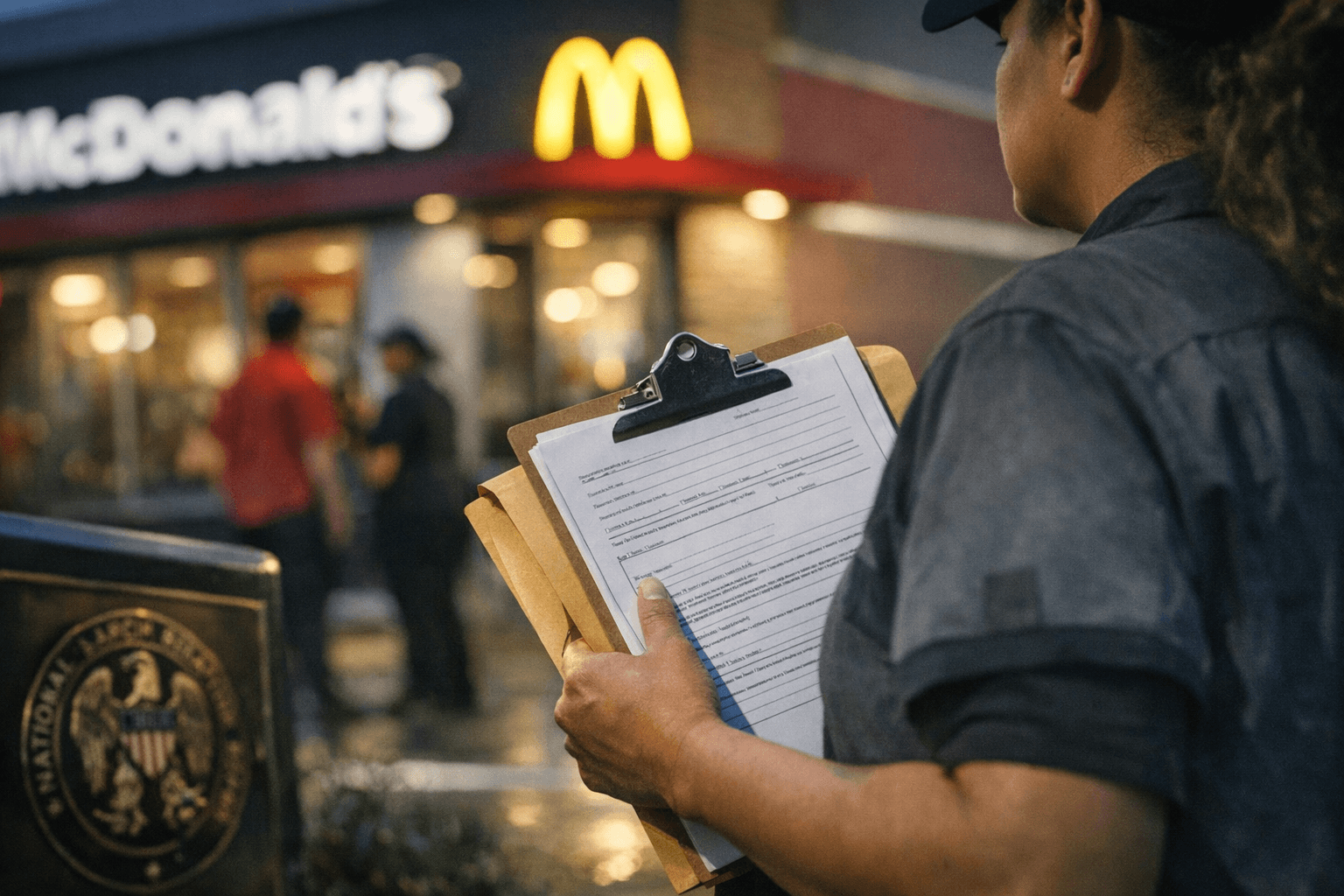
1. Identify the conduct. NLRA violations typically involve interference with organizing, retaliation for protected activity, refusal to bargain in good faith, or surveillance of union activity.
You do not need to have a union at your workplace to file.
2. Contact your regional NLRB office. This case was handled by Region 13 in Chicago, but the NLRB has regional offices across the country.
You file with the region where you work, not where the company is headquartered.
3. Complete Form NLRB-501. This is the official charge form.
It asks for the name of the employer, the address of the location involved, a description of the alleged violation, and your contact information. The NLRB offers the form in multiple languages.
4. Sign and submit. The charge must be signed.
You can file in person, by mail, or electronically through the NLRB's E-Filing system.
5. A six-month statute of limitations applies. The conduct you are describing must have occurred within six months of when you file.
This is one of the most commonly misunderstood aspects of the process. If you wait too long after the incident, the NLRB cannot pursue it.
After you file, an NLRB field attorney or investigator will contact you, review the allegations, and potentially interview witnesses. You will not pay any filing fee. The NLRB, if it finds merit, can prosecute the case on your behalf.
The franchise complexity
McDonald's operates through a franchise model, meaning the majority of its roughly 14,000 U.S. locations are owned and operated by independent franchisees, not by McDonald's Corporation directly. This has historically complicated NLRB enforcement because the question of who is the actual employer determines who can be charged and held liable.
In this case, the respondent is listed as McDonald's Corporation, not a franchise operator. That is a meaningful distinction. It suggests the charging party may be alleging conduct attributable to the corporate entity itself, though without access to the signed charge document, the specific theory of liability is unknown. Workers at franchise locations who believe the franchisor bears responsibility for their workplace conditions have a harder road, legally, but it is not an impossible one. The NLRB has in the past considered whether McDonald's Corporation functions as a joint employer alongside its franchisees, a legal question that carries significant implications for workers across the entire system.
Getting the actual charge document
If you want to read what was filed in case 13-CA-378957, the NLRB's docket page directs you to submit a FOIA request to the NLRB FOIA Branch. The document may be released with redactions to protect personal information. Journalists, advocates, and workers with an interest in the case can all submit FOIA requests. The NLRB's website lists the FOIA submission process, and requests can be filed electronically.
The case is open, the investigation is proceeding through Region 13, and the next significant public milestone will likely be either a formal complaint issued by the NLRB or a closure notice if the agency finds no merit. Both outcomes would appear on the docket. Until then, what is known is narrow but specific: a worker or workers took the formal step of filing a federal labor charge against one of the largest employers in the United States, and that charge is now a matter of public record.
This article was produced by Prism’s automated news system from verified source data, official records, and press releases, then run through automated quality and moderation checks before publishing. The system is built and supervised by the people who set the standards it runs under. Read our full AI policy.
Did this article answer your question?