The Future of Restaurant Technology: drive‑thru voice AI, predictive scheduling and what it means for McDonald’s staff
Voice AI and predictive scheduling are moving from McDonald's pilot programs to store-wide rollouts in 2026, and crew who understand the tech now will be the hardest to cut.

Every order you take at a drive-thru window, every shift schedule your manager posts, every menu board that quietly adjusts its prices at noon: all of it is being rebuilt around machine learning in 2026. The technology layer that once lived at the front of the house, in kiosks and mobile apps, is burrowing deep into back-of-house operations, reshaping forecasting, inventory, and labor decisions that used to belong entirely to humans. For McDonald's crew members and managers, this isn't a distant horizon story. McDonald's is in the middle of a technology overhaul spanning all 43,000 of its restaurants, touching kitchen equipment, drive-thru ordering systems, and AI-powered management tools simultaneously.
What the Drive-Thru Voice AI Actually Does
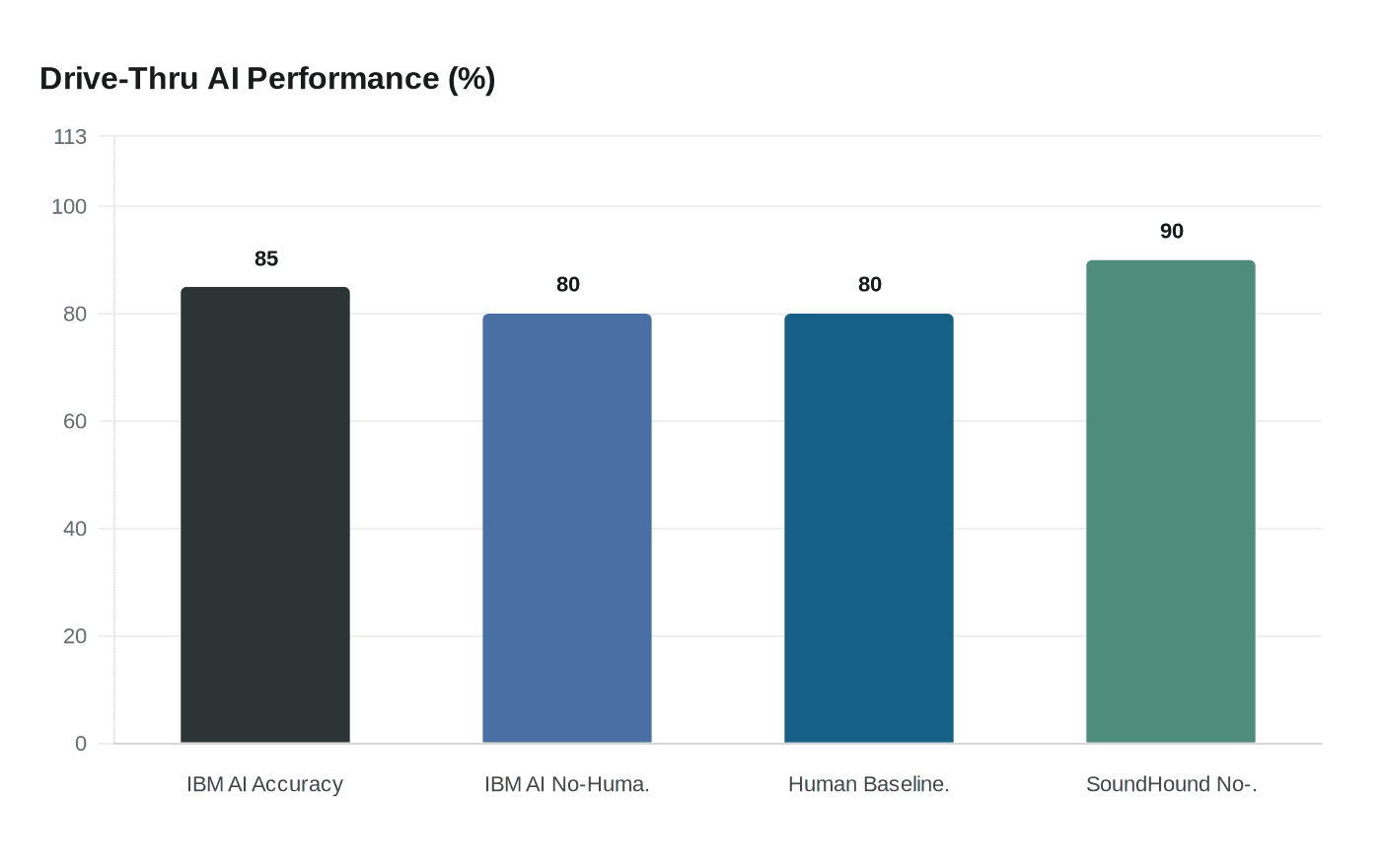
The most visible piece of this shift is conversational AI at the drive-thru speaker. McDonald's spent years testing voice-ordering technology, first through a partnership with IBM beginning in 2021, before pausing that initiative when accuracy and reliability fell short. The early IBM-powered version was reported at roughly 85% accurate, capable of handling about 80% of orders without a human stepping in. That performance gap prompted McDonald's to explore other vendors, including a partnership with Google Cloud that positions Google as the front-runner for the next deployment.
The numbers from the wider industry set the bar: SoundHound AI, one of the leading voice platforms for quick-service restaurants, claims its system handles more than 90% of orders without human intervention, compared to a human baseline of 80% to 85% accuracy. It also claims a roughly 10% improvement in lane speed. For a chain where drive-thru volume can represent 70% or more of sales, shaving seconds per car and reducing missed or wrong items adds up fast.
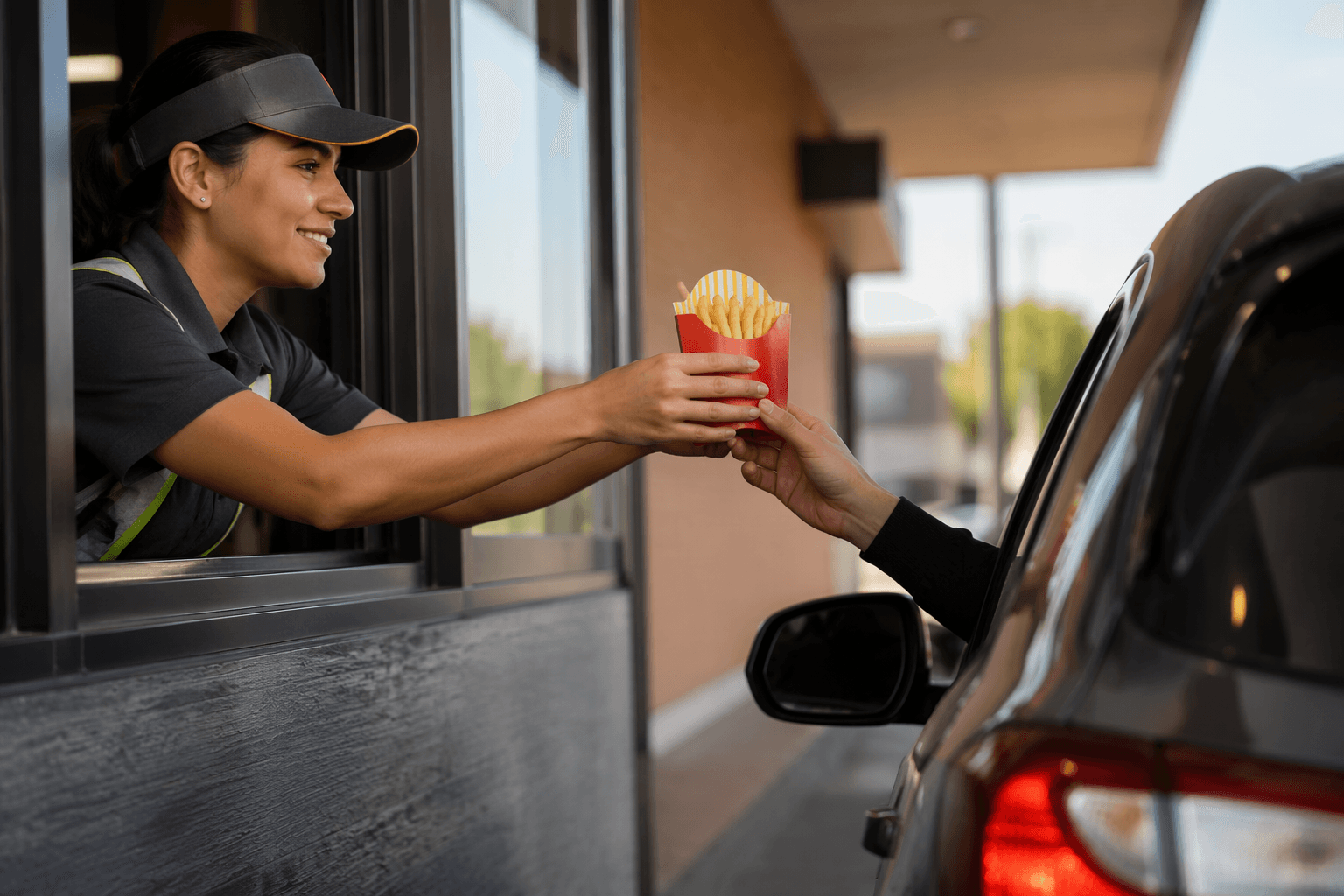
But the accuracy statistic cuts both ways for crew. When the AI misreads a modifier ("no pickle" becomes "extra pickle"), the customer who pulls to the window becomes your problem, not the algorithm's. That is the core dynamic every drive-thru employee needs to internalize: you are no longer the order-taker. You are the quality checkpoint.
What Changes at the Window: A Shift in the Life
Picture a lunch rush on a Tuesday. The AI voice system at the speaker takes the first 12 cars without issue, building orders directly into the POS and triggering the kitchen display. On car 13, a customer wants a custom McFlurry modification the AI doesn't recognize. The system flags it as an exception and routes it to the headset-wearing crew member stationed at the monitor. On car 17, a non-native English speaker with a heavy accent trips the voice model's confidence threshold, and the system escalates again.
This is what the workload looks like under AI-assisted ordering: longer stretches of monitoring interspersed with high-pressure intervention windows. The routine part of the job gets quieter; the exception-handling part gets denser. Crew members who once took every order now need to read a live order queue, spot errors before the bag is handed over, and communicate clearly with customers whose expectations were set by a robot. Those are different skills from "welcome to McDonald's, can I take your order?"
The kitchen side mirrors this. IoT sensors embedded in fryers and other equipment feed data to predictive maintenance systems that flag potential breakdowns before they happen. When a McFlurry machine sensor triggers an alert, it lands in a queue that a crew member or manager has to act on, not just a ticket on a clipboard.
The Schedule Board Gets a Machine Learning Engine
Predictive scheduling is the second major shift, and it may ultimately affect more people more directly than the drive-thru AI. McDonald's point-of-sale data, every order from every location, now feeds continuously into machine learning models through the Google Cloud partnership. Those models drive automatic demand forecasting, which flows into staff scheduling and inventory replenishment. Orquest, the AI-based workforce management platform deployed globally by McDonald's, can generate optimized schedules for up to 300 employees simultaneously in minutes, accounting for drive-thru demand, delivery volume, kiosk traffic, and time-of-day variation at once.
The operational promise is real: better-matched staffing means fewer slow periods where you're overstaffed and watching the clock, and fewer slammed rushes where the lobby line snakes to the door with four people on the floor. Predictive models that cut unplanned overtime also directly reduce one source of friction between managers and crew.
The risk, however, is also real. When the algorithm forecasts lighter demand and trims scheduled hours, the question of where that time goes is a human decision, not a machine one. Is the productivity gain reinvested into better coverage, higher wages, or kept as margin? That is a franchisee-level call, and it determines whether predictive scheduling becomes a tool that stabilizes your paycheck or one that quietly erodes it.
The Must-Ask Questions Before Your Store Goes Live
Whether your location is piloting voice AI this quarter or your manager just switched to a new scheduling platform, there are questions worth asking now rather than after the system is already running.
- What is the AI's measured accuracy rate at your specific location, not a chain-wide average?
- What is the escalation protocol when the system can't resolve an order? Who gets the notification, how fast, and on what device?
- When the AI makes an error that reaches the customer, how is it logged and corrected?
On accuracy and escalation:
- What data inputs drive the forecast model, and who reviews the output before shifts are posted?
- If the AI recommends cutting hours for a particular role or time slot, who has authority to override that recommendation?
- Are there minimum hours guarantees written into your employment terms, or are hours fully at the algorithm's discretion?
On scheduling fairness:
- Does the drive-thru AI retain voice recordings, and if so, for how long?
- Does the scheduling system use biometric data, customer traffic cameras, or performance metrics that individual crew members aren't aware of?
On privacy:
These aren't abstract concerns. Several U.S. states have passed laws specifically governing algorithmic scheduling, biometric data collection, and voice data retention in commercial settings. Knowing what applies in your jurisdiction before the tech is live is far better than finding out after.
A Short Upskilling Roadmap for Crew and Managers
The skills that make you valuable in an AI-assisted store are not the ones being automated. Here is where to focus, by role:
- Exception handling fluency: practice identifying order errors quickly on a live POS screen rather than waiting for the customer to report them
- Customer de-escalation: when an AI-generated order is wrong, the customer's frustration lands on you; short de-escalation scripts and the authority to comp items immediately matter
- Basic equipment literacy: understand what error states on kiosks, headsets, and kitchen displays mean so you're not waiting for a manager to restart a terminal mid-rush
For crew members:
- Learn to read the scheduling model's output critically, not just accept it. Which assumptions drove the forecast? What happened last time demand diverged from the prediction?
- Establish a feedback loop with your scheduling vendor. Most platforms have a mechanism to flag inaccurate forecasts; using it consistently improves accuracy over time and documents your involvement in oversight
- Require vendor service-level agreements that include employee-facing training, not just IT onboarding. If the vendor won't commit to training your crew, that is a negotiating point, not a fixed condition
For shift managers:
- Order correction rate at the window (tracks AI accuracy in your actual environment)
- Exception escalation response time (how fast crew handles AI hand-offs)
- Scheduled vs. actual hours variance (the gap between what the algorithm predicted and what was actually needed tells you how reliable the forecast is)
Metrics to watch:
When the Tech Breaks: How to Give Useful Feedback
Every system will fail at some point, and the quality of the feedback you give when it does determines how fast it gets fixed. When a drive-thru AI misreads an order, note the time, the item, and the specific modification involved, not just "it got it wrong." When a schedule turns out to be mismatched with actual traffic, document the specific peak hour and the headcount gap, with numbers. This kind of granular reporting is what vendors and managers need to recalibrate models, and it positions crew members who provide it as participants in the process rather than passive subjects of it.
McDonald's CIO Brian Rice said plainly that "our restaurants, frankly, can be very stressful." The technology rollout is, at least in part, an attempt to address that. But the difference between stress-reducing automation and stress-amplifying automation comes down to implementation choices made at the franchise level: whether pilots preserve or expand worker hours, whether training is funded, and whether the productivity gains from better forecasting and faster ordering end up shared. Crew members who understand how these systems work, and who ask pointed questions about how deployment decisions are made, are in the best position to push those choices in the right direction.
This article was produced by Prism’s automated news system from verified source data, official records, and press releases, then run through automated quality and moderation checks before publishing. The system is built and supervised by the people who set the standards it runs under. Read our full AI policy.
Did this article answer your question?