Atlassian-Google Cloud partnership shows where work management is headed
Atlassian's Google Cloud push turns AI into a workflow and governance race. monday.com now has to defend flexibility without sounding generic.
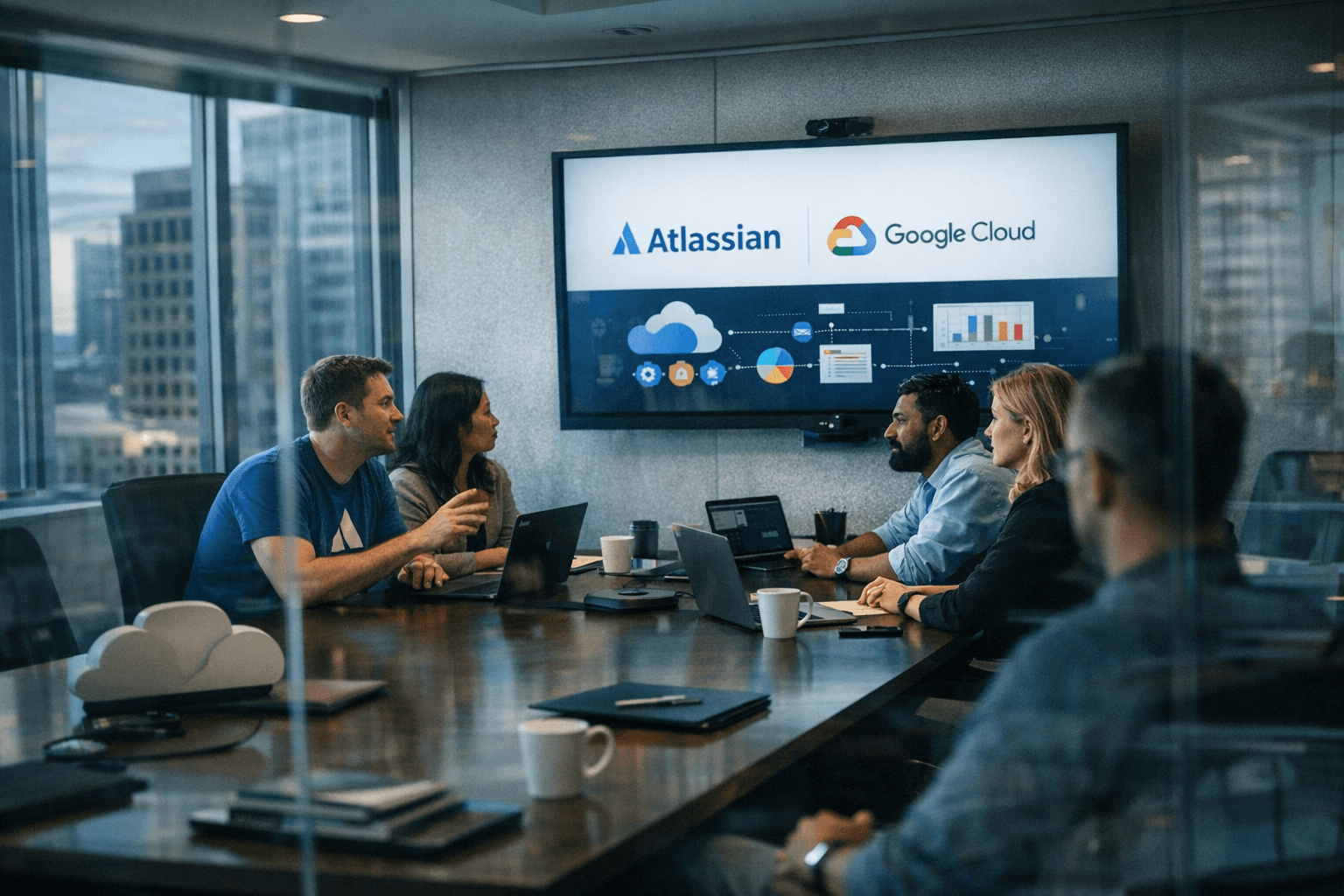
Atlassian is betting that work management will be won inside the workflow
Atlassian is pushing the work-management market toward a more integrated, more opinionated future. On April 22, 2026, the company deepened its Google Cloud partnership by tying Rovo more tightly to Google Workspace and Gemini Enterprise, so AI agents can show up inside the tools people already use to plan, write, and execute work.
That is more than a product update. Atlassian also said it is building high-performance AI training and inference infrastructure on Google Kubernetes Engine and Google Cloud AI Hypercomputer, with key workloads already running there and early gains in scale and agility. It also said Gemini 3 Flash will power certain Rovo capabilities, which adds another layer to the buyer question now forming around enterprise AI: not just whether the assistant is smart, but whether it is governed, affordable, and embedded enough to matter.
Why the Google Cloud deal matters beyond the headline
This partnership did not appear overnight. Atlassian first announced a multi-year partnership with Google Cloud on August 7, 2025, and has spent the months since positioning Rovo as an AI layer across Jira, Confluence, and connected SaaS apps through its Teamwork Graph. Atlassian says more than 3 million users now harness AI across its apps, which gives the company a real installed base to convert from curiosity to routine usage.
The Google Cloud side of the story is just as important. Google said it is bringing partner-built agents from its Agent Marketplace into the Agent Gallery inside Gemini Enterprise, a move that underscores how quickly enterprise AI is becoming an ecosystem play rather than a single-vendor feature race. Atlassian’s recognition as the 2026 Google Cloud Partner of the Year in the Technology: Application Development - Developer Experience category adds another signal that the relationship is being treated as infrastructure, not window dressing.
For enterprise buyers, that changes the frame. The conversation is no longer about who has the flashiest assistant demo; it is about who can keep AI close to the work while preserving security, oversight, and control. Atlassian and Google Cloud are making a clear argument that the winning stack is the one that feels native to daily work and still passes procurement, compliance, and IT scrutiny.
What monday.com has to answer now
For monday.com teams, especially in product and sales, the competitive lesson is hard to miss. Rivals are increasingly packaging app suite, AI agent, and cloud infrastructure as one story, which makes it harder to win enterprise deals with a broad promise like “we have AI.” Buyers want specifics now: which model is running, where data lives, how governance is enforced, and whether the platform can move cleanly across planning, collaboration, and execution.
That puts pressure on monday.com to explain its Work OS in sharper terms. The company has long sold flexibility, but flexibility alone can start to sound generic when competitors are offering tightly integrated ecosystems with named models, named infrastructure, and a direct line from workflow to cloud governance. The product story has to answer a different question now: why choose a cross-tool orchestration layer when another vendor is offering an increasingly seamless native environment?

The sales story also gets more demanding. When a prospect asks whether AI is embedded deeply enough to matter, the response cannot stop at capability lists. It has to connect the platform to trust, deployment, and actual business workflow, because that is where the market is moving and where the comparison with Atlassian is becoming most obvious.
monday.com’s numbers show strength, but not insulation
monday.com is not entering this shift from a weak position. In fiscal 2025, the company reported revenue of $1.232 billion, up 27% year over year, and fourth-quarter revenue of $333.9 million, up 25%. Customers with more than $50,000 in annual recurring revenue represented 41% of total ARR, a useful sign that the company is still moving upmarket.
The company also said monday vibe was the fastest product to cross $1 million in ARR in its history, which suggests there is real appetite for AI-native workflow tools inside its base. And with more than 250,000 customers worldwide using its AI work platform, monday.com already has the kind of scale that can support a stronger enterprise AI narrative.
But scale does not erase the competitive risk. Atlassian’s Google Cloud move raises the bar around model choice, deeply embedded automation, and the kind of governance that enterprise buyers now expect as standard. monday.com can point to momentum, but it has to keep proving that its version of AI is not just helpful, it is operationally central.
The real buyer choice is getting sharper
This is where the strategic divergence becomes clear. Atlassian is leaning into deeper lock-in and native AI convenience through a tighter Google ecosystem. monday.com’s opportunity is to stand for something different: a more flexible Work OS that can sit across tools without forcing customers into a single cloud gravity well.
That distinction matters because enterprise buying is becoming less about feature parity and more about operating philosophy. Do teams want AI that lives inside a suite and inherits its governance model, or a workflow layer that can travel across systems and adapt to different stacks? The answer will shape product roadmaps, sales motions, and how both companies talk about trust.
For monday.com, the next phase of competition is not about proving that AI exists inside the product. It is about proving that AI can execute work across the stack without losing control, context, or credibility. In this market, the companies that win will be the ones that make AI feel less like an add-on and more like the operating layer for how work actually gets done.
Know something we missed? Have a correction or additional information?
Submit a Tip