Microsoft’s 2026 Work Trend Index shows AI success needs redesign
Microsoft’s latest Work Trend Index says AI fails when workflows stay broken, a warning that lands directly on monday.com's AI Work Platform push.
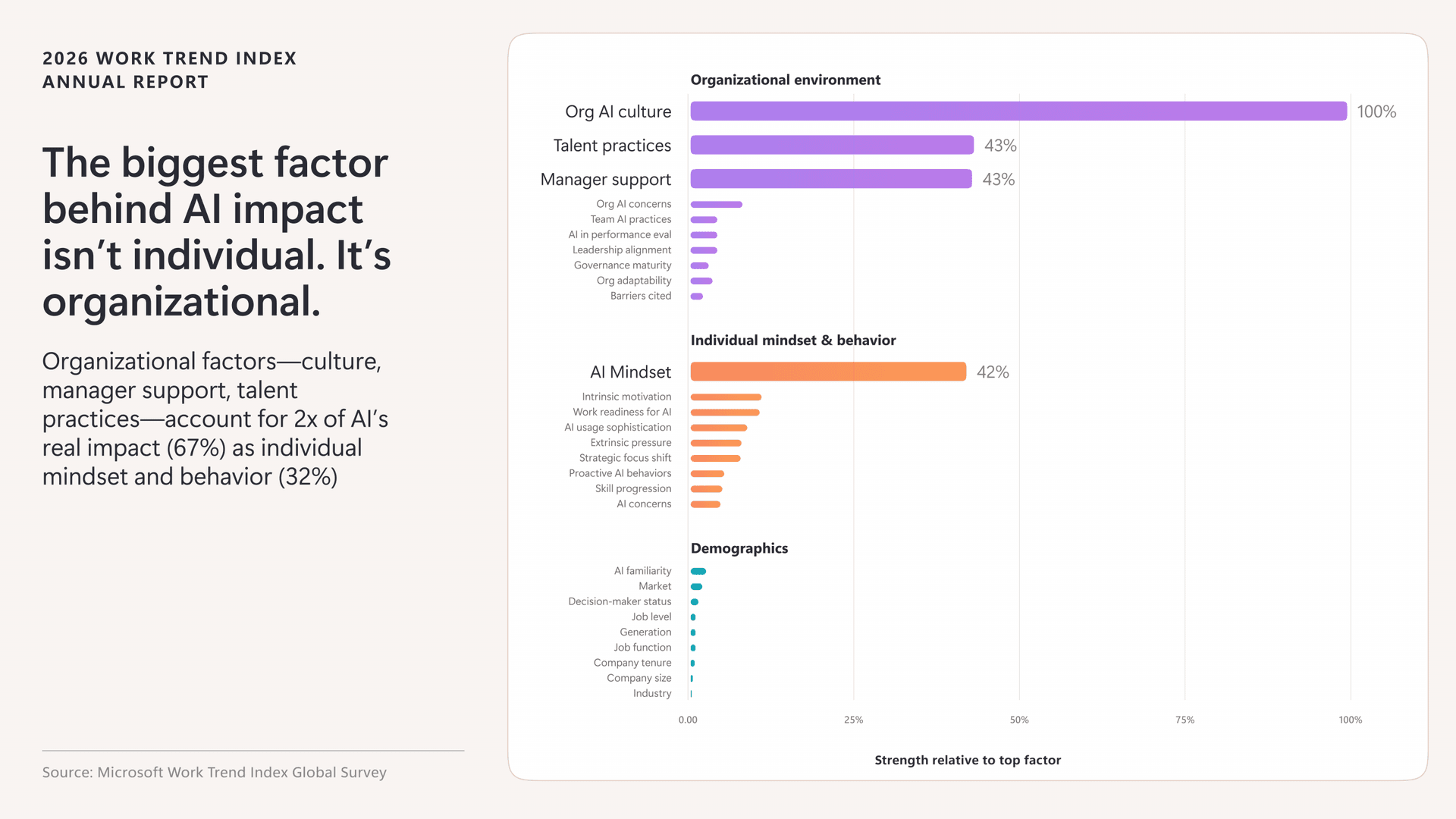
Microsoft’s warning is not about employee enthusiasm. It is about the gap between people who are ready to use AI and organizations that are still built to slow them down. That is the core lesson in the 2026 Work Trend Index, and it matters for monday.com because the product is no longer just selling task management. It is selling the operating layer where AI either gets embedded into work or stalls at the edge of it.
What Microsoft actually measured
The 2026 report is built to look past hype. Microsoft says the survey covered 20,000 full-time employed or self-employed knowledge workers who use AI at work across 10 markets, with fieldwork running from February 18, 2026, to April 7, 2026. It also says it analyzed trillions of anonymized Microsoft 365 productivity signals and consulted leading experts in AI, work, and organizational psychology.
That mix matters because it pushes the report beyond attitude polling. Microsoft is trying to understand how work really moves, where it gets stuck, and what happens when AI is dropped into a process that was designed for slower handoffs and narrower decision-making. For monday.com teams, that is the useful part: AI adoption is not just a training issue. It is a workflow issue, a governance issue, and a measurement issue.
The bottleneck is the organization, not the model
Microsoft’s frame around frontier firms, role redesign, workflow rearchitecture, and operating model as strategy points in one direction: AI value shows up only when the company changes how work is organized. The report’s bluntest idea is the “transformation paradox,” where workers are ready but their organizations are not.
That is the bottleneck map monday.com should care about. A customer can buy a smart assistant and still fail to see results if ownership is unclear, data is fragmented, approvals are scattered, or managers keep old habits in place. A workflow that forces people to chase status updates across tools is still a bad workflow, even if an AI layer can summarize the mess faster. The real question is whether the platform helps redesign the work itself.
For product teams, that means the hard problems are not only model quality or prompt design. They are connector quality, permissions, sync reliability, auditability, and whether an agent can act safely inside a live business process. If the surrounding system cannot support trust, the AI feature becomes a demo, not a habit.
Why the report is an inside-baseball warning for monday.com
Microsoft’s own Work Trend Index page shows the company has been building this argument for years. The landing page places the 2026 report alongside earlier annual reports from May 8, 2024, April 23, 2025, and June 17, 2025, with titles that track the same theme: AI is here, infinite work is real, and the hard part is redesigning work around it. The 2026 report is not a one-off warning. It is the latest step in a multi-year case that access to AI is not the finish line.
That lands directly at monday.com, where the strategic story has shifted from work management to AI-native work orchestration. On May 6, 2026, the company said it had made the biggest change in its history and reintroduced itself as an AI Work Platform. The point was not just branding. monday.com said AI agents are now built natively into the product and can draft campaigns, qualify leads, close support tickets, onboard new hires, and process purchase requests under human supervision.
That is exactly the kind of capability Microsoft’s report suggests will matter. The market is moving away from AI as a helper bolted onto the side of the workflow and toward AI as an actor inside the workflow. For monday.com, that means every product decision now has to answer a new question: does this feature merely speed up a task, or does it change how work gets routed, reviewed, and completed?
Where AI adoption stalls in practice
Microsoft’s framing points to a handful of failure points that product teams can no longer ignore.
- Management habits. If managers still demand status checks, manual approvals, and inbox-based follow-ups, AI gets trapped in old routines.
- Workflow redesign. If work is not re-mapped around ownership and decision rights, agents can only automate fragments.
- Trust and governance. If users do not understand what an agent can do, or where the guardrails sit, adoption stays shallow.
- Training. Training helps, but Microsoft’s message is that training alone does not fix broken systems.
- Measurement. If teams cannot see whether AI is shortening cycles, reducing rework, or improving throughput, the value story stays vague.
For monday.com, those are not abstract themes. They are product requirements. Agents need clear permissioning, visible handoffs, and boundaries that make managers comfortable letting software act on behalf of the team. Without those controls, customers may experiment but not rely on the system.
The numbers inside monday.com make the case more concrete
The company’s own Q1 2026 results show why this shift is more than marketing. monday.com reported revenue of $351.3 million, up 24% year over year. It also said it posted record GAAP and non-GAAP operating income, had 65,016 paid customers with more than 10 users, and had more than 250,000 customers worldwide.
One detail stands out for anyone watching the operating model discussion: monday.com’s CFO said AI productivity gains inside the company are allowing revenue to grow without headcount growth in lockstep. That is the internal version of Microsoft’s thesis. AI is not just trimming minutes off a task. It is changing the way the business scales.
The company has been signaling this direction for longer than the May rebrand. At Elevate 2025, monday.com introduced monday agents, monday magic, monday vibe, monday sidekick, and monday campaigns, and said more than 250,000 customers were already using the platform. By June 1, 2026, monday.com’s investor relations page still described it as the AI work platform used by over 250,000 customers worldwide. The message is consistent: the company wants to own the layer where work is planned, routed, and executed.
What monday.com should build next
If Microsoft is right, the next product battle is not who has AI features, but who can remove the friction around actual adoption. monday.com should be thinking in terms of tools that make agents trustworthy and operationally useful.
- stronger workflow redesign tools, not just automation templates
- clearer permissions and human-approval controls
- better syncing between systems so agents do not operate on stale data
- governance features that show what an agent did, why it did it, and who can reverse it
- measurement tools that show whether AI is improving cycle time, accuracy, or customer response
That means:
This is the strategic layer Microsoft is pointing to. AI success will not come from adding another assistant icon to the interface. It will come from making the platform strong enough that agents can run work inside a business without creating confusion, risk, or extra cleanup.
For monday.com, that is the real test now. The company has already shown it can turn AI into a product story. The harder task is turning that story into an operating model that customers can actually trust.
This article was produced by Prism’s automated news system from verified source data, official records, and press releases, then run through automated quality and moderation checks before publishing. The system is built and supervised by the people who set the standards it runs under. Read our full AI policy.
Know something we missed? Have a correction or additional information?
Submit a Tip