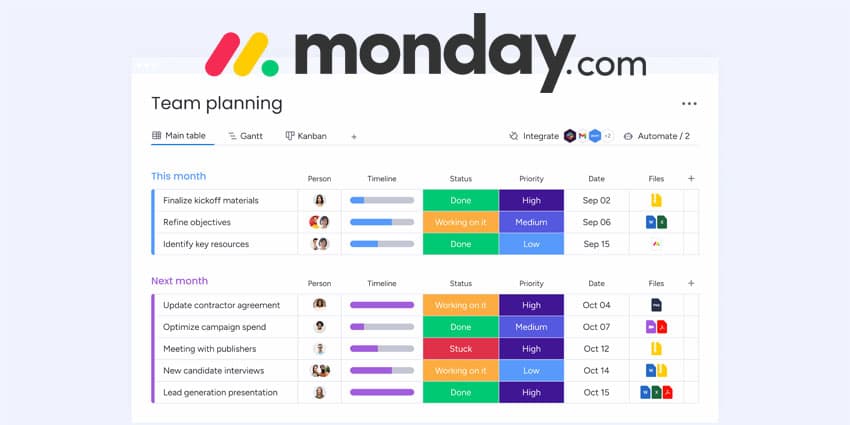
monday.com compares Notion and Asana in enterprise work management battle
monday.com is arguing that enterprise buyers should stress-test platforms for scale, not checklists, because the real failure point is what happens when work becomes cross-functional and messy.

The real comparison is what breaks at scale
The hardest question in work management is no longer which app has the prettiest feature list. monday.com’s own comparison of Notion, Asana and monday work management pushes a different test: what still works when a team grows from a neat pilot into a business with hundreds of users, multiple approvals, and more than one department touching the same work.

That matters because the failure mode is usually familiar. Teams start with tools that feel simple and flexible, then hit disconnected projects, duplicated data, and manual updates that eat time and blur visibility. monday.com is using that reality to reset the buying criteria: the real platform decision is not feature parity today, but whether the system can support governance, process complexity, and cross-functional scale a year from now.
How monday frames the market
In monday.com’s framing, Notion is strongest as a documentation and knowledge-sharing tool. Asana is positioned as task coordination software. monday work management is presented as something broader: a Work OS built for cross-department workflows, automation, and scale. That distinction is not just marketing polish. It mirrors the questions enterprise buyers ask when a pilot stops being a side project and starts becoming the operating model.
For product managers inside monday.com, that framing is a reminder that customers are not only comparing features, they are comparing the shape of the workflow itself. A customer may love Notion for project notes or Asana for task handoffs, but once the organization needs portfolio oversight, standardized processes, and less manual chasing, the discussion shifts to whether the platform can run the business, not just track work.
For sales teams, the message is even sharper. The company is not trying to win on a bare checklist. It is trying to explain workflow ownership, cross-functional visibility, and total cost of ownership in terms that matter when a customer has to support more users, more teams, and more operational risk.
Where small-team software starts to buckle
The reason this comparison lands is that the transition from small-team convenience to enterprise reliability is where many work tools expose their limits. A product that works beautifully for a department of 10 can become fragile once dozens of people need the same source of truth, the same approvals, and the same reporting logic. At that point, every manual update becomes a small tax on the business.
monday.com’s own explanation of the problem is blunt: tools that work well for small teams often struggle to handle hundreds of users. The result is not just inconvenience. It is the accumulation of disconnected projects, duplicated data, and wasted time that prevents leaders from seeing what is actually happening. In a market where platforms can look interchangeable from a distance, that operational friction is often the difference between a tool that gets adopted and one that becomes another layer of noise.
That is why the company keeps emphasizing usability, integrations, and scale. Work management is not treated as a narrow project-tracking category. It is treated as infrastructure for how companies coordinate decisions, enforce process, and keep work visible when complexity rises.
The enterprise pitch is now explicit
monday.com’s enterprise messaging makes this argument even more direct. Its enterprise materials describe the product as a way to move from strategy to execution with centralized visibility, portfolio management, standardized processes, resource optimization, automation, and AI-powered workflows. The same messaging points to dashboards, Gantt views, and real-time risk identification as part of the system.
The company sharpened that story in a May 12, 2025 enterprise announcement, saying enterprise capabilities were built to reduce the gap between strategy and execution. The risks it named are the ones workers feel when a company scales badly: missed revenue opportunities, rising operational costs, and heightened exposure to execution mistakes. That is not a pitch about task management alone. It is an argument that the platform should act like an operating layer for the business.
The newer capabilities monday.com highlighted, including portfolio dashboards, AI risk insights, AI executive reports, managed templates, and cross-project dependencies, all serve the same goal. They reduce blind spots. They also make it harder for teams to hide behind local workflows that look efficient in isolation but break down at the organizational level.
The numbers show why the company cares about this segment
The enterprise push is not happening in a vacuum. In its 2024 Annual Report on Form 20-F, filed with the Securities and Exchange Commission on March 17, 2025, monday.com said enterprise customers, defined as customers with more than $50,000 in annual recurring revenue, rose 39% year over year, from 2,295 as of December 31, 2023 to 3,201 as of December 31, 2024.
That growth sat alongside $972.0 million in fiscal 2024 revenue, up 33% from the prior year. The company also said it expected total revenue of $1.208 billion to $1.221 billion for 2025, implying 24% to 26% growth. For employees, those numbers matter because they show where the company’s center of gravity is moving: toward larger accounts, more complex deployments, and customers that expect software to fit into governance, not just convenience.
monday.com also says it was the only work-management platform named a Gartner Magic Quadrant Leader in three categories in 2025. Whether a customer buys that argument or not, the message is clear. The company wants to be seen not as one more project app, but as a serious enterprise contender with enough credibility to win large, process-heavy organizations.
What each team inside monday.com should take from the comparison
For engineers, the comparison is a signal that the product has to keep supporting flexible data models and more complex automations if it wants to win larger organizations. Enterprise buyers are not asking for static templates. They are asking for systems that can absorb different workflows, preserve visibility across teams, and keep automations reliable as the number of dependencies climbs.
For product managers, the lesson is to think in growth-stage scenarios, not feature grids. A pilot might succeed because a small team can tolerate manual cleanup, but an enterprise rollout fails if the workflow cannot survive cross-project dependencies, resource planning, and executive reporting. The better question is not whether a feature exists, but whether it holds up when the customer turns one team’s process into the company’s process.
For sales professionals, the story gives a cleaner way to explain why monday.com talks so much about total cost of ownership. Subscription price is only the first line item. Training, admin overhead, and the time it takes to make a system useful can easily matter more when adoption spans departments. That is the practical edge in the Notion versus Asana versus monday.com debate: buyers are not only choosing software, they are choosing how much operational work they are willing to carry themselves.
The competition may still look close on paper, but the market is splitting along a more important fault line. The winners will be the platforms that still make sense when the organization gets larger, the workflows get messier, and the cost of confusion stops being theoretical.
Know something we missed? Have a correction or additional information?
Submit a Tip