Monday.com explains how user story templates improve product team execution
A good user story template turns fuzzy requests into buildable decisions. monday.com says that clarity improves planning, estimates, onboarding, and release quality.
Why user stories still matter
The difference between a team that ships and a team that circles is often the quality of its user stories. monday.com’s guidance treats the user story template as a working tool, not paperwork: it helps product, design, engineering, and go-to-market teams turn loose feature ideas into decisions that can be built, reviewed, and sold.
That matters especially at monday.com’s scale, where more than 250,000 customers worldwide use the platform and multiple product lines compete for attention. When a roadmap fills with requests, a clear story template can keep the conversation anchored to the user, the problem, and the outcome, instead of drifting into internal opinions or vague task lists.
The core structure: who, what, why
monday.com’s recommended format is simple: who the user is, what they want to do, and why it matters. That structure is the real value of the template. It forces teams to describe a feature from the customer’s perspective, which is a cleaner test of whether the work deserves to be built in the first place.
The classic pattern, “As a… I want… so that…,” is widely associated with Rachel Davies and Connextra in the early 2000s, and Agile Alliance still treats user story templates as a standard Agile tool. In practice, that means the template is not a new management fad. It is a long-running discipline that keeps teams focused on customer value instead of internal activity.
For product managers, that distinction is crucial. A request such as “improve the dashboard” becomes more useful when it reads as, “As a sales manager, I want to see pipeline changes by region so that I can spot risk before the quarter closes.” The second version gives design something to shape, engineering something to build, and sales leadership something to judge.
Why templates reduce friction across teams
monday.com says standardized user stories improve clarity, strengthen alignment between business and technical teams, reduce misunderstandings, and make sprint planning and estimation easier. That is where the template earns its keep. It removes guesswork early, when the cost of confusion is still low, instead of after work has already been built in the wrong direction.
The same logic applies across functions. Product needs a requirement that can be prioritized, engineering needs a scope that can be estimated, design needs a user outcome that can be prototyped, and go-to-market teams need a feature story they can explain to customers. A strong user story template gives each group the same north star.
monday.com also ties the practice to sprint planning in its Agile guidance, saying teams typically select user stories from a prioritized backlog and use them to estimate effort. That makes the template more than documentation hygiene. It becomes the input that helps a team decide what gets built next, how long it might take, and what trade-offs are acceptable.
How monday dev fits into the workflow
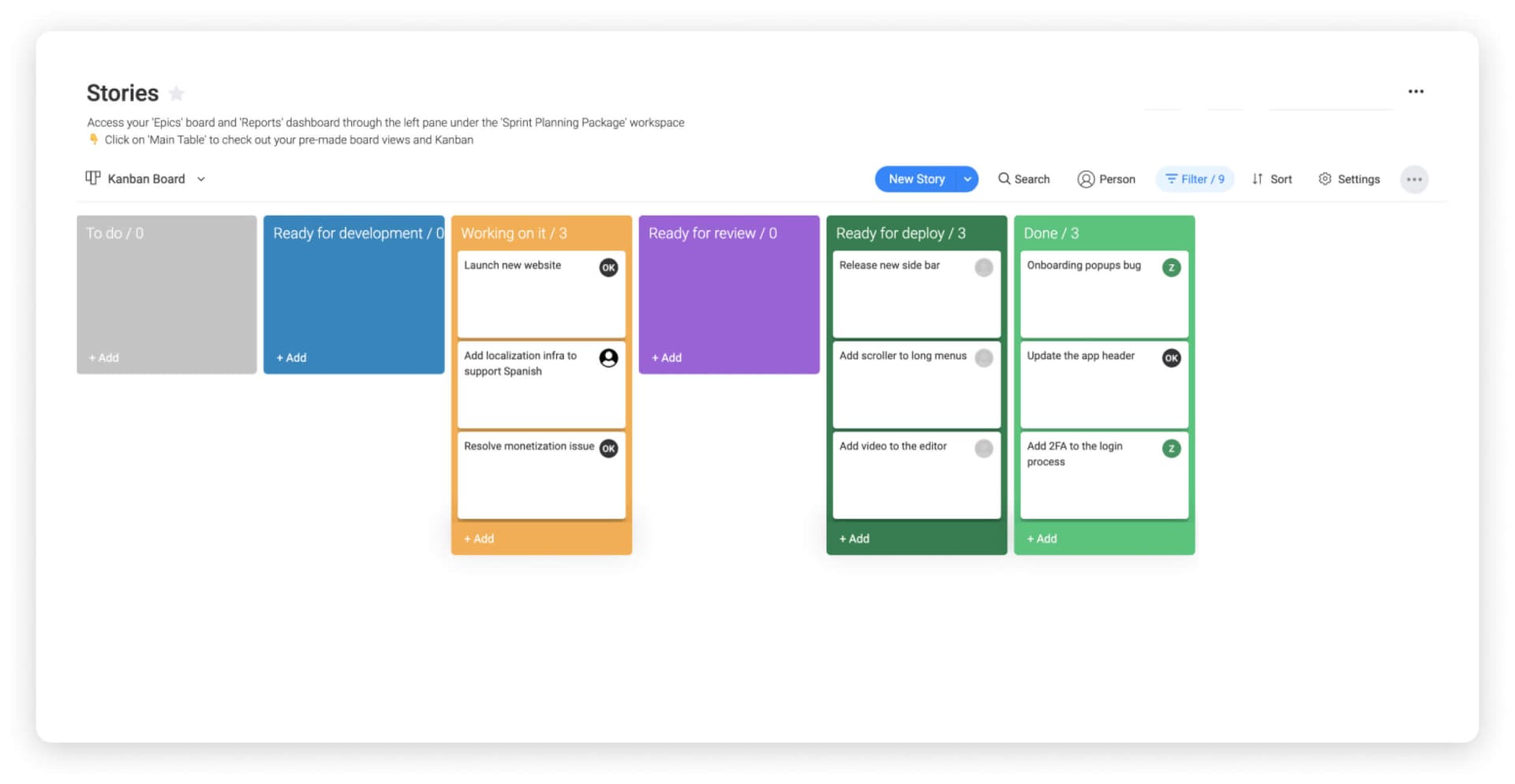
The company is not just writing about the method; it is embedding it into the product. monday dev is positioned as an end-to-end development execution platform for engineering, product, and cross-functional teams, and monday.com’s support materials say it connects devs, product design, and business teams from product strategy to launch.
That positioning matters because it shows how monday.com thinks teams should operate. A user story is not meant to sit in a document and die. It should move through planning, execution, and delivery in one connected workspace, where the story remains visible as work gets broken down, assigned, and tracked.
The company’s broader template strategy reinforces that approach. Its Template center includes boards, docs, WorkForms, dashboards, and bundles of multiple connected workflow elements. In other words, monday.com treats templates as infrastructure for repeatable work. The user story template sits inside a larger system designed to make processes easier to standardize across teams.
What better stories change in day-to-day execution
The practical payoff of a stronger story template is easier to see in the middle of a release cycle. When the story is clear, teams can spot missing assumptions earlier, challenge weak requests faster, and keep the build tied to a user outcome. When the story is vague, the work tends to fragment, and everyone ends up filling gaps with their own interpretation.
That is why the template is so useful for cross-functional planning. A roadmap full of undefined asks can feel like a stack of disconnected tasks. A roadmap built from well-formed stories feels more like a sequence of customer outcomes, which is easier to review internally and easier to explain externally.
It also gives product teams a simple threshold for readiness: if the team cannot clearly say who the feature serves and what change it creates, it is usually too early to build. That rule is especially useful in organizations where multiple teams are competing for the same delivery capacity and where product judgment has to be defended with evidence, not enthusiasm.
The operational payoff is measurable
monday.com’s customer examples show why this discipline matters in real delivery environments. Call Box says it used monday dev templates to standardize its development workflow, generate tasks, and create delivery timelines visible to all stakeholders. The results it reported were concrete: a 15% increase in quarterly throughput, a 90% decrease in new developer training time, and a 66%+ decrease in post-release bugs and defects.
Those numbers point to three separate benefits that product teams feel immediately. Throughput improves because less time is spent clarifying basic intent. Onboarding speeds up because new developers are not trying to reverse-engineer the team’s process from scratch. Quality improves because the expected outcome is captured earlier, before the work is released and defects start compounding downstream.
For employees inside a company like monday.com, that is the real career-credibility lesson. Better stories make teams more dependable, and dependable teams are easier to scale. They are also easier to sell, because customers and stakeholders can see a coherent chain from strategy to launch.
The bottom line for product teams
User story templates are not bureaucratic overhead. They are a shortcut to better execution when product, engineering, design, and go-to-market teams need to make the same decisions quickly and keep them aligned. monday.com’s framing is straightforward: when the story is clear, the work is easier to prioritize, estimate, and ship.
At a platform serving more than 250,000 customers, that kind of discipline is not optional polish. It is how a roadmap stays connected to outcomes, and how a team keeps from building impressive software that solves the wrong problem.
Know something we missed? Have a correction or additional information?
Submit a Tip