monday.com explains transparent hiring process for job seekers
monday.com’s hiring video is a rare preview of how the SaaS company says it screens for mutual fit. Job seekers can use it to test for structure, candor and decision speed.
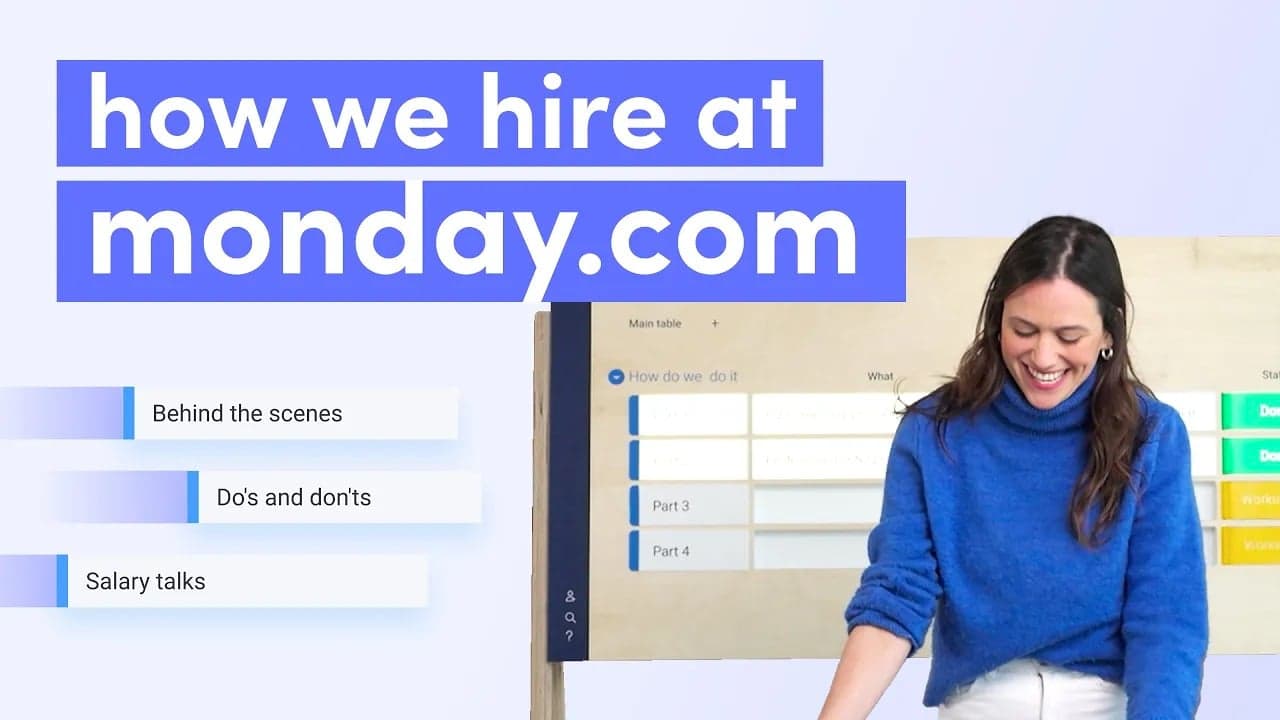
Posted on YouTube in August 2022, monday.com’s hiring video tells candidates, “At monday.com, we’re all about transparency.” It says it was made to explain how the hiring process works, what the company tends to look for, and how it decides whether there is a mutual fit.
What the video tells candidates to expect
At a fast-scaling SaaS company, hiring also tests how a team operates when priorities shift, products evolve, and managers need people who can handle change without losing focus. monday.com is signaling that it wants candidates who are comfortable with direct communication, structured evaluation, and a clear answer on whether the role is actually right for both sides.
If a company values transparency at the entry point, candidates can reasonably expect that same style in sprint planning, feature rollouts, quota setting, and cross-functional handoffs once they are inside. The interview becomes a preview of the management style, not just a gatekeeper.
Why scale changes what transparency means
monday.com’s investor relations page lists over 250,000 customers worldwide using the platform, which brings people, workflows, and AI agents together on one flexible system. The company’s FY2024 annual report lists $972 million in revenue, 33% year-over-year revenue growth, 112% net dollar retention, and 2,500-plus employees worldwide. It also lists $296 million in free cash flow, equal to 30% of revenue.
At a company that big, one unclear interview loop can ripple through a large and growing workforce, especially when the product itself is built around operational visibility. monday.com is not just selling software that tracks work. It is also trying to staff a business that has moved from growth-stage discipline into a scale-up rhythm, with all the hiring pressure that comes with it. In 2025, monday.com said in podcast appearances and investor materials that it had surpassed $1 billion in annual recurring revenue, which puts even more weight on how carefully it defines roles and expectations.
At that scale, a transparent process is a signal about whether the company can align teams quickly enough to keep product innovation moving while supporting a global customer base.
The company’s own hiring materials point to structure
The hiring video is not the only clue. monday.com’s engineering blog publishes a technical interviews guide, and the company also makes hiring-related templates available, including a recruitment process template and interview templates and score sheets. That combination points to a structured approach rather than an improvisational one.
Structured hiring usually produces better signal. It can mean interviewers are evaluating the same competencies, using defined criteria, and documenting decisions instead of relying on gut feel. It also suggests there may be a shared internal language for what a strong engineer, product manager, or seller looks like, which is often a better sign than a vague promise of “culture fit.”
What outside candidate signals suggest
A 2022 Reddit post in r/antiwork said a monday.com interview had three parts and that a recruiter read from a script. Glassdoor search snippets show the company’s interview experience as multi-stage, often including phone screenings, technical assessments, and team interviews.
Glassdoor search snippets show a mixed but generally positive picture of the employer brand. The company is shown at 3.9 out of 5 stars based on 801 reviews, and one snippet places interview experience at 62.9% positive. That is not a verdict on its own, but it does give applicants a way to cross-check the company’s transparency claims against the candidate experience others describe.
The real test is whether interview stages are explained up front, whether the same expectations show up across rounds, and whether candidates get enough feedback to understand the decision. The Reddit and Glassdoor signals suggest that monday.com’s process is not especially casual. For some applicants, that will feel reassuring. For others, it will feel rigid.
A checklist you can use in your own SaaS search
monday.com’s hiring approach is most useful when you turn it into a screening tool for other interviews. The same transparency signals should be visible wherever you apply.
- Are the interview stages laid out before the first call, including any technical assessment or team round?
- Does the recruiter explain what competencies each round is testing, or do the requirements shift as you move forward?
- Is the feedback loop defined, or do candidates have to chase for updates?
- Do managers describe success in the role with measurable outcomes, not vague cultural language?
- Is the final decision owned by a clearly named leader or panel, or does it seem ad hoc?
- Do the company’s hiring materials, like interview guides or score sheets, match the way recruiters actually behave?
- Does the process feel consistent enough that you can prepare, or does it rely on improvisation and guesswork?
Those questions are especially relevant in SaaS, where jobs can span ambiguous product work, customer demands, and fast-moving business targets. At monday.com, where the business has crossed 250,000 customers and scaled to 2,500-plus employees, that kind of clarity is part of how the company shows it can grow without losing control of the basics.
This article was produced by Prism’s automated news system from verified source data, official records, and press releases, then run through automated quality and moderation checks before publishing. The system is built and supervised by the people who set the standards it runs under. Read our full AI policy.
Did this article answer your question?