Monday.com guide shows how workflow AI can prevent costly disruptions
monday.com’s manufacturing AI guide is really a buyer’s guide for operational AI, where the test is whether it can stop a missed shipment from becoming a chain reaction.

When workflow AI has to keep work moving
The most useful AI is not the kind that produces another alert. It is the kind that catches a machine running hot, a quality note left by the previous shift, or a missed shipment before those problems spill into production, maintenance, supplier follow-up, and customer commitments. That is the practical standard monday.com sets in its manufacturing guide, and it reaches far beyond factories.
The lesson for anyone building, selling, or supporting the platform is simple: enterprise buyers do not want AI as decoration. They want AI that connects signals across functions, turns insight into follow-through, and helps teams act before disruption becomes expensive.
The real job of AI is to prevent the cascade
The guide starts from a familiar operational reality. In manufacturing, one broken link rarely stays isolated. A delayed shipment can force production changes, a hot machine can trigger maintenance work, and a quality issue from the prior shift can create rework, supplier escalation, and customer fallout all at once. The value of AI in that environment is not volume of alerts, but early pattern recognition across machine data, quality records, and supply updates.
That framing matters because it describes how work actually fails. Most disruptions are not single incidents. They are sequences, and the company that spots the sequence early is the company that avoids overtime, missed deadlines, and the all-hands scramble that follows. monday.com’s approach is built around that logic: workflow AI should help organizations see the operational chain, not just the latest isolated event.
For employees inside monday.com, that is more than a messaging choice. It is a product signal. Buyers are judging whether the platform can do real coordination work across production, maintenance, quality, and supply chain teams without forcing them into another silo.
What enterprise buyers are really buying
The guide makes clear that customers are not shopping for abstract AI capability. They are buying three things at once: insight that crosses functions, a central system that turns insight into action, and a way to keep teams aligned when conditions change fast. That is a different pitch from generic automation talk, and it is closer to how operational leaders make purchase decisions.
This is where workflow AI becomes a decision tool rather than a feature list. If the system can surface a quality trend before it creates scrap, route the issue to the right owner, and keep the next step visible until the problem is resolved, it has already done more than an alerting system ever could. It has reduced friction between departments that often work with different data, different priorities, and different timelines.

That is also why the manufacturing example is useful outside manufacturing. Service teams, ops teams, and revenue operations all face similar breakdowns: one delay creates three new tasks, and those tasks drift because nobody owns the whole chain. The buyer question is not whether AI can classify data. It is whether AI can keep work moving when the first plan breaks.
Why vertical relevance now matters at monday.com
For product and engineering teams, the guide reinforces a shift in how workflow software gets judged. Broad AI claims are no longer enough. The value proposition now includes vertical relevance, meaning the platform has to show that it understands the realities of a specific work environment and can operate inside them. Manufacturing is a strong proving ground because the consequences are concrete and measurable.
That has implications for what gets built. A useful workflow AI layer has to respect exceptions, approvals, audit trails, and human fallback. It has to make it easy to see who approved what, where the work stalled, and what happened when a person had to step in. In high-stakes operations, those details are not administrative clutter. They are the difference between control and confusion.
For a company like monday.com, that is the bridge between generic work management and deeper enterprise trust. If the platform can show that it handles the messy parts of execution, not just the happy path, it becomes easier to sell into serious operational environments. The manufacturing guide is a signal that the company wants to be evaluated on that basis.
What sales teams should take from the guide
The strongest commercial lesson is not about industry jargon. It is about specificity. Sales teams do better when they can connect AI to a named business pain, such as a delayed shipment, a maintenance issue, or a quality miss that creates downstream cost. That makes the value concrete and helps buyers picture how the platform would actually be used on Monday morning, not just how it sounds in a demo.
The guide also shows why ROI language works best when it is tied to coordination. A platform that helps production, quality, maintenance, and supply chain teams stay synchronized is not selling a vague productivity boost. It is selling fewer handoff failures, faster escalation, and less time lost to chasing status across departments. That is the kind of outcome enterprise customers can defend internally.
The practical sales message is straightforward:
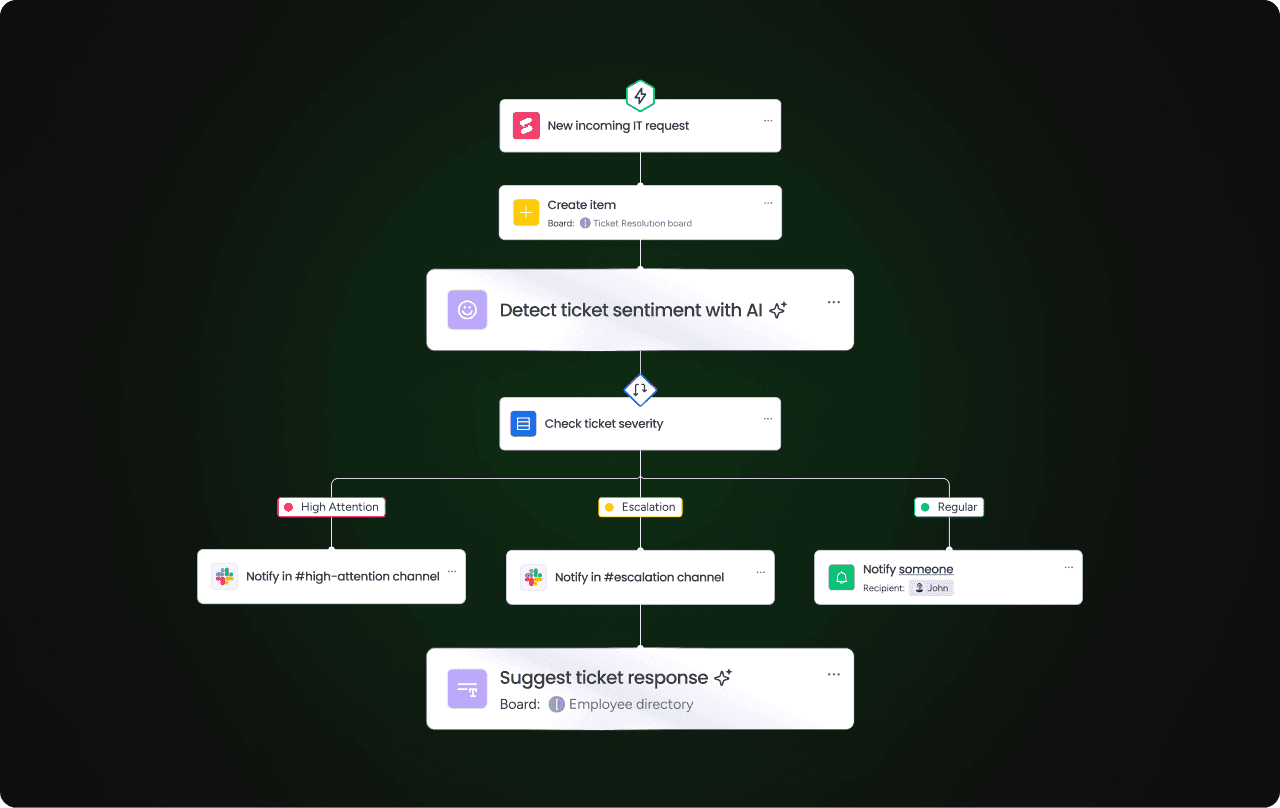
- Spot problems early, before they turn into a cascade.
- Route work across the right teams without creating a new silo.
- Keep approvals and fallback paths visible when humans need to intervene.
- Tie AI to operational continuity, not to novelty.
That is a much stronger argument than simply saying a platform is AI-powered. It speaks to how buyers measure risk.
Why this matters inside monday.com’s culture
For a company built around work management, the manufacturing guide also reflects an internal cultural test. Remote-first and hybrid teams still have to prove they understand work as it happens in the field, on the floor, and across distributed systems. Product teams need to translate that reality into features that feel native to serious operations. Sales teams need to explain those features without slipping into hype. Support teams need to back up the promise with actual reliability.
That is where workflow AI becomes a company-wide issue, not just a product line item. If monday.com wants to win high-stakes accounts, it has to show that its AI helps organizations act, recover, and keep moving. The manufacturing example does that by focusing on disruption, not decoration.
The bigger takeaway is that workflow AI is maturing. Buyers are no longer impressed by a system that merely notices trouble. They want one that helps carry the work through the trouble, across teams, with enough structure to keep accountability intact. monday.com’s guide points directly at that shift, and it gives the company a sharper way to sell what serious customers are actually buying.
Know something we missed? Have a correction or additional information?
Submit a Tip