Monday.com guide shows managers how to lead remote teams effectively
Monday.com’s remote-management guide argues that distributed teams run on clarity, cadence and trust, a lesson that still fits hybrid work in 2025.
The hardest part of remote work is not doing the job from a kitchen table or spare bedroom. It is doing it without the in-person feedback loops managers usually rely on to spot confusion, momentum or delay. For engineers, product managers and sales teams alike, distributed work is not just office work moved home; it is a different management problem built around clearer ownership, steadier follow-up and fewer assumptions.
Remote management is about legibility
Remote management is both a process and a philosophy for leading workers who are not in the same room. The challenge is replacing the informal cues and quick course corrections that happen naturally in person.
At a practical level, the work gets harder fast. Assigning tasks, holding regular check-ins, monitoring progress, answering questions, coaching, mentoring and tracking productivity all demand more structure when teams are distributed. For someone in engineering, that can mean a sprint board that actually reflects ownership. For product, it means decisions do not vanish after a meeting. For sales, it means follow-up does not depend on memory or hallway conversations.
Remote work can improve efficiency and productivity, but only when managers build the right system around it. That system is not surveillance and it is not constant interruption. It is clarity about who owns what, cadence for when people reconnect, and trust that lets work keep moving without a manager hovering over every step.
What Monday.com’s own tools say about remote work
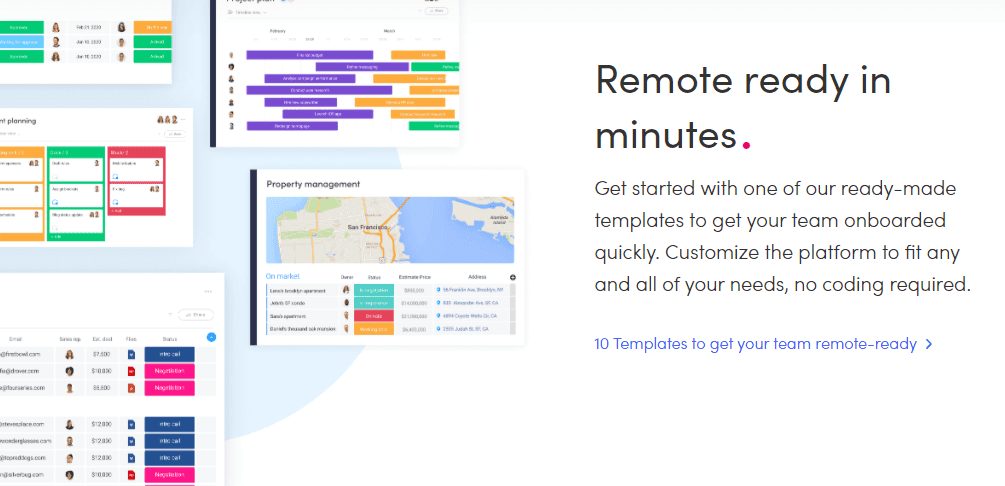
Monday.com’s Remote Work Hub turns the idea into workflows, with templates for remote work requests, sync meeting summaries, daily team tasks, a log for 1-on-1 meetings, team time tracking, remote equipment checks, a knowledge library, a resource center and employee onboarding.
Instead of hoping people remember what happened in a meeting or where a request landed, the hub pushes teams toward repeatable processes that leave a trail. In a work-OS environment like Monday.com, boards, check-ins and status visibility are meant to reduce ambiguity, which is exactly what remote management needs.
The company’s remote-working software page presents the same logic: cloud-based software helps teams align fast, set goals, collaborate easily, boost communication and track progress whether people are at home or in the office. The product’s core promise overlaps with the daily management challenge inside the company itself.
Why the basics still matter in a hybrid, AI-heavy workplace
A lot of workplace talk in 2025 focuses on new tools, especially AI, but the unresolved problems are still the old ones: role clarity, accountability and follow-through. Hybrid teams can automate summaries and shuffle tasks faster than ever, yet they still stumble when ownership is fuzzy or when managers never close the loop on what happens next.
In a distributed workplace, success depends less on location and more on management quality, clear expectations and intentional team design. The location debate can swallow the conversation, but the real issue is whether people know what good looks like, who is responsible, and how progress gets checked.

Among workers whose jobs can be done from home, 35% were working from home all the time in March 2023, down from 43% in January 2022 and 55% in October 2020, but still well above the 7% pre-pandemic level, according to Pew Research Center. In January 2025, Pew Research Center also found that many remote workers say they would be likely to leave their job if they could no longer work from home, which makes disciplined remote management less of a perk and more of a retention issue.
For Monday.com teams, that backdrop is especially relevant because the company sells the infrastructure that makes distributed work possible. If managers do not create visible ownership and reliable follow-through, the software can track the mess, but it cannot fix the management gap by itself.
What this looks like inside Monday.com
Monday.com is an Israeli software company based in Tel Aviv-Yafo, with Roy Mann as CEO and a profile snapshot showing 3,155 employees. The company says more than 250,000 customers worldwide use its platform.
Monday.com became a publicly traded company on Nasdaq on June 10, 2021, which means execution is visible not just to employees and customers but to the market as well. In a SaaS business, that tends to sharpen attention on process, coordination and delivery, the same themes that show up in its remote-management advice.
This article was produced by Prism’s automated news system from verified source data, official records, and press releases, then run through automated quality and moderation checks before publishing. The system is built and supervised by the people who set the standards it runs under. Read our full AI policy.
Did this article answer your question?