Monday.com pushes predictive analytics to turn marketing insights into action
monday.com is turning predictive analytics into a workflow trigger, with lead scoring and churn alerts meant to move budgets, staffing, and follow-up before targets slip.

Predictive analytics is moving from reporting to intervention
monday.com is pushing marketers to stop treating analytics as a rearview mirror. In its April 15 guide, the company argues that a campaign can look healthy at launch and still miss the mark if teams only react after conversion data arrives. The point is not just to forecast what customers might do next, but to use that forecast to change what happens next.
That shift matters because it changes the manager’s job. Predictive analytics is no longer just a reporting layer for weekly reviews; it is supposed to shape day-to-day decisions on budget, lead prioritization, staffing, and follow-up timing. If the model says one segment is far more likely to convert or churn, the team is meant to act before the quarter slips, not after the dashboard turns red.
The fastest wins are the ones closest to revenue
monday.com’s guide puts lead scoring and churn prediction at the top of the list for a reason: they are the clearest places to tie AI output to measurable business impact. Lead scoring can help sales and marketing sort high-value prospects faster, while churn prediction can flag which accounts need intervention before renewal risk turns into lost revenue. The company says those use cases can produce measurable impact within months, but only if teams build a clean, unified data foundation first.
That caveat is the real story. Predictive tools fail when the underlying data is fragmented, stale, or full of conflicting definitions. If marketing, sales, and customer success are working from different systems and different logic, the model may generate a polished answer without producing a reliable action.
A practical Monday.com-style workflow looks less like a report and more like an operating rule set:
- high-scoring leads get routed immediately to the right rep
- churn-risk accounts trigger retention outreach before the renewal deadline
- budget shifts toward segments with the strongest predicted return
- follow-up timing adjusts based on the behavior the model is detecting
That is the difference between insight and execution. Monday.com is arguing that the value is not in knowing more, but in deciding faster.
The platform pitch is coordination, not dashboards
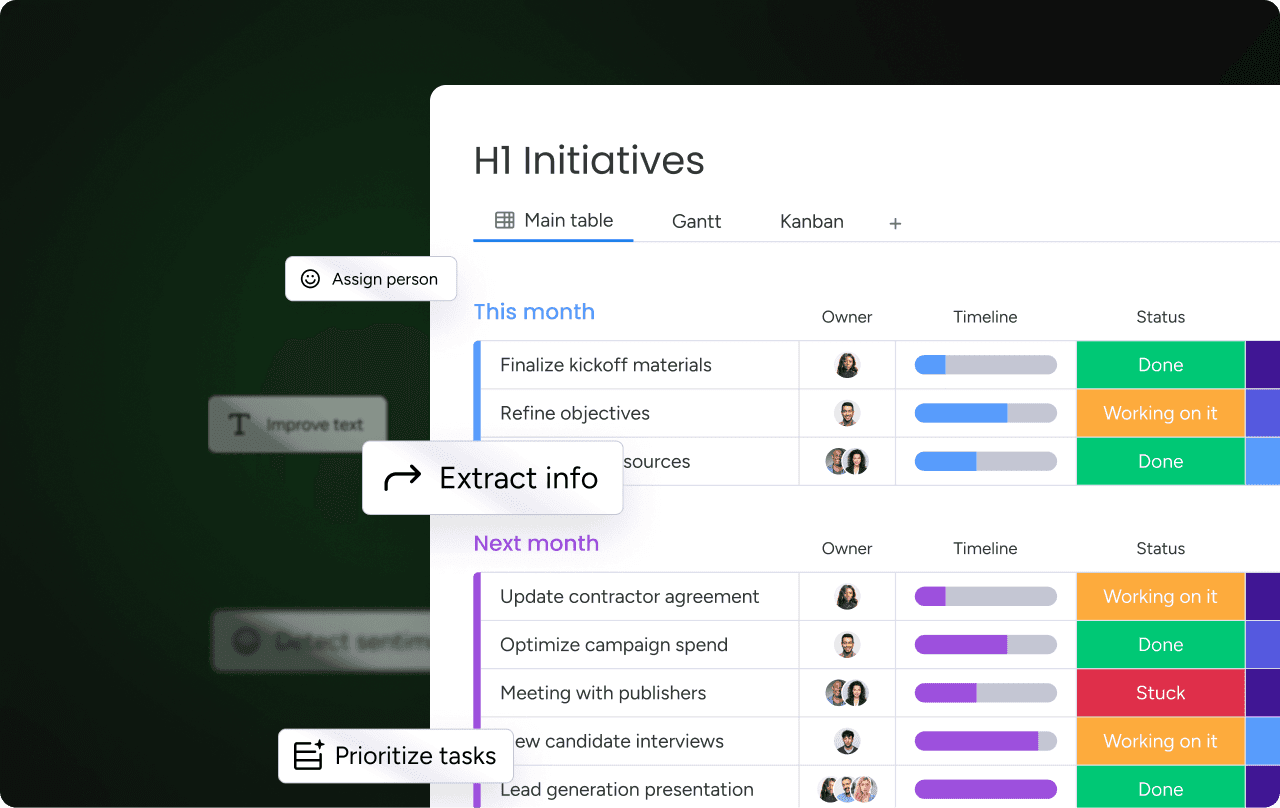
The company is also using this marketing playbook to sharpen how it talks about its own product. monday work management and AI Blocks are presented as the mechanisms that turn prediction into action without manual handoffs. In the company’s support documentation, AI Blocks sit at the center of its AI features and can be used in AI columns, automations, and the workflow builder, which makes the blog post’s promise concrete rather than abstract.
That framing is revealing for employees across product, go-to-market, and customer success. monday.com is not selling customers a smarter chart. It is selling a coordination layer where a score, a signal, or a model output can trigger the next step in the workflow. For workers inside the company, that means the product story has to connect data quality, AI output, and workflow design into one operating model.
It also raises the bar for adoption. Customers will not trust predictive analytics if the result is another dashboard that nobody uses on Tuesday morning. To be useful, the system has to change who gets the lead, when a rep follows up, when retention steps begin, and which team owns the next move.

The company’s own scale makes the message harder to ignore
The predictive-analytics push arrives alongside a bigger corporate story. monday.com says it has more than 250,000 customers worldwide, and in fiscal 2025 it reported revenue of $1.232 billion, up 27% year over year. Fourth-quarter revenue reached $333.9 million, up 25% year over year, while customers with more than $50,000 in annual recurring revenue represented 41% of total ARR at the end of the year.
That customer mix matters because predictive analytics is easier to sell when buyers already have enough operational complexity to feel the pain of slow decisions. The company also said it ended 2025 with 4,281 customers contributing more than $50,000 in ARR, a sign that its platform is increasingly anchored in larger accounts where workflow automation and AI execution can touch multiple teams at once.
monday.com’s investor relations language now leans into that same direction. The company describes itself as an AI work platform that “not only helps manage and orchestrate work, but also does the work for you.” That is a more aggressive claim than standard SaaS automation talk, and it shows how central execution has become to the company’s positioning.
AI is no longer a side feature in the monday.com story
The predictive marketing post also fits a longer arc in monday.com’s AI messaging. At its 2025 Investor Day, the company said it had executed more than 67 million AI actions on the platform, and it pointed to a broader product push that included monday Sidekick, monday Vibe, monday Magic, and monday Agents, with monday Agents slated for 2026. In other words, the company is not treating AI as a bolt-on feature set. It is trying to make AI feel native to the workflow itself.
That evolution is visible in the contrast between the company’s earlier SEC filing, which emphasized growth, platform expansion, and cloud software execution, and its newer investor materials, which are much more explicit about AI agents and automated work. The marketing guide sits squarely inside that transition. It tells customers that the future is not better reporting. It is an environment where the platform sees the signal, decides who needs to act, and helps carry out the response.
The broader market is moving in the same direction, but not as quickly
McKinsey’s 2025 State of AI survey helps explain why monday.com is leaning so hard on this argument. The survey says organizations most often use generative AI in marketing and sales, and it finds that more than three-quarters of respondents say their organizations use AI in at least one business function. At the same time, many companies are still stuck in pilot mode and have not scaled AI broadly.
That gap is exactly where monday.com is positioning itself. The company is telling buyers that the hard part is not model experimentation. The hard part is cleaning up the data, building trust in the predictions, and rewiring process so the forecast triggers an actual business move. In a market full of AI demos, that is a more useful promise.
For monday.com employees, the internal lesson is straightforward. The company is asking customers to justify AI investments with defined problems, unified data, and automated responses. If that logic holds, predictive analytics will not be another feature to admire in a board review. It will become a daily operating tool that changes how teams spend money, assign work, and recover revenue before it disappears.
Know something we missed? Have a correction or additional information?
Submit a Tip