Monday.com's Hybrid Work Policies: What Employees Need to Know
As rigid RTO mandates drive 13% higher turnover at competitors, monday.com's flexible hub model is a live recruiting weapon, but only if teams enforce it with real operating discipline.

Full return-to-office mandates reduce a company's candidate pool by 50 to 70 percent and increase time-to-hire, according to hiring research published this year. For a product-and-AI company competing for the same senior engineers, staff PMs, and enterprise sales talent as Salesforce, Atlassian, and ServiceNow, that is not an abstract HR statistic. It is a direct cost to velocity. Monday.com's flexible model, combining regional hubs with remote and hybrid arrangements, is already an asymmetric advantage over the peers who blinked and went full five-day. The question is whether teams inside the company are running hybrid in a way that compounds that advantage or quietly eroding it through vague norms and inconsistent manager behavior.
The RTO Landscape Monday.com Is Operating In
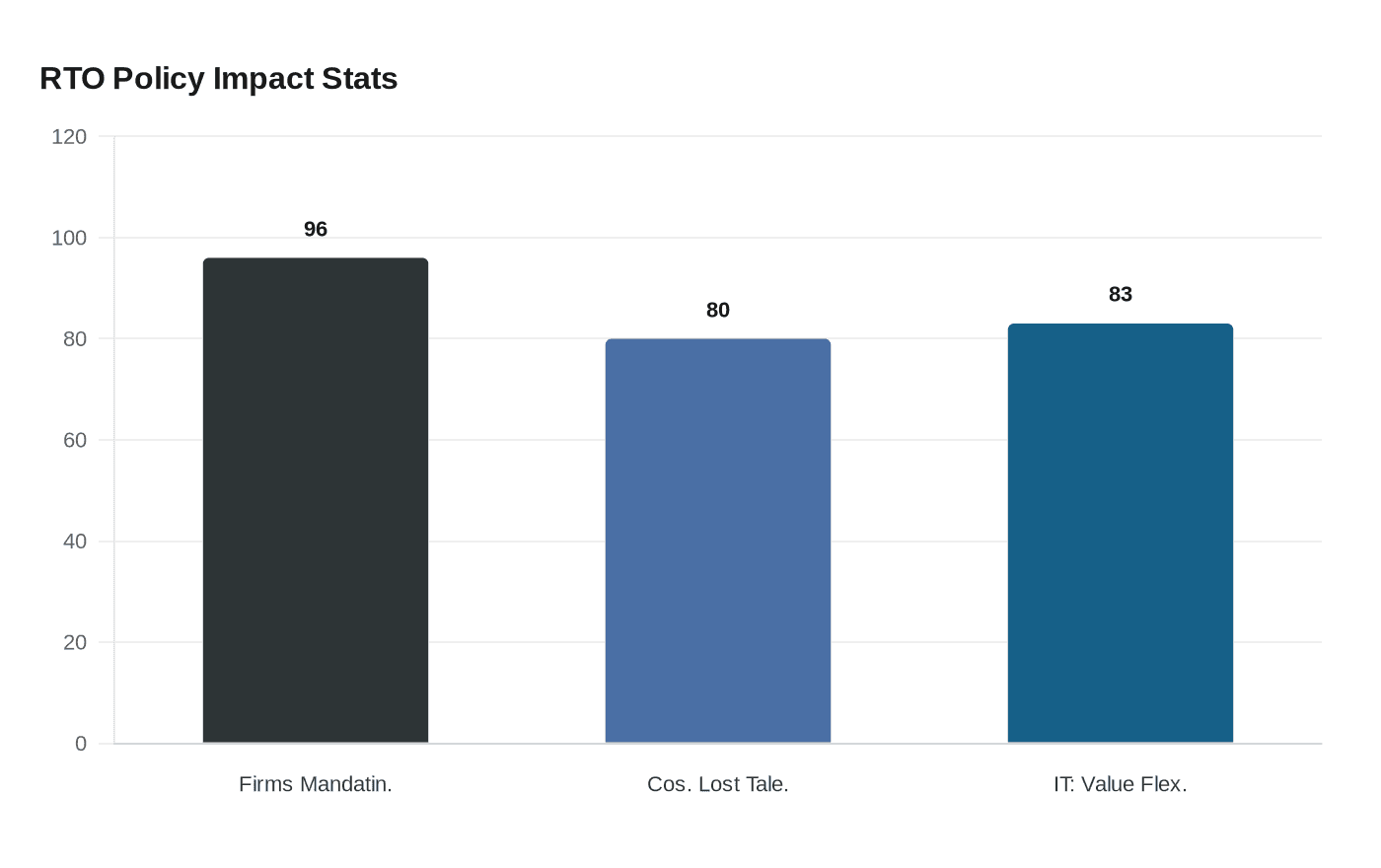
The broader market has split into two camps. On one side, companies like Amazon and several major financial institutions have imposed full in-office mandates, with 96 percent of firms now mandating or encouraging some form of return. On the other, the data on outcomes keeps cutting against rigidity: firms enforcing rigid return-to-office mandates experience 13 to 14 percent higher turnover. Eight in 10 companies admitted they lost talent due to RTO mandates, and 83 percent of IT workers say flexible work arrangements are either "high value" or "essential." The dominant model that has emerged from this shakeout is the 2-to-3-day hybrid week, with the 3-2 structure (Tuesday through Thursday in-office) now the most common structured arrangement globally, according to Gallup's 2025 State of the Global Workplace report.
Monday.com sits in the more defensible camp. Its public careers and investor materials signal a flexible model built around regional hubs, with global hiring that distributes talent across geographies rather than concentrating headcount in one mandate-able office. That design gives managers real latitude; it also means the company's stated flexibility only converts into a talent advantage if the policy is explicit enough for employees to rely on when evaluating competing offers.
Role-Based Expectations: The Foundation That Prevents Favoritism
The most consequential hybrid policy decision is not how many days per week, but which activities require physical co-location and which are genuinely remote-compatible. Ambiguity on this question is where implicit bias enters: if "in-office days" are never defined by purpose, they default to visibility contests that disadvantage remote employees and eventually drive them out.
Effective hybrid design at monday.com means specifying the categories of work that warrant in-person presence. Onboarding sprints for new hires, sensitive enterprise client meetings, dedicated hack weeks, and cross-functional discovery workshops are the clearest candidates. Asynchronous product work, documentation cycles, code reviews on established codebases, and most pipeline reviews do not require a desk. Writing that distinction into team-level working agreements, and pinning it in a monday.com board, is not bureaucracy; it is the mechanism that makes the policy enforceable and legible to a new hire comparing offers.
Making Mentorship the Reason to Come In
One of the most consistent findings across 2025 and 2026 workplace research is that younger employees are not resisting the office in principle; they are resisting the office when it offers nothing a home setup does not. The thing the office actually does better, according to Built In's 2026 reporting on return-to-office dynamics, is mentorship and career development: pairing with senior engineers, impromptu design critiques, and the kind of longitudinal relationship-building that accelerates early careers.

Monday.com managers who want office days to generate genuine ROI should structure them around these activities explicitly. Junior engineers benefit from in-person code-review sessions and pair-programming blocks that are harder to replicate asynchronously. Junior PMs benefit from sitting in on enterprise sales calls and seeing how discovery workshops are actually run. If an office day is essentially a series of video calls conducted from an open-plan desk, no one will treat it as a pull factor for talent, and the retention benefit disappears. The specific programming matters: designate office days for pairing, design critiques, and career-development workshops, and communicate that designation clearly in team calendars and board items.
Async-First Tooling: Where Monday.com Has a Structural Advantage
The single biggest operational differentiator between hybrid teams that function well and hybrid teams that slowly fragment is documentation discipline. High-performing distributed teams do not just communicate more; they write better and they write earlier. Architecture decisions get recorded before implementation begins. API contracts are published to shared boards before the first downstream team has to ask. Test matrices are living documents, not someone's local notes.
Monday.com's Work OS gives distributed teams customizable boards, powerful automation, and a transparent workspace that is unusually well-suited to operationalizing this. The same boards, automations, and cross-board connections that product teams use to track launches can anchor async collaboration norms. Concretely, this means:
- Engineering teams should codify architecture decision records (ADRs) and API contracts as standardized board items with defined owners and review-by dates, using automations to notify downstream teams when specs are updated.
- Product squads should maintain a living launch checklist board with templated items for each phase, so distributed stakeholders can track progress without requiring a synchronous status call.
- Sales and CS teams should keep quota alignment, account plans, and pipeline reviews in shared boards accessible to remote reps, eliminating the information asymmetry that emerges when hub-based reps absorb hallway context that remote colleagues never receive.
Meeting norms require the same specificity. End-to-end agendas shared 24 hours in advance, decision logs published within the same board after each session, and defined asynchronous-review windows before any cross-functional decision is finalized are the mechanisms that prevent the office from becoming an informal decision-making venue that remote employees cannot access in real time. Codifying these as board automations, rather than relying on team memory, is what makes them stick across manager transitions and headcount changes.
The Equity Problem That Quietly Kills Retention
Remote employees in hybrid companies leave at higher rates not primarily because they miss the office but because they perceive, correctly or not, that proximity to decision-makers is a prerequisite for promotion. That perception becomes self-fulfilling when promotion data is not monitored by location. Research consistently shows that without explicit tracking, remote employees receive fewer high-visibility project assignments and advance more slowly, a pattern that disproportionately affects employees in time zones distant from the company's main hub.
Monday.com's global hiring footprint makes this particularly relevant. With engineers, PMs, and sales professionals distributed across Tel Aviv, New York, London, and beyond, the company has both the opportunity and the obligation to make promotion criteria transparent and to track outcomes across locations. Compensation bands should be visible to employees navigating career decisions. Exception processes, for cases where role requirements differ from stated norms, should be published and consistently applied. Managers who are personally in-hub should be aware of the visibility they create for co-located reports that remote reports do not automatically receive, and should compensate deliberately.
Role-Specific Operating Norms
The gap between a hybrid policy that reads well and one that actually works at the team level closes when each function has specific, actionable norms rather than generic guidance.
For engineers, the highest-leverage habit is documentation-first development. Publishing architecture decisions, API contracts, and test matrices before and during implementation, rather than after, means remote colleagues can onboard and contribute without synchronous catch-up sessions. When in-office sprints are scheduled, the agenda should be weighted toward complex cross-team alignment problems and pairing on architecturally significant work, not routine standups that work perfectly well asynchronously.
For product managers, the office cadence should map to the product development cycle. In-person onboarding for new squad members at the start of each cycle, discovery workshops at the problem-framing stage, and cross-functional breakouts during prioritization are the moments where physical co-presence adds the most. Weekly async summaries for stakeholders who are not co-located preserve context for the distributed majority of contributors and reduce the meeting load for everyone.
For sales and customer success, office weeks should align with enterprise customer events, negotiation cycles, and account-planning sessions, not arbitrary calendar conventions. High-touch customer rehearsals and role-play preparation benefit from in-person intensity. Pipeline reviews and quota alignment, by contrast, should live in shared boards accessible to remote reps at any time, so the information advantage does not concentrate in whichever office happens to host a given week's leadership visit.
Hybrid Policy as a Product, Not a Decree
After the chaos of 2020-2021, the aggressive RTO mandates of 2022-2023, and the market correction of 2024-2025, the corporate world has converged on a remarkably consistent model. The companies genuinely winning the talent market are not the ones with the most generous policies on paper; they are the ones that treat hybrid arrangements as a feature to be iterated on. That means tracking engagement and retention by location, running regular feedback loops, and adjusting based on what the data shows rather than what leadership wishes were true. It means making the contract between company and employee explicit, measurable, and visible, not buried in an onboarding document no one re-reads.
For monday.com's engineers, product managers, and sales professionals, the practical implication is concrete: push your manager to write down the role-based norms, not just describe them verbally. Ask for the decision log from the last cross-functional meeting. Make the async handoff the default rather than the afterthought. The company's flexible model is a real advantage in the current labor market. Whether it stays that way depends entirely on the discipline with which teams actually run it.
This article was produced by Prism’s automated news system from verified source data, official records, and press releases, then run through automated quality and moderation checks before publishing. The system is built and supervised by the people who set the standards it runs under. Read our full AI policy.
Did this article answer your question?