Notion’s Claude upgrade raises pressure on monday.com AI reliability
Notion’s Claude Opus 4.7 upgrade is now a direct sales threat to monday.com, with fewer tokens, fewer tool errors and stronger workflow reliability.

Notion just turned an AI model bump into a competitive argument against monday.com. On April 16, Notion said Claude Opus 4.7 was now inside its product, with fewer tokens, three times fewer tool errors and more reliable handling of complex workflows. Anthropic says the model is 14% better than Opus 4.6 on complex multi-step work, while cutting tool errors to about a third of the previous level.
That matters because monday.com has spent the past year making AI a core part of its pitch, not a side feature. The buyer question is no longer whether a workspace app has AI; it is whether the AI can be trusted to sit inside real work, complete multi-step tasks and avoid breaking the workflow it is supposed to speed up. If Notion can claim better output at lower token usage, the pressure on monday.com is not just technical. It is commercial.
The pricing angle makes the challenge sharper. Anthropic kept Opus 4.7 at $5 per million input tokens and $25 per million output tokens, and said the model is available across Claude products, the API, Amazon Bedrock, Google Cloud Vertex AI and Microsoft Foundry. That makes the reliability message portable across the enterprise stack, not confined to one app. For monday.com engineers, that raises the bar on its own AI layer. For product managers, it means model quality is now part of the product story, not an internal implementation detail.
Notion has been building this case step by step. It introduced Claude Opus 4.6 in Notion on February 9, then launched Custom Agents on February 24, added custom skills for Notion AI on March 20 and rolled out AI Autofill in databases powered by Custom Agents on April 14. Notion says Custom Agents are free to try through May 3, then move to Notion credits starting May 4. The cadence shows a clear strategy: stitch model upgrades, autonomous agents and database automation into one workflow narrative.
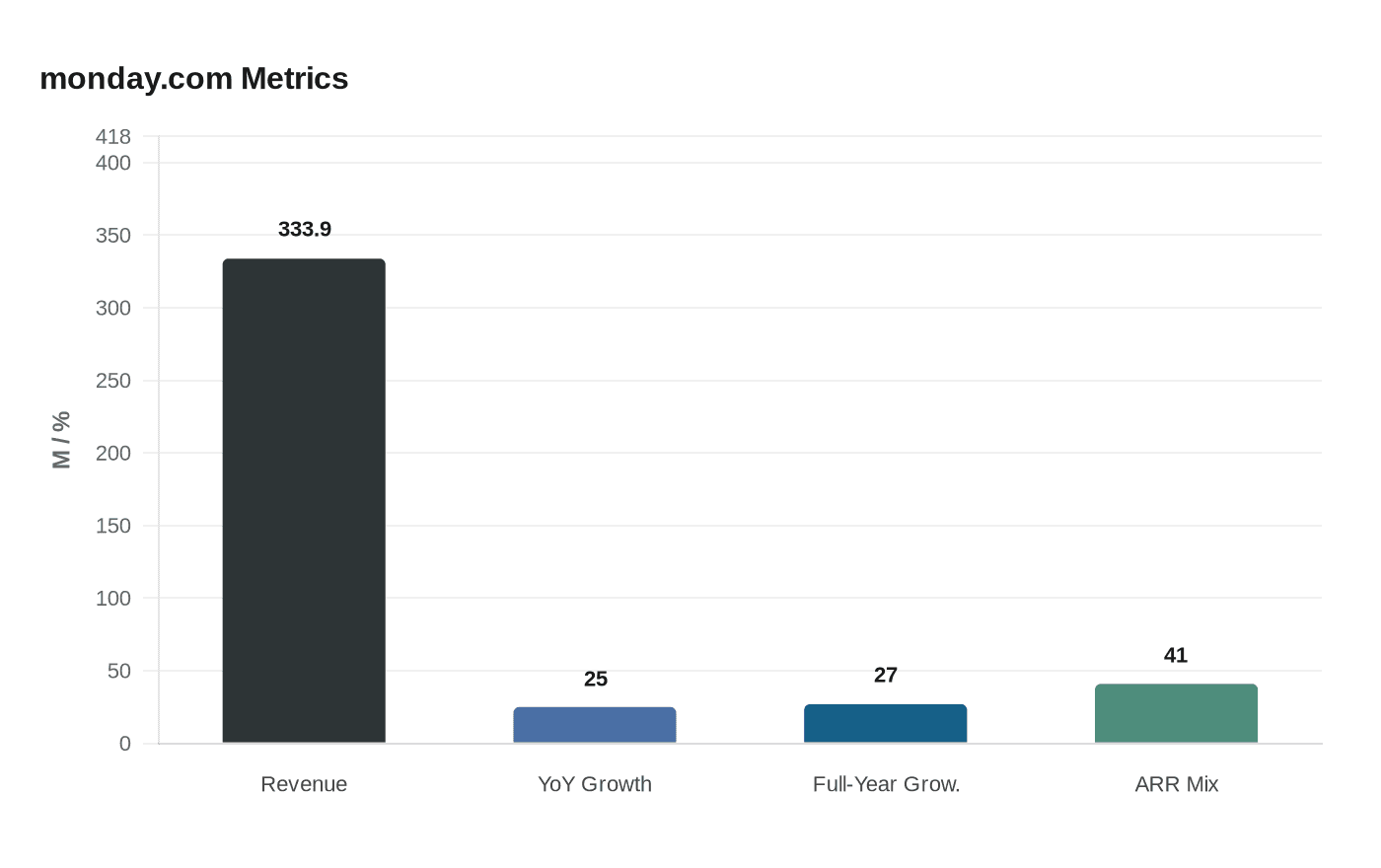
monday.com is not standing still. It introduced platform-wide AI features including monday magic, monday vibe and monday sidekick on July 10, 2025. In its fourth-quarter 2025 results, monday.com reported revenue of $333.9 million, up 25% year over year, and full-year revenue growth of 27%. It also said monday vibe became the fastest product in company history to pass $1 million in annual recurring revenue, and that customers with more than $50,000 in ARR made up 41% of total ARR. On March 23, monday.com said it welcomed AI agents to its platform and built dedicated infrastructure for external agents.
For monday.com, the takeaway is blunt: Notion is no longer arguing that it has AI. It is arguing that its AI is dependable enough to run the workflow. In enterprise software, that is the difference between a feature demo and a purchasing decision.
Know something we missed? Have a correction or additional information?
Submit a Tip