Oracle cuts workforce 13 percent as AI drives restructuring
Oracle’s workforce fell to 141,000 as AI and restructuring drove $1.84 billion in charges, a sign that automation is now reshaping org charts, not just products.
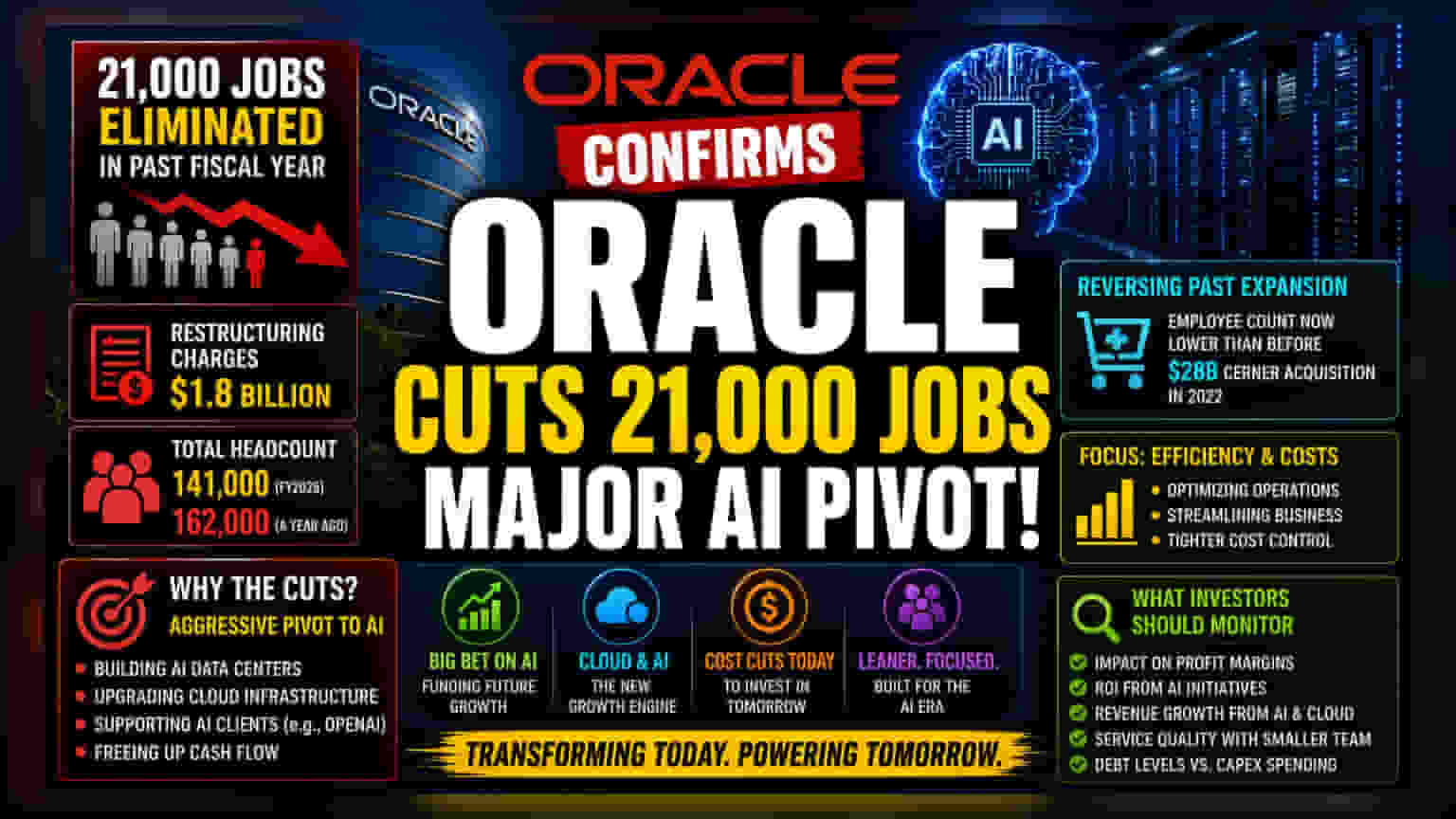
Oracle’s AI story is no longer just about faster software or smarter customer demos. It is showing up in headcount, with the company’s workforce dropping 13 percent, or about 21,000 employees, to 141,000 as of May 31, 2026, from roughly 162,000 a year earlier.
The cut came with a steep price. Oracle recorded about $1.84 billion in restructuring charges in fiscal 2026, up from $374 million in the prior fiscal year, underscoring how expensive the company’s reorganization became as it pushed ahead with AI adoption across operations.
Oracle said the workforce changes were not driven by AI alone. Its filing pointed to management and product changes, performance issues, strategic shifts and acquisitions as additional reasons for the adjustments. The company also said the adoption and deployment of AI technologies across its operations had resulted, and may continue to result, in reductions to its workforce.
That distinction matters for workers inside monday.com’s product, engineering and sales teams. The signal from Oracle is not simply that AI can lift productivity. It is that enterprise software companies are using AI as a lever for staffing, budget discipline and restructuring, while asking fewer people to carry more work. Oracle said the changes can be disruptive and can reduce productivity, a reminder that automation often arrives with friction before it delivers savings.
For monday.com, which has leaned hard into its own AI narrative, the competitive pressure is already visible. The company announced a Digital Workforce of AI agents in 2025, said in July 2025 that it was making a platform-wide AI shift, and said in its first-quarter 2026 results that it had launched an AI work platform with native agents. monday.com also said monday vibe was the fastest product to pass $1 million in annual recurring revenue in company history.
That positioning gives monday.com an opportunity, but it also raises the bar. Buyers increasingly want software that saves labor, not just software that adds features. More than 250,000 customers worldwide already use monday.com’s platform, and those customers are likely to expect AI to cut repetitive work across support, operations and project execution without draining quality or morale.
Oracle’s numbers show where the market is heading. AI is becoming a budgeting decision as much as a product feature, and for cloud software companies, the next question is no longer whether to automate, but which jobs disappear, which get consolidated and which teams are asked to do more with less.
This article was produced by Prism’s automated news system from verified source data, official records, and press releases, then run through automated quality and moderation checks before publishing. The system is built and supervised by the people who set the standards it runs under. Read our full AI policy.
Know something we missed? Have a correction or additional information?
Submit a Tip