Why monday.com teams need better customer questions
Sharper customer questions keep monday.com from building the wrong thing. The payoff is faster workflow fixes, cleaner prioritization, and AI features that match how teams actually work.
The hidden product skill that changes what gets built
The fastest way to waste time at a scaling SaaS company is to trust the dashboard before you understand the workflow. At monday.com, that matters because the platform is built to adapt to many different team types, not to force one rigid process on everyone. Better customer questions are not a soft skill here. They are an operating skill that decides whether a feature removes friction, whether a sale is real, and whether a design problem gets fixed before it shows up in the numbers.

That is the common thread running through customer interview advice from Atlassian, the management lens in Harvard Business Review, and monday.com’s own product direction. Strong discovery does three things at once: it sharpens roadmap decisions, reduces rework, and helps PMs, designers, and customer-facing engineers surface blockers earlier. Weak discovery does the opposite. It produces demos that look persuasive, features that do not change behavior, and internal confidence that arrives long before customer value does.
Start with the workflow, not the likeability test
The first question shift is simple: stop asking whether customers like a feature and start asking what work it changes. A feature can look clean in a dashboard and still fail to reduce any real friction. For monday.com teams, especially PMs, that means interviews should test whether a board, automation, or AI-generated workflow actually saves steps, clarifies ownership, or removes status-chasing.
This is where quantitative data only gives half the picture. Atlassian’s guidance on customer interviews pushes teams to share and analyze interviews regularly, because the point is not just validation. It is learning what a metric cannot tell you: where the user hesitates, where the handoff breaks, and where a workflow feels heavier than the team admitted in the first meeting. On a product that promises easy adoption and flexibility, that difference matters more than a polished feature tour.
Ask what the request is hiding
The second shift is for sales engineers and anyone handling discovery calls. When a customer asks for a demo, the weak response is to show the requested screens and move on. The stronger response is to ask what business process sits behind the request. That is how you find out whether a buyer wants a reporting view, a handoff mechanism, a compliance trail, or just relief from a broken spreadsheet.
That approach matches the broader management logic Harvard Business Review highlights in smarter-question research: probing questions uncover hidden risks, improve learning, and strengthen performance in uncertain environments. At monday.com, the question is not just what the customer says they want. It is what they are trying to stop doing every day. If the team cannot name that, the demo can still win attention while missing the real job.
Look for patterns across roles, not just loud anecdotes
The third shift is to stop treating customer feedback as isolated stories and start reading for repeated patterns across functions. A single complaint can be noisy. A pattern across product, design, marketing, and support is usually a roadmap signal. That is especially relevant in a company like monday.com, where customer-facing teams often see the breakage before product teams see the trend line.
Harvard Business Review’s work on asking smarter questions is useful here too: the goal is not to collect more opinions, but to improve learning in uncertainty. In practice, that means design and research teams should be translating qualitative notes into recurring blockers, while PMs decide whether those blockers point to onboarding, customization, automation, or permissions. The fastest teams do not force interview notes to compete with data. They let each one explain the other.
Use interviews to catch the problem before the metric does
The fourth shift is especially important when a SaaS company starts to trust its scale too much. monday.com said fiscal 2025 revenue reached $1.232 billion, up 27% year over year, and that customers with more than $50,000 in ARR represented 41% of total ARR. Those are strong numbers, but they can also tempt teams into assuming the product problem is already well understood. That is exactly when discovery discipline matters most.
There is a practical reason for that. Once a platform has more than 250,000 customers worldwide, the cost of a misunderstanding multiplies across use cases, team sizes, and implementation styles. A small interview miss can become a large product miss if it rolls into a feature, then into a launch, then into customer support. Better questions catch the mismatch while it is still qualitative: why a journey is failing, what part of the process feels manual, and which step is slowing the team down.
AI raises the bar on discovery, not the other way around
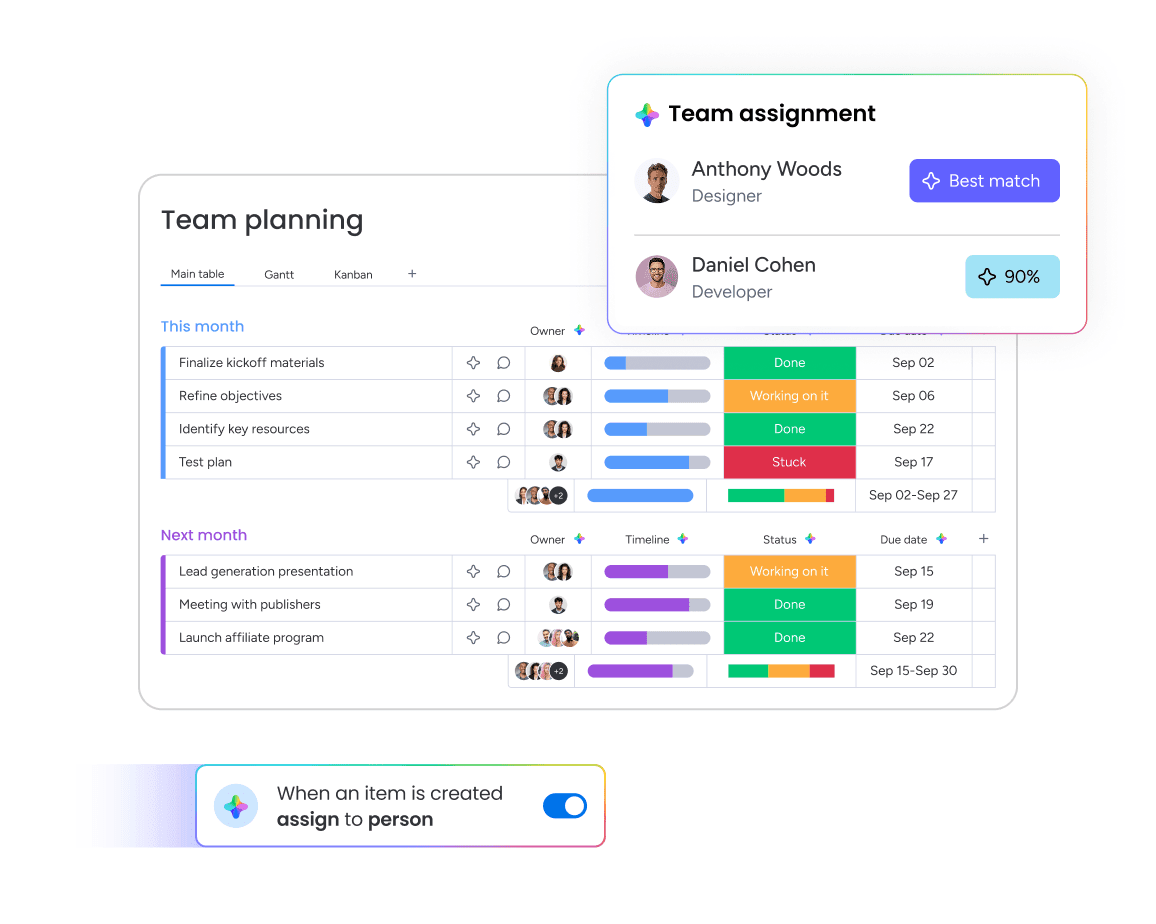
The fifth shift is the one monday.com teams cannot ignore right now. On July 10, 2025, monday.com said its AI capabilities were built in response to real customer needs. It also said monday magic can generate a complete workflow or board from a single plain-language prompt, and monday vibe lets customers build secure custom business apps without writing code. That sounds like a speed story, but it is really a discovery story.
If customers can describe what they need in one prompt, the burden on the team shifts upstream. PMs and designers have to know what users mean when they say they want a workflow, an app, or a faster way to execute work. The better the questions, the better the prompt, the better the generated output. In an AI-first product motion, vague discovery does not just create a bad interview. It creates the wrong software.
The customer stories show what good questions can save
The clearest proof is in the customer stories monday.com tells about its own platform. Entrepreneur’s team had been using Google Sheets for sales pipeline tracking and found it labor-intensive and error-prone. After adopting monday.com, the company said implementation across teams took one week, leadership saved 11 hours per month, and overall digital sales rose 23%. Those numbers matter because they show what a good workflow fit looks like: less manual cleanup, faster adoption, and measurable commercial gain.
McDonald’s tells a similar story from a different scale. monday.com says interconnected boards, timeline tracking, and automations gave marketing, operations, and logistics a shared source of truth. That is not a cosmetic benefit. It cuts down on constant email follow-ups and turns scattered coordination into a visible operating system. For teams inside monday.com, the lesson is blunt: if an interview does not uncover the actual handoff problem, the build may end up polishing the wrong surface.
CRM is the clearest example of the cost of asking badly
monday.com’s own CRM history makes the point even harder to miss. In August 2025, monday CRM crossed $100 million in ARR. The product was built because sales teams were tired of rigid, complex CRMs that felt like punishment instead of productivity tools. monday.com said customers valued setup measured in hours rather than months and workflows they could customize without IT.
That is what better questions are for. Not trivia. Not politeness. Not a script. The right question reveals where software is getting in the way, where process has become pain, and where flexibility is actually worth paying for. On a platform built around work execution, the teams that ask best will keep shipping closer to how work really happens, not how a dashboard makes it look.
This article was produced by Prism’s automated news system from verified source data, official records, and press releases, then run through automated quality and moderation checks before publishing. The system is built and supervised by the people who set the standards it runs under. Read our full AI policy.
Know something we missed? Have a correction or additional information?
Submit a Tip