Nintendo Fiscal-Year Sales Nearly Double as Switch 2 Drives Growth
Nintendo's sales nearly doubled as Switch 2 demand, digital sales, and services pushed the company deeper into platform business. The hottest internal work now sits in ecommerce, live-ops, localization, and publishing.
Nintendo’s latest year made one thing clear for employees in Kyoto and around the world: the company’s growth is no longer driven by hardware alone. Net sales jumped 98.6% to 2,313.0 billion yen, operating profit rose to 360.1 billion yen, and net profit reached 424.0 billion yen as Switch 2 sales, a higher unit price, and a stronger digital mix reshaped where the business is expanding and where careers are most likely to grow.
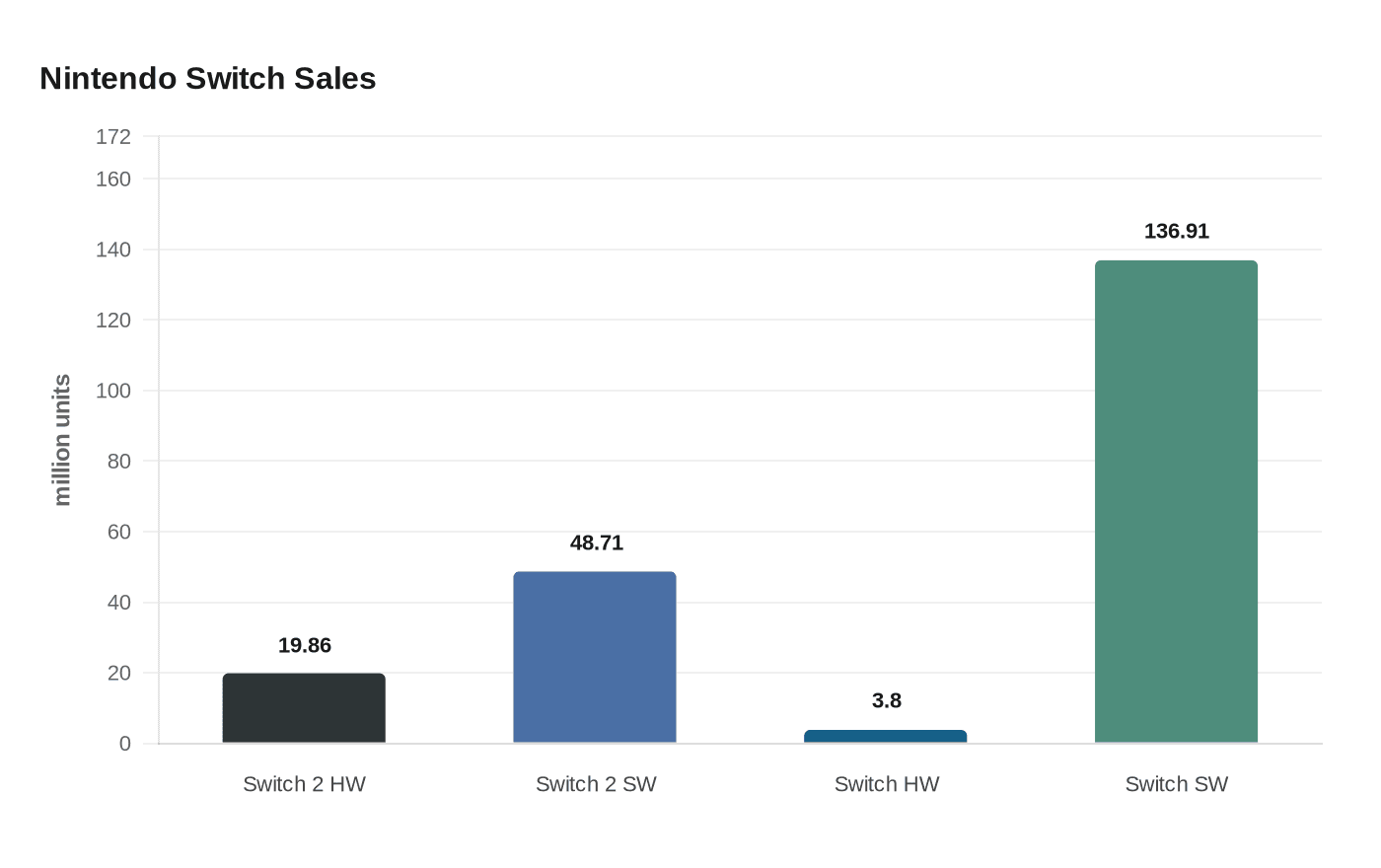
The dedicated video game platform business, which includes hardware, software, add-on content, and Nintendo Switch Online, generated 2,239.5 billion yen in fiscal 2026, the year ended March 31, 2026. Nintendo sold 19.86 million Switch 2 hardware units and 48.71 million software units in the year, while the original Nintendo Switch still added 3.80 million hardware units and 136.91 million software units. That combination tells developers, producers, and QA teams where the pressure sits now: platform performance, software attach, and service reliability matter as much as launch hardware. The company said the higher individual unit price of Switch 2 also helped lift sales, which means product, finance, merchandising, and regional operations are all tied more tightly to every console sold.
Digital is becoming a bigger part of that picture. Nintendo reported 407.6 billion yen in digital sales, and digital sales made up 54.6% of total dedicated-platform software sales. For internal teams, that shifts the center of gravity toward ecommerce, downloadable content, online memberships, localization, and the live-ops work that keeps players engaged after launch. It also raises the importance of regional coordination, since 76.9% of sales came from outside Japan. As the business stretches across more language versions, storefronts, and service layers, quality control is no longer just about the game build itself. It extends to timing, store presentation, account systems, and the handoff between hardware and network services.
The scale of the old platform still matters too. Nintendo said the original Switch reached 155.92 million cumulative hardware units and 1,528.14 million cumulative software units worldwide by March 31, 2026, giving the new system an enormous installed-base transition to manage. In the first half of fiscal 2026 alone, Switch 2 had already sold 10.36 million hardware units and 20.62 million software units, showing that momentum was building well before the full-year close. One softer spot remains the IP-related business, which fell to 73.5 billion yen, down 9.7% year over year as revenue tied to The Super Mario Bros. Movie declined. Even so, the bigger story inside Nintendo is unmistakable: the company has become a more global, more recurring-revenue platform business, and the fastest-moving opportunities now sit where hardware, software, and services meet.
This article was produced by Prism’s automated news system from verified source data, official records, and press releases, then run through automated quality and moderation checks before publishing. The system is built and supervised by the people who set the standards it runs under. Read our full AI policy.
Did this article answer your question?