Nintendo sets May 8 earnings date, annual report highlights priorities
Nintendo has locked in a May 8 earnings release, while its annual report keeps flagging employees, R&D, facilities and capital investment as core priorities.
Nintendo has already put May 8 on the board, and for anyone inside the company that date works like a countdown clock. The investor-relations calendar lists the fiscal-year earnings release for the year ending March 2026 on Friday, May 8, 2026, with March 31, 2026 set as the record date for year-end dividends in Nintendo’s 86th fiscal year.
That schedule matters because Nintendo’s annual report is built less like a glossy brochure and more like a management map. The FY2025 report, for the fiscal year ended March 31, 2025, sits alongside FY2024 and FY2023 in the company’s archive, and Nintendo says the document is based on its annual securities report prepared under Japan’s Financial Instruments and Exchange Act. In other words, this is the company’s formal way of showing what it considers important, not just what it wants outside readers to admire.
The table of contents makes that plain. Along with financial results, it includes history, subsidiaries and associates, employees, management policy, sustainability, risk factors, research and development activities, capital investments, and major facilities. That spread tells workers and applicants that Nintendo still presents itself as a long-cycle business where the people side of the house, the hardware pipeline, software development, and operational footprint are all part of the same conversation. In a company known for quality-first execution, those headings are as revealing as any earnings headline.
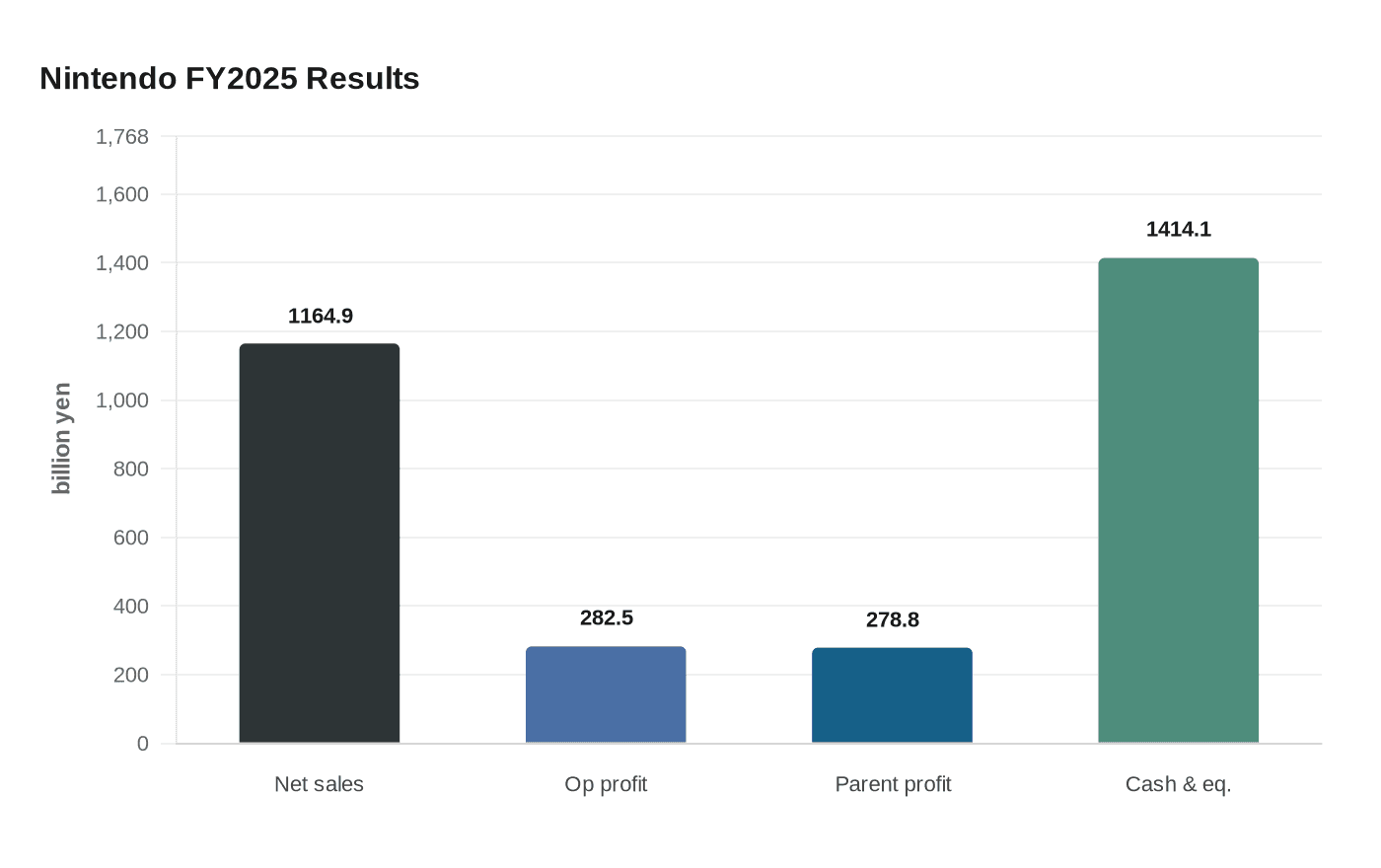
The numbers reinforce that point. Nintendo said it had 8,205 consolidated employees as of March 31, 2025, and it reported FY2025 net sales of 1,164.9 billion yen, operating profit of 282.5 billion yen, and profit attributable to owners of parent of 278.8 billion yen. Cash and cash equivalents stood at 1,414.1 billion yen, up 560.6 billion yen from the prior year. For business teams, those figures are not just finance milestones. They help explain why certain projects, regions, or platform bets may gain weight in internal planning discussions.
Nintendo also says dividends are paid twice a year, after the second quarter and at fiscal year-end, based on profit levels in each fiscal year. That makes the IR calendar more than a disclosure tool. It is a practical planning cue for producers, developers, localization staff, QA leaders, and corporate teams trying to read where management is headed next. The annual report shows what happened, the results materials show how leadership interprets it, and the calendar shows when the next decision point will arrive.
This article was produced by Prism’s automated news system from verified source data, official records, and press releases, then run through automated quality and moderation checks before publishing. The system is built and supervised by the people who set the standards it runs under. Read our full AI policy.
Did this article answer your question?