New tax break for tips and reporting changes: what the April 6 Conversation explainer means for Pizza Hut drivers and tipped staff
Miss logging this week's cash tips and you could lose more than $3,000 in federal deductions. Here's what Pizza Hut drivers need to do now under the new tip tax break.
A Pizza Hut delivery driver pulling in $275 a week in cash and app tips, working 30 hours at a base rate of $10 an hour, clears roughly $14,300 in tip income over the course of a year. Under the federal tax package signed in 2025, that same driver could deduct all of it from their federal taxable income, potentially cutting their tax bill by more than $3,000. At the full $25,000 deduction cap, a worker in the 24% bracket saves roughly $6,000 at filing. Not one dollar of that is automatic, and at least five things have to happen before any of it shows up.
A tax professor's explainer published by The Conversation on April 6 translated the new "no tax on tips" law into paycheck language for tipped workers and gig drivers. The implications run directly through Pizza Hut's delivery routes, dine-in floors, and franchise payroll offices.
What the break actually is
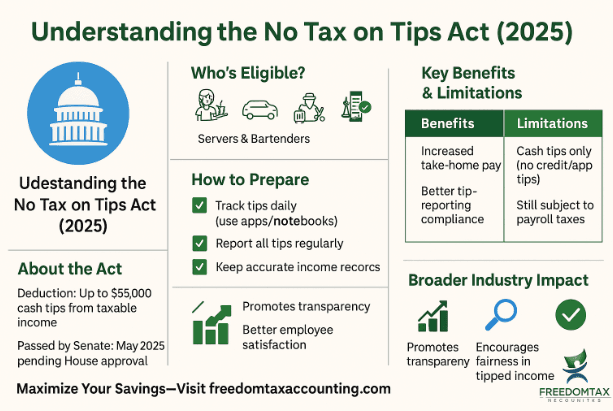
The new deduction is filed on Schedule 1-A, attached to a standard Form 1040. It allows eligible tipped workers to subtract up to $25,000 in qualified tip income from their federal taxable income for tax years 2025 through 2028. The phase-out begins at $150,000 in modified adjusted gross income, or $300,000 for joint filers, a ceiling most hourly delivery drivers and servers won't approach.
Eligibility is occupation-based. The IRS published guidance in September 2025 identifying nearly 70 qualifying occupations, covering food service workers whose roles customarily and regularly received tips on or before December 31, 2024. Delivery drivers and restaurant servers fall squarely within that list. One category that doesn't: mandatory service charges or automatic gratuities added to large party orders. Those flow through payroll as regular wages, not tips, and do not count toward the $25,000 deduction. If your location adds a 20% automatic gratuity to big orders, that money is taxed like a salary, full stop.
The concrete math: one week, one driver
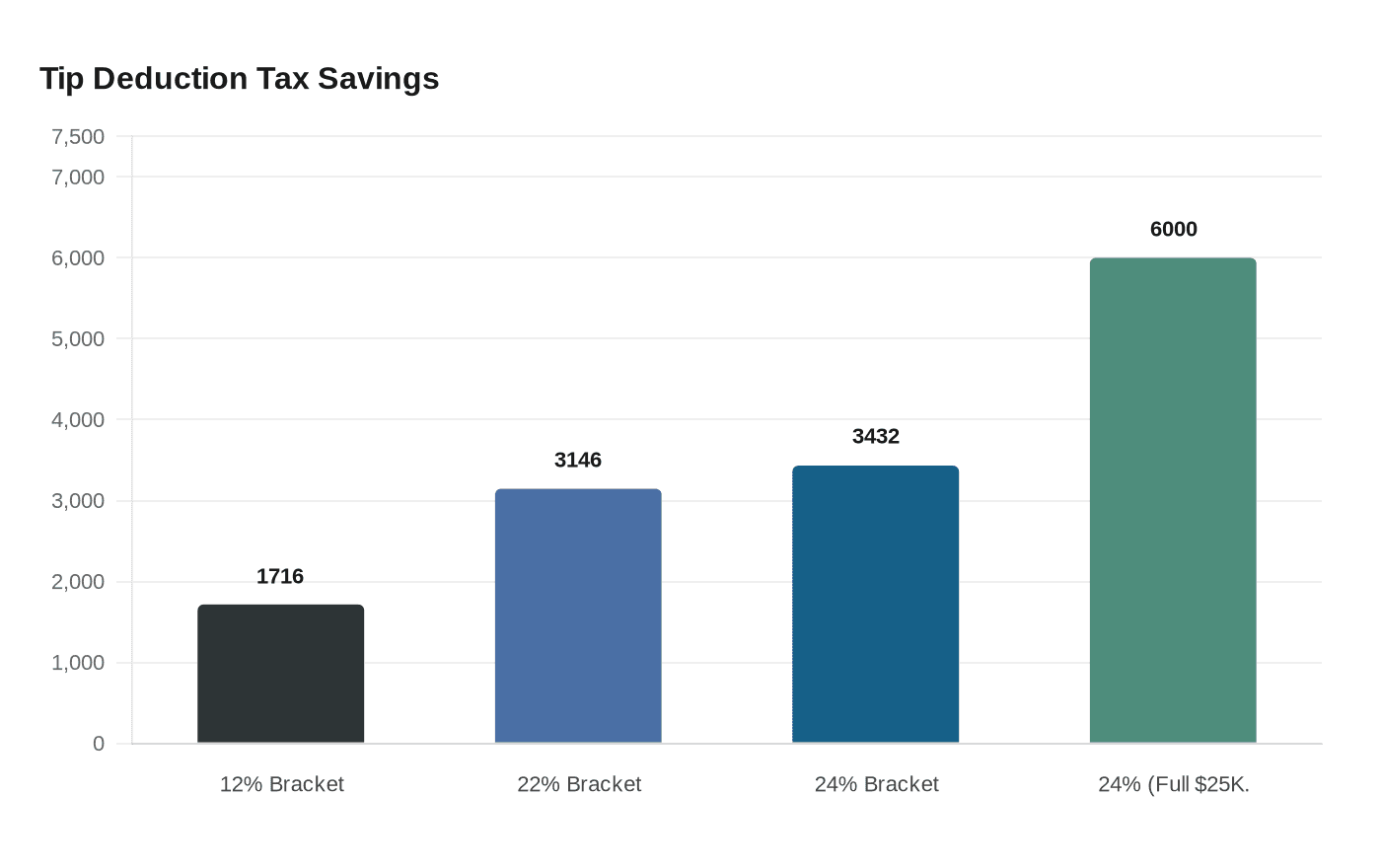
Take that 30-hour driver again. The week's gross: $300 in wages, $275 in mixed cash and app tips, totaling $575. Across 52 weeks at a similar tip rate, the annual tip total lands around $14,300. In the 22% bracket, eliminating $14,300 from taxable income saves approximately $3,146 at filing. In the 24% bracket, the same tip income yields $3,432 back. Even a driver in the 12% bracket sees a real number: around $1,716. For the rare driver whose tips hit the full $25,000 cap, the 24% bracket delivers that $6,000 headline savings figure.
None of this reduction touches Social Security or Medicare taxes. Tips are still fully subject to FICA. The deduction applies only to federal income tax liability.
The scenario that should make you stop and read this twice
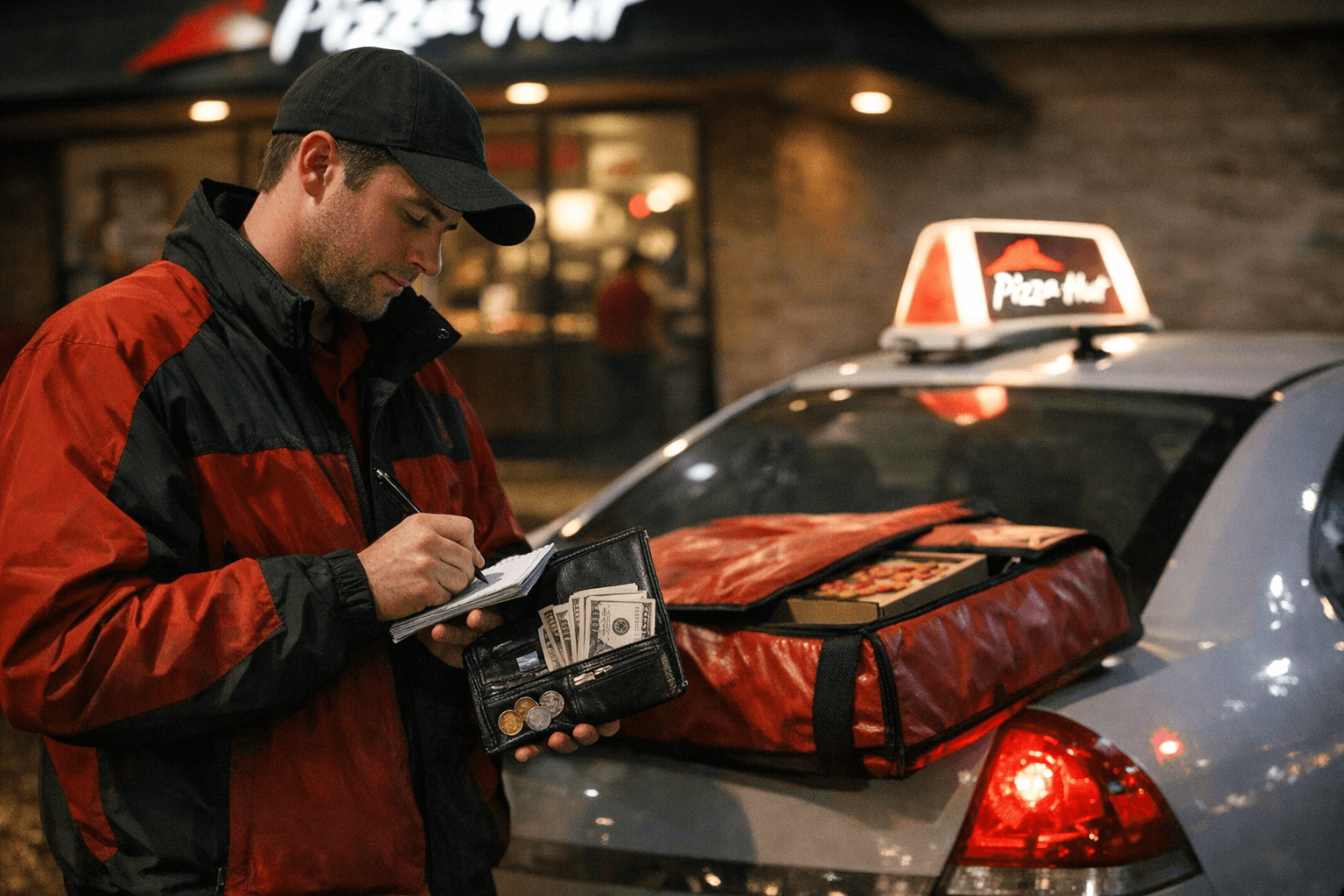
Self-employed workers like rideshare and delivery app drivers must report tip income on Schedule C and pay self-employment tax, which covers Social Security and Medicare tax. A driver who splits shifts between an in-store Pizza Hut schedule and gig platforms like DoorDash or Uber Eats is dealing with two separate income streams on two separate tax documents. App-based tips arrive on a 1099. Cash tips handed at the door at the end of an in-store delivery are the worker's responsibility to track and report.
Here is the compounding risk: if a driver averages $100 a week in cash tips but never logs them, and their platform 1099 reports $8,000 in app tips, the IRS sees only half the picture. That underreported cash income can draw scrutiny, and the undocumented deduction is simply gone. Worse, a gig driver who assumes the tip deduction wipes out all tax on platform income and then skips quarterly estimated payments could walk into April owing both a self-employment tax balance and an underpayment penalty, because the deduction only cuts income tax, not FICA. Many gig workers will find that their state income tax bills mostly stay the same, because some states, such as California and Massachusetts, don't allow the deduction of this income from their taxable income. That means a driver in Los Angeles gets the federal break but pays California income tax on the full tip amount anyway.
Self-employed workers can also claim a deduction for the miles they drive for work, which rose from 70 cents per mile in 2025 to 72.5 cents in 2026. For gig-platform drivers especially, stacking the mileage deduction with the tip deduction is where the real savings compounds.
5 things to do before your next shift
1. Start a dated tip log today. Record every cash tip by date, delivery address, and amount.
A notes app, a notebook, or a spreadsheet all work. What the IRS cares about is a contemporaneous record, not a reconstruction from memory in March.
2. Save every platform pay statement. DoorDash and Uber Eats generate weekly earnings breakdowns with tip line items.
Although businesses are encouraged to provide information that will help their workers and contractors claim the 2025 tip deduction, the IRS announced that basic tip tracking and reporting requirements for business owners did not change for the 2025 tax year. However, there will be changes for the 2026 tax year. Don't wait for the forms to be standardized; archive what exists now.
3. Decide whether to update your W-4. Employers must use an employee's updated Form W-4 and the federal income tax withholding procedures to allow the employee to account for their expected deduction and receive more money in each paycheck instead of waiting until filing their income tax return to receive the full benefit of this deduction.
You may account for these deductions manually by using the deductions worksheet and inputting the result in Step 4(b) of the 2025 Form W-4, or by consulting a tax professional. Submitting a revised W-4 to your Pizza Hut payroll manager now means more money in each remaining paycheck rather than a lump refund next spring.
4. Know your tips from your service charges. Ask your manager explicitly how the store handles gratuity line items on receipts and whether any automatic gratuities run through payroll.
Only voluntary customer tips, cash at the door or an app-based amount the customer chose, qualify for the deduction.
5. Ask payroll about your 2026 W-2. For the 2026 tax year, businesses will have to separately report cash tips and provide a "Treasury tipped occupation code" on revised W-2 and certain 1099 forms.
That is a significant change from 2025's transitional rules, and knowing now means no surprises when the form arrives in early 2027.
What franchise managers need to do
The payroll implications here are practical and immediate. Franchise owners and payroll administrators need to cleanly separate voluntary tips from service charges in their reporting systems before the 2026 W-2 filing year arrives. Workers are going to ask questions, and a one-page internal guide summarizing who qualifies (delivery drivers, dine-in servers), what counts as a qualified tip, and how Schedule 1-A works can prevent a wave of confusion at filing time.
The benefit varies too much by bracket for blanket messaging. A driver in the 12% bracket saves less than half what a driver in the 24% bracket saves on identical tip income. Telling every employee they're getting a huge break without specifying the math sets up disappointment, particularly for newer workers still in lower brackets.
The deduction window runs through the 2028 tax year. Four years is enough time for good recordkeeping habits to pay off significantly, and also enough time for sloppy habits to compound into real problems. The drivers who start logging today and update their withholding now are the ones who will actually see that Schedule 1-A deduction convert into real money, rather than discovering at filing time that the records needed to claim it were never kept.
This article was produced by Prism’s automated news system from verified source data, official records, and press releases, then run through automated quality and moderation checks before publishing. The system is built and supervised by the people who set the standards it runs under. Read our full AI policy.
Did this article answer your question?