Pizza Hut Drivers Earn Pay From Wages, Tips, Fees, and Mileage
Most Pizza Hut customers assume the delivery fee tips the driver. It doesn't. Here's where driver pay actually comes from, and how to protect every dollar of it.
What Actually Goes Into a Pizza Hut Driver's Paycheck
Flip over a Pizza Hut receipt and you'll see a delivery fee listed before the tip line. Those are two separate things, and confusing them is the single most expensive mistake a driver can make when evaluating whether a shift was worth it. A Pizza Hut driver's total compensation is built from four distinct pieces: an hourly base wage, tips (cash and electronic), mileage reimbursement, and, in some markets, a per-delivery bonus. Because Pizza Hut operates as an overwhelmingly franchise-driven system, the exact mix of those four pieces is determined not by corporate headquarters but by the individual franchise operator running your store, bounded by state and local law.
The Base Hourly Wage: On the Road vs. Inside the Store
The starting point is an hourly rate, and the first thing drivers often discover is that the rate isn't always flat. Many franchise operators run a split pay structure: a lower hourly rate while the driver is on the road making deliveries, and a higher rate for time spent inside doing prep, dishes, or closing side work. According to driver accounts, one common structure pays around $7 per hour during delivery runs and $10 per hour for in-store time. ZipRecruiter data from March 2026 puts the average Pizza Hut delivery driver wage at roughly $15.54 per hour when tips and reimbursements are factored into an annualized figure of $32,314, but the base hourly component alone sits well below that number in most markets.
In states with a tipped minimum wage, the legal floor works differently. Employers can pay a reduced base wage as long as tips bring the driver's total hourly compensation up to the full state or federal minimum. If tips fall short in any given pay period, the employer is legally required to make up the difference. This is a critical distinction drivers should understand before signing on: a $5-per-hour base wage is legal in some jurisdictions, provided the tip math works out. When it doesn't, and the employer doesn't correct it, that's a wage violation.
Delivery Fees: The Number That Looks Like Driver Pay But Isn't
Customers regularly assume the $3 to $5 delivery fee on their order goes straight to the person who rang their doorbell. In the vast majority of Pizza Hut franchise operations, it does not. The delivery fee is retained by the company or the franchise operator to offset overhead: fuel subsidies, insurance, labor scheduling costs, and platform fees. Drivers are explicitly prohibited at many locations from telling customers that the delivery charge doesn't go to them, which means the misunderstanding compounds with every order.
The practical result: a customer who pays a $4 delivery fee and leaves a $1 tip, feeling they've already compensated the driver generously, has effectively contributed nothing to the driver's variable income. The delivery fee and the tip occupy completely different boxes in the accounting ledger.
Tips: The Biggest Variable in the Shift
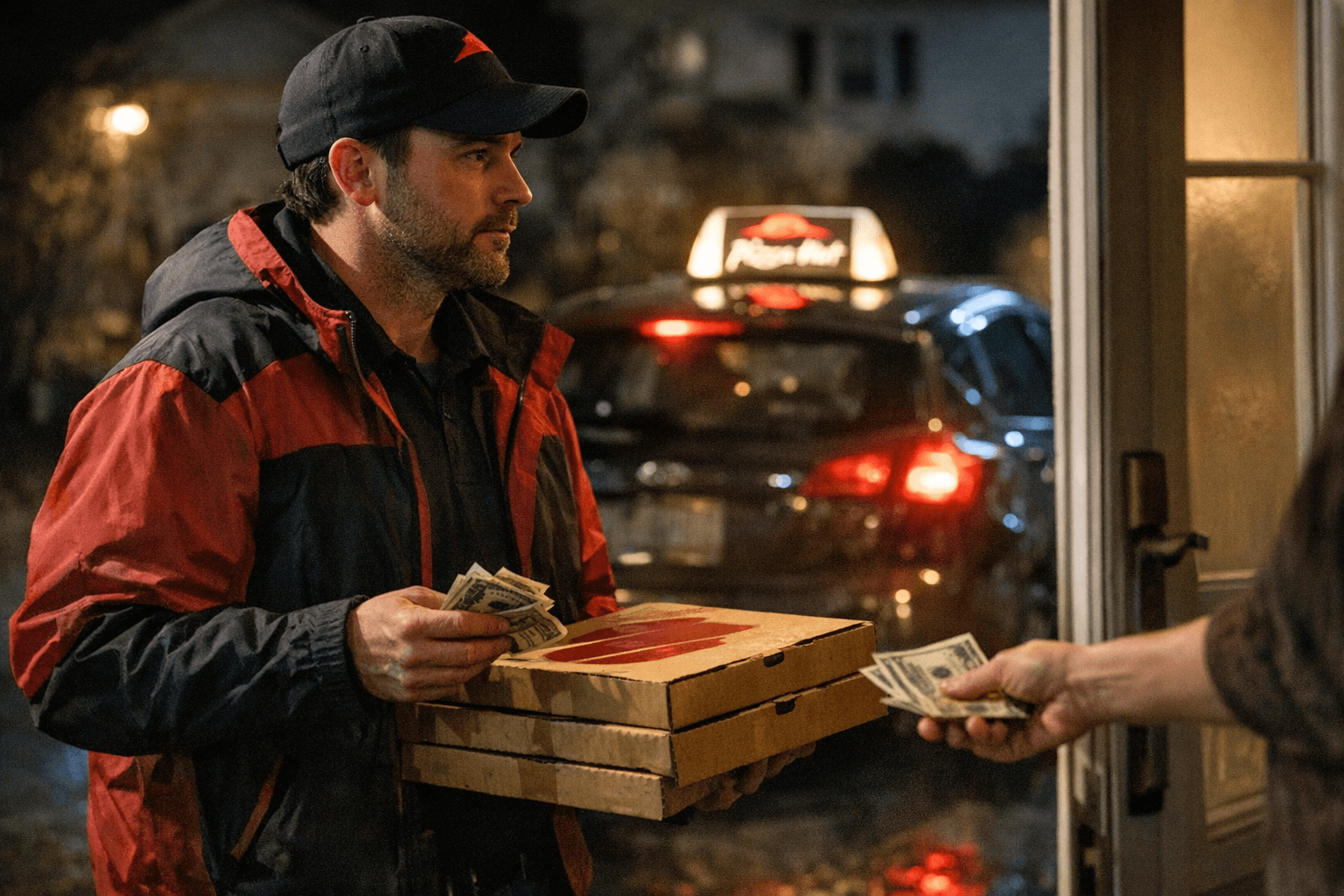
Cash and electronic tips are typically the single largest swing factor in what a driver actually takes home above their base wage. Cash tips are straightforward: the driver receives them at the door and keeps them immediately. Card tips and in-app tips routed through the Pizza Hut ordering platform or third-party apps like DoorDash or Uber Eats introduce timing and policy complications that vary by store and by platform.
For drivers working DoorDash or Uber Eats fulfillment on behalf of Pizza Hut, the tip-forwarding timeline and whether full tip amounts pass through are governed by each platform's specific policies, which differ from Pizza Hut's own in-house ordering flow. The standard customer guidance recommends tipping 15 to 20 percent of the food subtotal, with a floor of roughly $5 for a typical order, but there is no enforcement mechanism. Drivers in markets with heavier competition from gig platforms report that tip averages have drifted downward as customers become accustomed to smaller, app-prompted suggestions.
The IRS now treats tips as taxable income, and drivers are responsible for reporting cash tips accurately. Keeping a contemporaneous tip log, noting the date, amount, and whether each tip was cash or card, is not just good recordkeeping practice; it's the primary protection against discrepancies in pay stubs and the only defensible document in a payroll dispute.
Mileage Reimbursement: What the IRS Sets vs. What Franchises Pay
Because Pizza Hut drivers use their own personal vehicles, the mileage reimbursement component is supposed to offset fuel, insurance, and wear-and-tear costs. The IRS set the 2026 standard business mileage rate at 72.5 cents per mile, up 2.5 cents from the 2025 rate of 70 cents. At 15,000 business miles in a year, that 2.5-cent increase translates to an additional $375 in deductible driving costs.
The problem is that franchise reimbursement rates often run well below the IRS benchmark. Driver accounts cite per-mile rates in the range of 35 cents per mile, meaning a driver running 30 miles of deliveries in a shift might receive $10.50 in reimbursement against true vehicle costs that could approach $21 at the IRS rate. That $10.50 gap per shift, compounded over a full year, represents a meaningful reduction in effective hourly compensation that doesn't appear anywhere on a pay stub. Franchise owners are not legally required to match the IRS standard mileage rate, but when reimbursement consistently runs below actual cost, drivers are effectively subsidizing their employer's delivery operation with their own car.
Split Rates, Gig Competition, and the Real Effective Hourly Rate
The proliferation of third-party delivery apps has added a new layer of complexity to the split-rate question. A driver might spend part of a shift handling in-house Pizza Hut orders and part of the same shift appearing on a DoorDash or Uber Eats queue. Tracking which pay rate and which tip structure applies to each segment of that shift requires attention that most drivers don't have time for in the middle of a Friday rush.
Meanwhile, DoorDash and Uber Eats have raised the baseline expectation for drivers in the gig economy, creating pressure on Pizza Hut franchise operators in competitive urban markets to offer more competitive per-delivery pay or clearer tip policies. Drivers who understand the full compensation breakdown are in a better position to compare offers and identify whether a particular franchise's structure is paying a true living wage once vehicle costs are netted out.
How to Reconcile a Pay Stub and a Nightly Cash-Out
The best defense against pay errors is documentation collected in real time, not reconstructed after the fact. Here is a practical end-of-shift checklist for both drivers and managers:
- Record odometer readings at the start and end of each delivery run, not just the start and end of the shift
- Note every tip received, the amount, and whether it was cash or card
- Compare your punch-in/punch-out time to any app-logged time if you work both in-house and third-party orders
- Check that your mileage reimbursement on the pay stub reflects actual miles driven, not a flat per-delivery estimate that may undercount longer routes
- Confirm that card tips forwarded to your paycheck match what was authorized by customers
Driver checklist:
- Post the store's mileage rate and tip-handling policy visibly in the back office and cover it at new-hire orientation
- Verify that payroll accurately reflects tip reports for each driver before payroll closes
- Ensure drivers understand when and how to report cash tips for withholding purposes
- Review the per-mile reimbursement rate annually and benchmark it against the current IRS standard, particularly during fuel price spikes
Manager checklist:
For franchise operators, the practical recommendation is to index mileage reimbursement to a recognized benchmark and update it at least once a year. A driver who is losing money on vehicle costs during a fuel spike is a driver who is going to start watching DoorDash sign-up bonuses more carefully. In a labor market where gig platforms can onboard a new driver in under 48 hours, retention is directly tied to whether drivers trust that their full compensation structure is transparent and fair.
The four components of a Pizza Hut driver's pay, base wage, tips, delivery reimbursement, and mileage, each operate under different rules, and the gap between what a customer thinks they're paying and what the driver actually receives is wider than most people on either side of the transaction realize. Drivers who understand the mechanics don't just protect their own earnings; they become the employees most likely to catch payroll errors before they compound into larger disputes.
This article was produced by Prism’s automated news system from verified source data, official records, and press releases, then run through automated quality and moderation checks before publishing. The system is built and supervised by the people who set the standards it runs under. Read our full AI policy.
Did this article answer your question?