Pizza Hut Drivers: How to Track Pay, Tips, and Mileage
Most Pizza Hut drivers never calculate their true hourly rate after fuel and wear; a simple daily log can reveal whether a shift actually pays.
Fuel costs fluctuate. Tips vary by neighborhood. Franchise reimbursement policies differ from store to store, sometimes block to block. For Pizza Hut delivery drivers, the gap between what a shift looks like on paper and what it actually pays can be wide, and without careful recordkeeping, that gap is nearly impossible to close.
This guide is built for company-employed Pizza Hut drivers, kitchen crew who float into delivery roles, drivers who stack Pizza Hut shifts with gig apps like DoorDash or Uber Eats, and the store managers and franchise owners who set the policies everyone has to live under.
What You Need to Track, and Why
Most wage disputes at the store level don't start with dramatic misconduct. They start with fuzzy records: a driver who thinks they worked 38 hours documented as 35, a mileage reimbursement verbally promised but never confirmed in writing, cash tips that nobody logged. Good recordkeeping doesn't just protect you legally; it gives you the data to have a productive conversation with a manager about whether your compensation is actually working.
There are five core categories worth tracking on every shift.
Hours Worked
Clock in and clock out, every shift, without exception. If your store uses a digital time system, verify your punch records weekly; errors stack up. For drivers who work both in-house Pizza Hut shifts and third-party delivery apps in the same day, keep a separate daily log that reconciles app time and store time. Off-the-clock work disputes are among the most common wage claims in food service, and timestamped records are your first line of defense.
Mileage and Vehicle Costs
Every delivery trip should have its own entry: the date, starting and ending odometer readings, the purpose (delivery), total miles driven, and a brief note such as "3 orders, 12 miles." That level of detail takes under a minute per trip and becomes essential if a reimbursement dispute arises.
On the reimbursement rate itself: franchise owners may offer a flat per-mile rate, a structured reimbursement policy, or something ad hoc. You can also use the IRS standard mileage rate as a benchmark for what your vehicle costs are actually running you. Either way, get the policy in writing before your first shift, not after your first paycheck. If a manager verbally tells you "we cover gas," follow up with a text or email asking for confirmation. That paper trail is worth more than any handshake.
Tips and Tip Credits
Record every tip you receive, cash and app-based, per order. This matters more than most drivers realize because tip credits and tip pooling rules vary significantly by state. Under certain state laws, employers are permitted to count tips toward minimum wage obligations, which can reduce the base hourly rate they're required to pay. Whether your store applies a tip credit, and whether that application is legal in your state, depends on local law you should verify.
If you're unsure how tips are being handled at your location, ask your manager directly and document the answer. State labor departments publish rules on tip credits and pooling; the U.S. Department of Labor's Wage and Hour Division handles federal-level questions.
Reimbursements and Employer Policy
Your vehicle is a business asset you're lending to your employer on every delivery. Insurance, routine repairs, tire wear, and required equipment like insulated delivery bags all add up to real costs that come directly out of your take-home. Log these expenses and keep receipts. Photographs of gas receipts and repair invoices count; a dedicated folder on your phone works fine.
If management hasn't offered a reimbursement policy, asking for one isn't a confrontation; it's a reasonable professional request. Come prepared with your mileage log. The numbers make the conversation concrete.
How to Calculate Your True Hourly Rate
The number that actually matters isn't your posted hourly wage. It's what you net per hour after all expenses. Here's how to work it out:
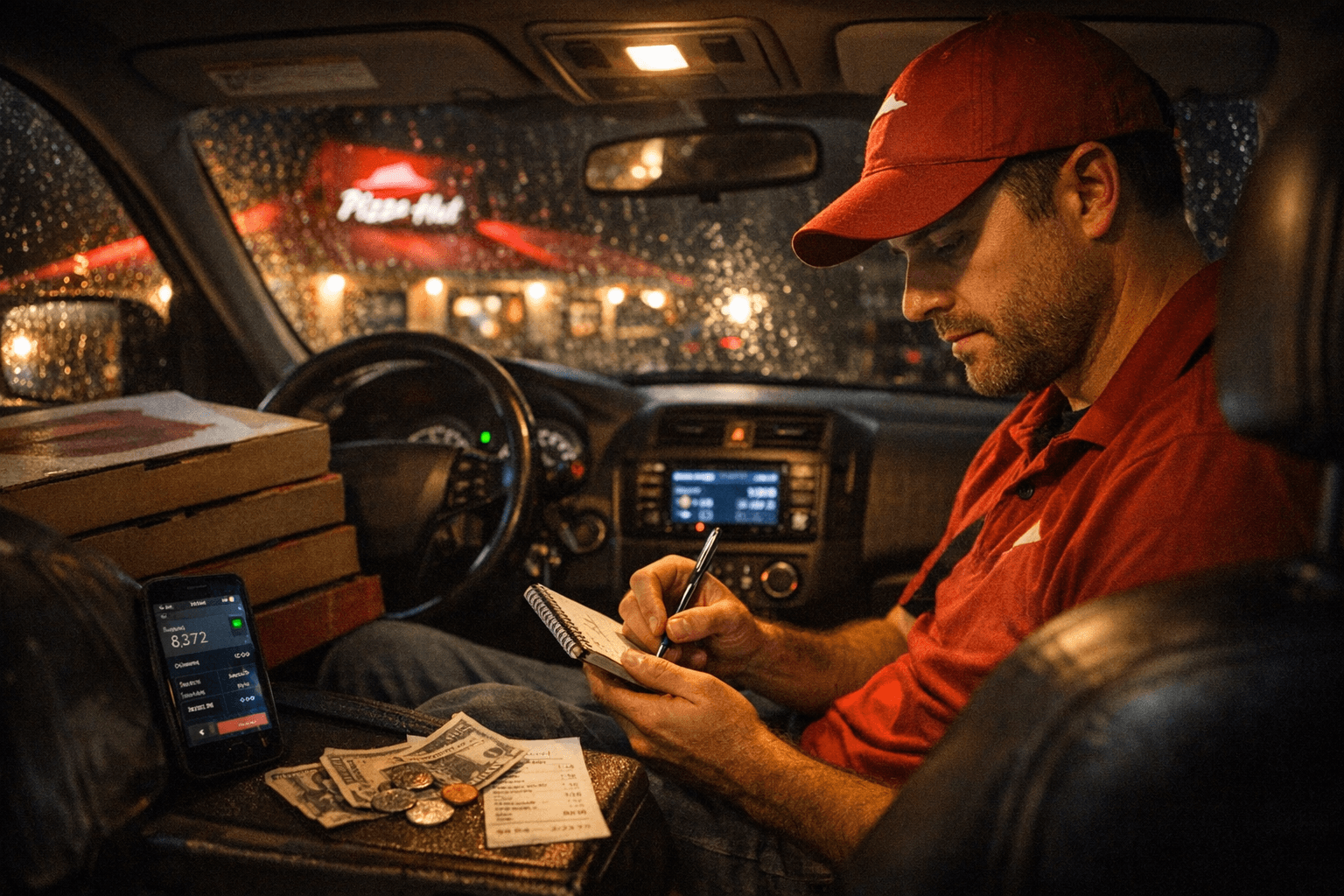
1. Add up your gross pay for the week: base hourly pay, tips received, and any reimbursements.
2. Subtract vehicle expenses: fuel, your share of wear and tear, insurance cost for that period, any required equipment you purchased.
3. Divide the result by total hours worked, including time spent at the store waiting for orders to come in.
That final number is your real hourly rate. Many drivers find it's meaningfully lower than their listed wage, particularly during slow shifts where wait time is high and reimbursements are thin. Running this calculation monthly lets you identify which shifts and which delivery zones are actually worth your time versus which ones are draining your vehicle without paying enough to compensate.
Navigating the Franchise Structure
Pizza Hut operates primarily through franchisees, meaning your direct employer is likely a franchise owner, not Yum! Brands corporate. That distinction matters because reimbursement obligations, tip policies, and even some wage floors are set at the franchise level. If you have a dispute over mileage reimbursement, you need to know whether the franchisee or corporate is legally responsible; the answer shapes where you direct a complaint.
Ask your manager explicitly: who is the legal employer of record at this location? Keep any documentation of reimbursement discussions, especially anything that involves both the store manager and a regional or corporate contact.
Some cities have also moved beyond state and federal minimums. Seattle-style local ordinances have established minimum pay floors specifically for platform delivery drivers in certain jurisdictions. If you work in a city with active labor policy, it's worth spending 20 minutes on your city or county's labor department website to confirm what floors apply to your work.
Best Practices for Drivers
A few habits that take minimal time but significantly strengthen your position:
- Use a simple spreadsheet or a dedicated mileage app to log odometer start and stop, order time windows, and per-order tips after every shift.
- Photograph gas receipts and any repair invoices connected to delivery work.
- Ask for reimbursement terms in writing at the point of hire, before problems arise.
- If you work under a franchisee, clarify in writing who is responsible for mileage coverage.
- Research your city and state's rules on tip credits, minimum wage floors, and delivery driver protections.
What Managers and Franchise Owners Should Do
Transparency on compensation policies isn't just good management; it directly affects driver retention. When drivers can't predict their net pay, they leave for gig platforms where the math, while imperfect, is at least visible.
Publish a written mileage and reimbursement policy and make sure every driver receives a copy at onboarding. Designate a specific contact for reimbursement questions so drivers aren't left guessing who to ask. During periods of sharp fuel price increases, consider automatic per-mile adjustments or an interim top-up to protect driver supply and reduce delivery cancellations. A store that loses drivers during a gas spike pays for it in unfulfilled orders and customer attrition.
Train shift leads on tip pooling rules and recordkeeping requirements. Tip pooling violations are among the more common wage claims in food service, and they're almost always preventable with proper training. Post all legally required wage notices in visible locations and give drivers a written copy of the reimbursement policy, not just a verbal summary.
For federal guidance on wage and hour rules, the U.S. Department of Labor's Wage and Hour Division is the primary resource. State labor departments cover localized rules on mileage, tip credits, and reimbursements. Drivers who believe they've been underpaid have the right to file complaints with state labor agencies or directly with the DOL.
The Bottom Line
Fuel, wear and tear, and equipment costs are real operating expenses that Pizza Hut drivers absorb on every shift. Without a clear reimbursement policy and consistent personal recordkeeping, those costs can quietly erode what looks like a reasonable wage into something much less. The drivers who protect themselves best are the ones who treat their shift log like a business record, because for a delivery driver using their own vehicle, that's exactly what it is. For managers, the calculus is simpler: clarity upfront costs almost nothing; wage disputes cost considerably more.
This article was produced by Prism’s automated news system from verified source data, official records, and press releases, then run through automated quality and moderation checks before publishing. The system is built and supervised by the people who set the standards it runs under. Read our full AI policy.
Did this article answer your question?