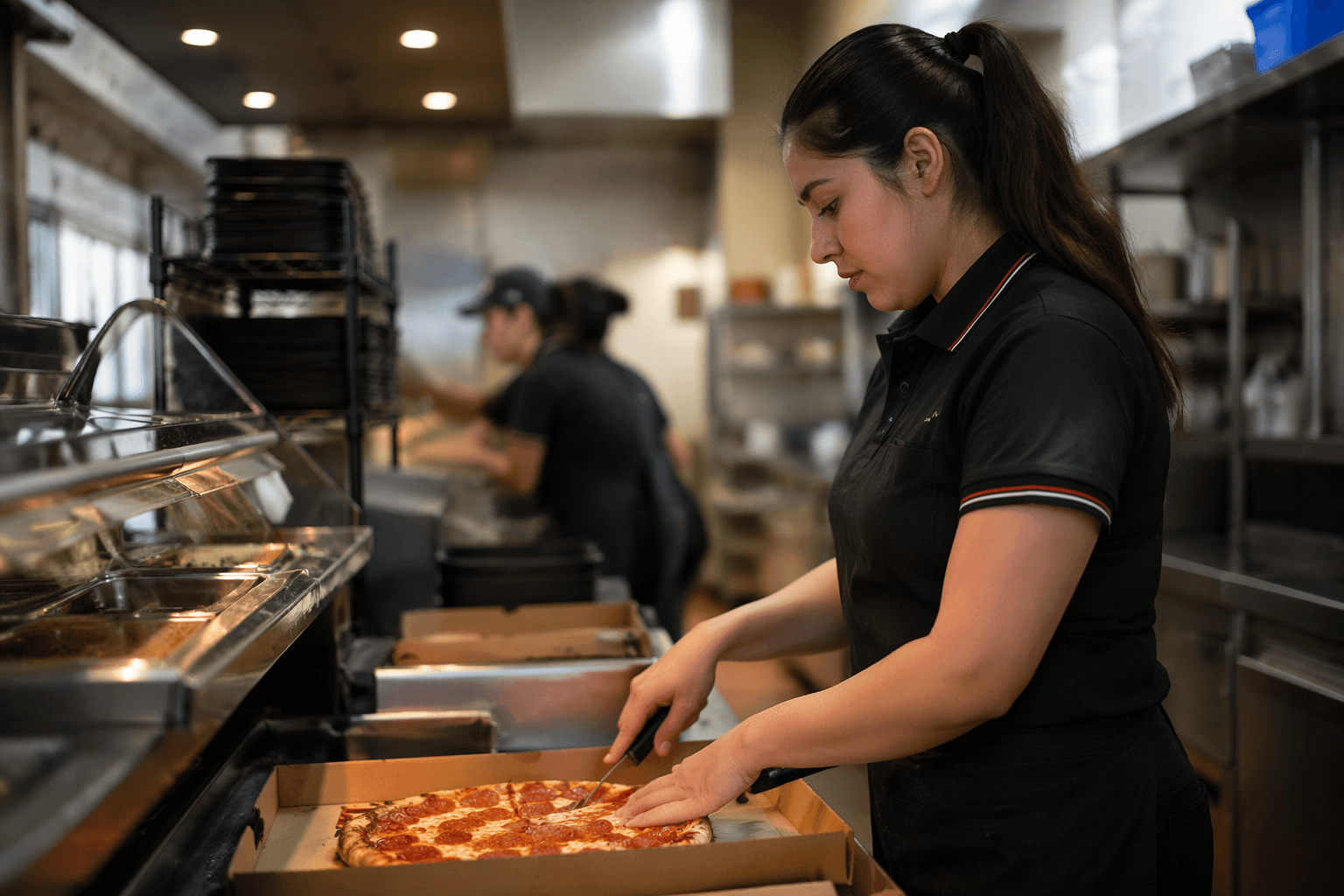
Pizza Hut job postings show pay, perks, and market-based wage differences
Pizza Hut’s job ads show the real paycheck is bigger than the hourly wage. Tips, mileage support, tuition help, and franchise-by-franchise variation matter as much as the posted rate.

What the Las Vegas posting really says
A Pizza Hut posting in Las Vegas puts the job in plain terms: $12.00 to $13.00 an hour, plus customer tips, mileage and cell phone data reimbursement for delivery work, and next-day access to wages already earned. That is the first thing to understand about these listings: the hourly rate is only the floor, not the full value of the job.
For a delivery driver, the listing is built around the realities of the road. Tips can turn a modest base wage into something more workable on a busy night, while mileage support and phone data reimbursement help cover the hidden costs of using your own car and device for work. If the store volume is steady and the delivery zone is active, those extras can matter as much as the posted base pay.
Why the pay package is not one number
The same brand can look very different from one city to another. A similar official posting in Renton, Washington shows that Pizza Hut’s base wage can be notably higher in another market, which is a reminder that compensation is not one-size-fits-all. Local labor markets, store volume, and ownership structure all shape what a job is really worth.
That variation is especially important at Pizza Hut because franchisees are the exclusive employers of restaurant workers. The careers site makes clear that benefits named in one posting may not be available everywhere, so a package that looks rich on paper in one restaurant may be thinner at another. The smart move is to treat the job ad as a starting point, not a guarantee.
How to read “flexible schedules”
Pizza Hut’s own language leans hard on flexibility, and that is not accidental. The company frames restaurant work as something that can fit around school, another part-time job, or family responsibilities, while still helping workers pay bills and have life outside work. In practice, that usually means the store needs coverage more than it needs a fixed nine-to-five rhythm.
For applicants, “flexible” often cuts both ways. It can mean easier access to shifts that work around class or childcare, but it can also mean your hours may move with sales, rush periods, and staffing gaps. Before accepting, ask how far in advance schedules are posted, whether you can set availability limits, and how often closing, weekend, and holiday shifts come up.
The benefits package is broader than most fast-food ads
The Las Vegas posting goes beyond wage language and lays out a surprisingly wide set of extras: a 401(k) with company match after one year, employee meals and discounts, the Pizza Hut Perks Program, free GED access through GEDWorks, reduced-cost college tuition through Life Unboxed EDU, an Employee Assistance Program, and PTO accrual. That mix tells you what kind of job Pizza Hut is trying to sell, not just to drivers but to people looking for an entry point that can stretch beyond a few months.
The education pieces are worth reading closely. Pizza Hut’s corporate careers page says Life Unboxed EDU offers company employees and franchise organization employees a 35% undergraduate tuition discount and a 20% graduate tuition discount through Colorado Technical University. It also says GEDWorks can provide a free GED, depending on whether the organization participates. For workers trying to finish school, start school, or move toward another job, those programs can be more useful than a small hourly bump.
What training language tells you about the job
Pizza Hut says training is meant to teach most of what a new hire needs to know, which is a clue that these roles are still designed to be accessible for first-time workers. That matters in restaurants, where turnover is high and the job often depends less on prior experience than on whether someone can learn the stations, pace, and customer flow quickly.
In other words, the company is not just selling a pay rate. It is selling an on-ramp. For some workers, that is exactly what makes the job useful: the ability to step in, learn the basics, and build a schedule around something else in life.
What to ask before you say yes
A Pizza Hut offer should be read as a whole package, and the details only become clear when you ask the right questions. The ad tells you what exists in the system; the interview tells you what exists in your store.
- What is the exact base pay for this location and role?
- If you are delivering, how are tips handled, and do drivers keep their own tips?
- How is mileage reimbursement calculated, and is there a separate phone-data payment?
- Does next-day pay cost anything, and how much of earned wages can be accessed?
- When does the 401(k) match start, and who is eligible?
- Which benefits are actually offered by this franchisee, not just mentioned on the site?
- How much notice do you get for schedules, and how often do shifts change?
- Are tuition help, GEDWorks, and the Employee Assistance Program available at this restaurant?
Those questions matter because the offer may look generous in one store and ordinary in another. At Pizza Hut, the franchisee is the real gatekeeper for what you actually receive.
The bigger pressure behind the posting
Pizza Hut is not a small chain experimenting at the margins. The brand says it has more than 19,000 restaurants in 108 countries and territories, and Yum! Brands says its system spans 63,000-plus restaurants across more than 155 countries and territories through about 1,500 franchisees. That scale explains why a single job ad can feel local and corporate at the same time.
It also sits inside a company under pressure to improve. Yum! Brands said on November 4, 2025, that it began a formal review of strategic options for Pizza Hut to maximize shareholder value and help the brand reach its full potential for franchisees, consumers, employees, and shareholders. For workers, that does not automatically change tomorrow’s shift. But it does mean the brand is being judged on performance, and that pressure usually flows down to labor, staffing, and how aggressively stores try to recruit and retain people.
The bottom line is simple: Pizza Hut’s posting is most useful when you read past the headline wage. The real job is the combination of base pay, tips, mileage support, schedule control, and which benefits your franchisee actually honors, and that combination can change the difference between a side job and a sustainable one.
This article was produced by Prism’s automated news system from verified source data, official records, and press releases, then run through automated quality and moderation checks before publishing. The system is built and supervised by the people who set the standards it runs under. Read our full AI policy.
Did this article answer your question?