Pizza Hut policy manual outlines workplace rules for Fort Wayne staff
Fort Wayne’s Pizza Hut manual puts attendance, uniforms, complaints, and discipline in writing, and franchise status decides who actually enforces the rules.
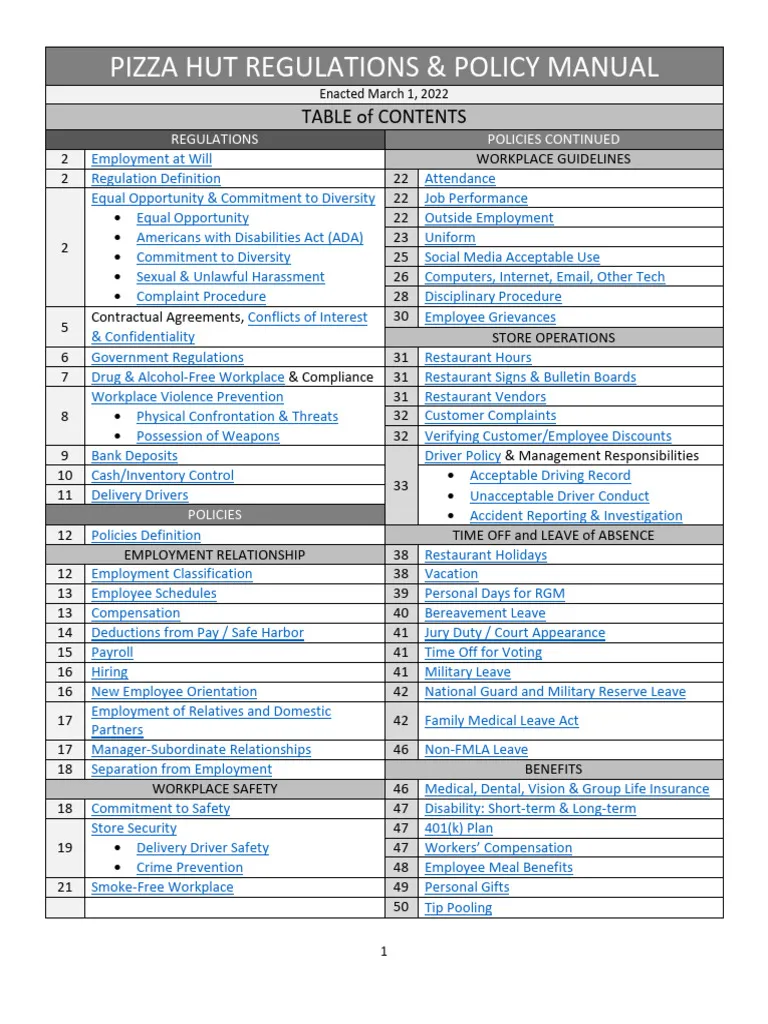
Enacted March 1, 2022, Fort Wayne’s Pizza Hut policy manual turns the day-to-day questions of restaurant work into written rules. It lays out the basics of employment at will, attendance, harassment reporting, uniform standards, and discipline.
What the manual covers
The table of contents is broad for a reason. It includes Employment at Will, Attendance, Equal Opportunity & Commitment to Diversity, Sexual & Unlawful Harassment, Complaint Procedure, Job Performance, Outside Employment, Uniform, Social Media Acceptable Use, Computers, Internet, Email, Other Tech, Disciplinary Procedure, and Contractual Agreements, Conflicts of Interest & Confidentiality.
For crew members, restaurant problems rarely arrive as one clean issue. A late driver, a line cook in the wrong uniform, a shift lead using a phone too much, or a worker who feels singled out all land in the same policy universe. For managers, the document is also a checklist: document attendance, apply the dress code the same way, and follow the stated discipline process instead of improvising mid-rush.
Why franchise status changes the picture
Pizza Hut’s careers site places the brand inside Yum! Brands and uses the taglines “GreatPeopleGreatPizza” and “Restaurant life. The ultimate IYKYK.” The hiring materials for some restaurant jobs make a sharper point: the franchisee, not Pizza Hut, Inc., is the employer. In plain terms, the brand may set the tone, but local ownership often controls the rules that affect a shift.
In a chain with company branding on one side and franchise management on the other, workers need to know which handbook actually governs the store where they clock in. If a dispute comes up over scheduling, discipline, or a complaint, the answer usually starts with the local operator’s rules.
Attendance, job performance, and uniform rules
Attendance is one of the clearest day-to-day pressure points in a pizza restaurant. A late driver can throw off deliveries, and a missing cook can stall the make line. The manual’s attendance and job performance sections give managers a written basis for coaching, documenting, and, if needed, disciplining workers who miss shifts or fall short of expectations.
Uniform rules serve the same purpose in a different way. In a place where drivers, order takers, and kitchen crew all move through the same small space, a written standard helps avoid arguments over what is acceptable on the floor. It also gives workers something concrete to point to if a supervisor’s expectations change from one shift to the next.
Phones, social media, and outside employment
The manual also reaches beyond the store itself. Social Media Acceptable Use and Computers, Internet, Email, Other Tech show that Pizza Hut of Fort Wayne expects workers to treat digital tools as workplace tools, not personal free-for-alls. Outside Employment is another important category, especially in food service where workers often juggle second jobs, school, or gig work around restaurant hours.
Those rules can matter fast in a pizza shop. A driver who picks up outside work may run into scheduling conflicts, and a crew member posting from the kitchen can create problems around privacy, brand image, or confidential information. The manual’s section on Contractual Agreements, Conflicts of Interest & Confidentiality suggests management wants those lines drawn clearly before a conflict turns into a discipline issue.
Complaint channels and harassment protections
The manual’s strongest worker protection comes through Equal Opportunity & Commitment to Diversity, Sexual & Unlawful Harassment, and Complaint Procedure. Those sections matter most when the person causing the problem is also part of the local chain of command. In a franchise store, that complaint path can be the difference between a problem being documented and a problem being ignored.
The Pizza Hut system has history here. In 2003, the EEOC announced that Pizza Hut would pay $360,000 to settle a sexual harassment complaint, and that settlement included anti-discrimination training and monitoring. Pizza Hut franchisee Ayvaz later agreed to pay $35,000 in a sex-based harassment and retaliation suit.
Employment at will and discipline
The manual starts with Employment at Will, which is the legal backdrop for most restaurant jobs. That means the relationship can be ended without a fixed term unless another law or agreement says otherwise, and the disciplinary procedure sets out the process for warnings, suspensions, or terminations.
Privacy and employee records
Pizza Hut’s workplace paperwork also shows how much modern employment now depends on handling personal data. A separate Pizza Hut U.S. Privacy Notice for California Company Employees and Franchisee Workers carries an effective date of January 1, 2023.
This article was produced by Prism’s automated news system from verified source data, official records, and press releases, then run through automated quality and moderation checks before publishing. The system is built and supervised by the people who set the standards it runs under. Read our full AI policy.
Did this article answer your question?