Pizza Hut uses AI tools to flag delayed deliveries, improve orders
Pizza Hut’s AI tools are cutting cold-delivery problems, but they also make every shift more measurable for crews, drivers, and managers.
What the system is trying to fix
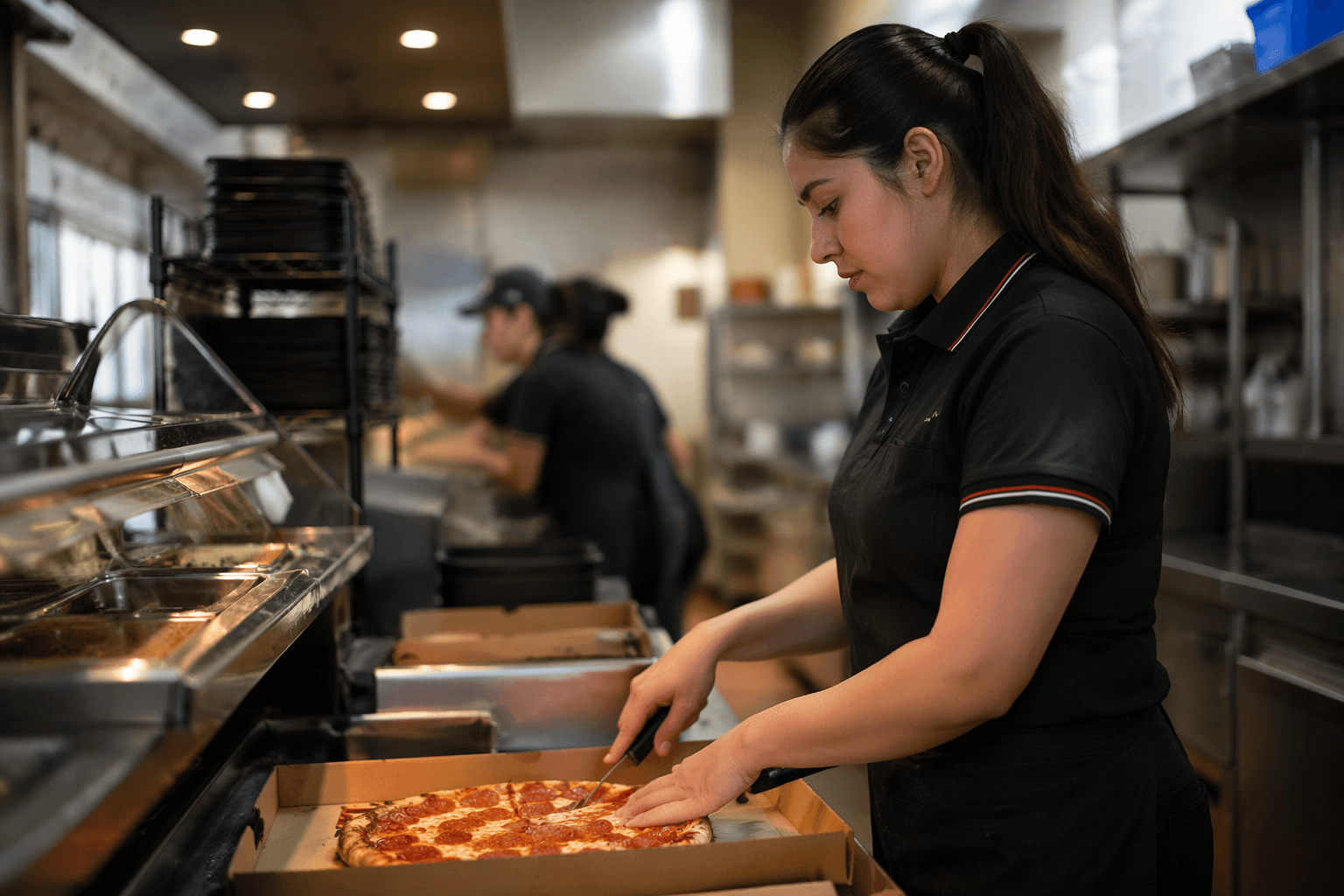
Pizza Hut’s newest tech push starts with a problem every shift crew recognizes: an order is ready, but the driver is not. In Yum’s restaurant systems, that delay is now visible before the food goes out, which means the kitchen can pause a pizza instead of baking it too early and letting it sit. That is good for customers, and it is also a sign of how deeply software is reaching into the rhythm of a Pizza Hut store.
The logic behind the move is simple. Yum’s digital and technology chief, Joe Park, has said the company wants tools that make work easier for team members, franchisees, and customers. That sounds like corporate language, but the Pizza Hut example gives it real weight. If a system can catch a delivery bottleneck before it turns into a cold pie and a bad score, it is doing more than speeding up an order. It is changing how the kitchen, the dispatch flow, and the manager’s attention all work at once.
The bigger Yum playbook behind Pizza Hut
Park’s rise matters here because he has been building this approach across the company, not just inside Pizza Hut. He was promoted to Yum! Brands chief digital and technology officer effective March 1, 2024, after serving as Pizza Hut Global’s digital and technology chief since 2021. Before that, he joined Yum in 2020 as its first chief innovation officer, and at Pizza Hut he oversaw omnichannel customer experiences, e-commerce, and restaurant technology for more than 19,000 restaurants in more than 100 countries.
That scale helps explain why Yum keeps talking about a platform strategy instead of one-off tools. By September 2024, the company said it had more than 60,000 restaurants across 155 markets, and 120 of those markets already had at least one Yum technology in place. In other words, the company is still rolling this out in layers, not flipping a single switch. For store teams, that usually means change arrives unevenly, with one market getting a new workflow while another is still doing things the older way.
Chris Turner, Yum’s strategy chief, has framed the company’s approach around “Easy Experiences” for customers, “Easy Operations” for restaurant teams, and “Easy Insights” for growth. The sales numbers show why the company is leaning so hard into digital. Yum said digital sales reached $24 billion in 2022, doubled from 2019, then approached $30 billion in 2023. By the first quarter of 2024, more than half of sales were coming through digital channels.
Why the 38 percent number matters on the line
The most revealing Pizza Hut detail in the entire story is the one about paused orders. Yum said Pizza Hut’s kitchen management system found that 38 percent of pizza orders were being paused before baking because there were no delivery drivers available. That is not a small operational hiccup. It is a direct window into what happens when labor availability and ticket timing collide.
For crew members, that pause can be a relief or a stress point, depending on how it is managed. On the one hand, it can prevent the classic wasteful cycle of making food too early, letting it get cold, then remaking it. On the other hand, once a manager sees that kind of bottleneck on a dashboard, the pressure shifts from “we are short on drivers” to “why did the system say this was blocked, and what did you do about it?” The tech can reduce frustration, but it also creates a tighter paper trail for every delay.
The real value here is not just speed. It is customer experience. A cold delivery hurts satisfaction scores, tips, repeat orders, and the store’s reputation in a way the back office feels almost immediately. By flagging the delay, the system gives the kitchen a chance to protect the food before the problem becomes visible to the customer.
What changes for kitchen crew, drivers, and managers
For kitchen crews, AI is not replacing the work so much as changing the sequence of the work. The old model was to keep the make line moving and hope delivery timing held up. Now, the system can tell the store when to wait, when to hold, and when to move. That sounds small, but in a high-volume Pizza Hut shift, small timing shifts determine whether the oven, the make table, and the dispatch rack are all working together or stepping on each other.
For drivers, the implications are more complicated. A system that flags pauses can make dispatch more efficient, but it also means fewer excuses for missed timing. If the software knows the order is delayed because no driver is available, then driver availability becomes a tracked performance problem, not just a staffing headache. That can help stores align delivery waves and reduce wasted trips, but it can also make every gap in coverage feel more visible to managers.
For managers, this is where the work changes fastest. Yum’s technology stack now includes kiosks, back-of-house automation, a proprietary point-of-sale system, and a global data hub, all meant to improve order accuracy, speed, and friendliness. That means managers are no longer only solving labor shortages and customer complaints by instinct. They are being asked to read dashboards, balance labor, manage throughput, and train teams around what the system is showing them.
Voice AI at Taco Bell shows where this is headed
Pizza Hut is part of a much broader experiment across Yum. In 2024, the company said Voice AI was already running in more than 100 Taco Bell U.S. drive-thrus across 13 states, with hundreds more locations targeted by the end of the year. Yum said the goal was to improve order accuracy, reduce wait times, and ease the task load for team members while the technology worked alongside digital menu boards, Poseidon POS, and Taco Bell Rewards.
That Taco Bell rollout matters to Pizza Hut workers because it shows the direction of travel. Yum is not using AI as a flashy add-on. It is using it to move labor out of repetitive tasks and into exception handling. In a pizza shop, that means fewer routine decisions may stay in a person’s head and more of them will be surfaced by software. That can make training easier for new hires, but it can also mean fewer chances to improvise without being noticed.
Byte by Yum! and the future of the store
By February 2025, Yum pulled much of this into a single system called Byte by Yum!, a consolidated proprietary platform covering online and mobile ordering, point of sale, kitchen and delivery optimization, menu management, inventory, labor management, and team-member tools. Yum said 25,000 restaurants globally were already using at least one Byte product, and in the U.S. all four brands were using pieces of it to process more than 300 million digital transactions a year. The company also began phasing out legacy names like Poseidon, Yum! Commerce Platform, Tracks, and SuperApp under the Byte umbrella.
For Pizza Hut teams, that consolidation is a two-sided change. It can remove friction when a store no longer has to juggle disconnected systems for orders, labor, and delivery. It can also quietly raise expectations, because more of the operation is now measurable in one place. When the platform gets better at spotting bottlenecks, managers are expected to fix them faster.
That is why this story is really about workload, not just software. The best version of Yum’s tech strategy does what Park says it should do: it gives people fewer robotic tasks and more room to actually run the restaurant. The risk is that the same tools can turn every shift into a more monitored, more tightly scored version of the old job.
That tension became even sharper when Yum announced a formal review of strategic options for Pizza Hut in November 2025, saying the brand needed additional action and describing Pizza Hut as having an increasingly powerful technology platform. That tells you the technology is no longer just a back-of-house upgrade. It is now part of the debate over what Pizza Hut is, how it operates, and how much room its workers will have to breathe inside the system.
This article was produced by Prism’s automated news system from verified source data, official records, and press releases, then run through automated quality and moderation checks before publishing. The system is built and supervised by the people who set the standards it runs under. Read our full AI policy.
Did this article answer your question?