2026 restaurant labor-law changes that affect pay, schedules and compliance
New wage floors, tip-credit rules and posting requirements will show up first in the schedule and the pay stub.
The National Restaurant Association projects $1.55 trillion in sales for 2026, but persistent cost pressures and a cooling labor market mean payroll mistakes can turn into real money fast for cooks, servers, bartenders and the managers signing off on shifts. A higher wage floor, tighter tip math and local poster rules are where restaurant labor law hits the floor first.
The federal floor still governs the basics
The Fair Labor Standards Act remains the baseline for most restaurant jobs. It covers minimum wage, overtime pay, recordkeeping and child labor standards for most full-time and part-time private-sector workers, including restaurant staff. Employers have to comply with both federal and state law, and some states give workers additional rights and protections.
Restaurant compliance rarely breaks on one big issue. It breaks in the seams between federal rules, state wage orders and city or county rules that can be stricter than either one. A line cook, host or server may never see the legal memo, but the effect shows up in hours, punch records, tip distribution and whether the pay stub matches the local wage floor.
Pay floors are already moving in California and New York
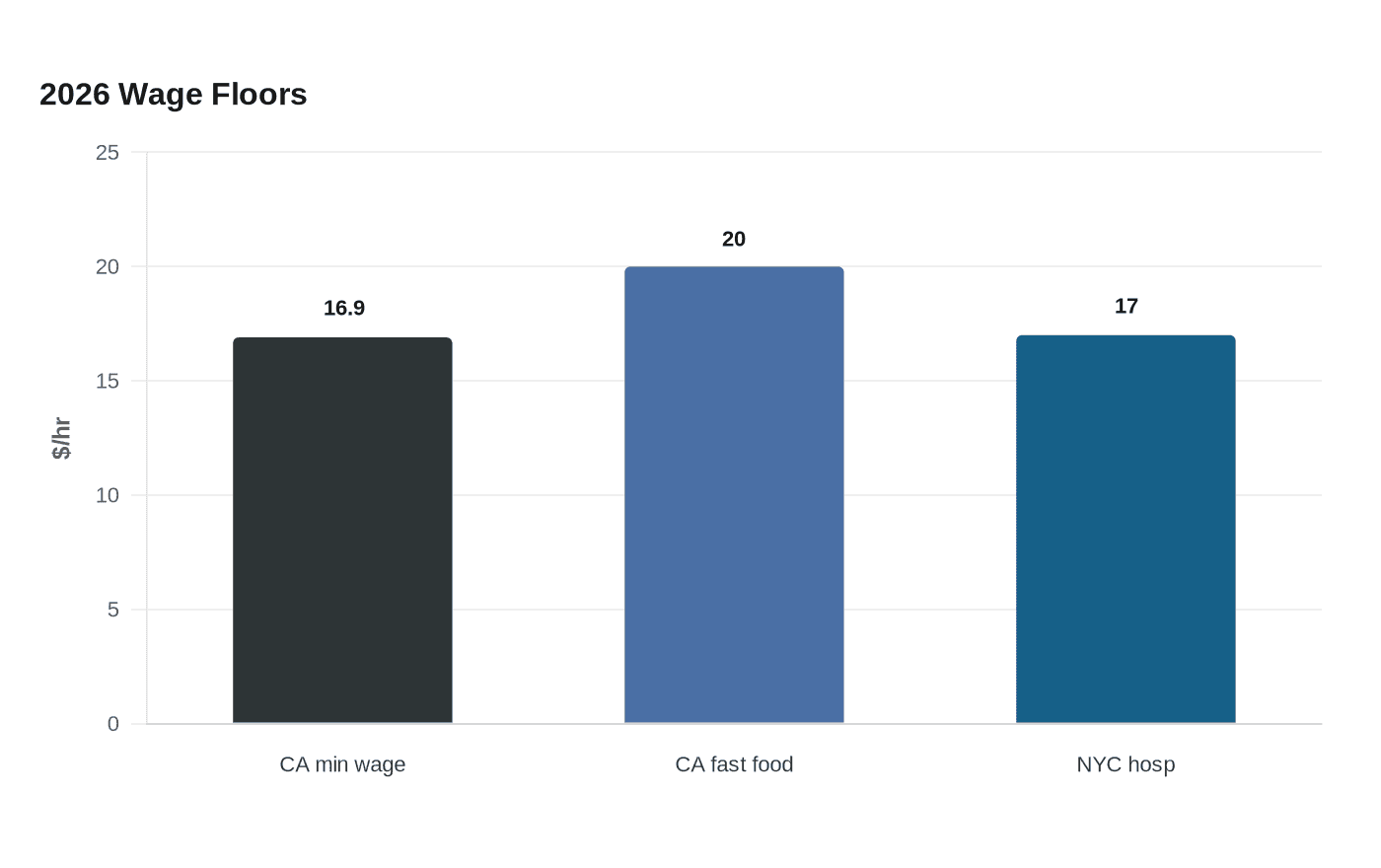
California’s minimum wage rises to $16.90 per hour in January 2026, and the state’s separate fast-food minimum wage stays at $20.00 per hour for covered employees. Those numbers do not just affect base pay. They influence how many people a manager can put on a shift, how aggressively a restaurant can schedule training hours and what a job ad has to promise before a candidate walks in.

New York is on a different schedule, but the same pressure applies. The New York State Department of Labor hospitality poster lists rates effective from January 1, 2026 through December 31, 2026, including a $17.00 hourly minimum wage for New York City hospitality workers and different cash-wage and tip-credit combinations for service employees and food service workers. For operators with locations in more than one borough or more than one state, that means the pay table is not a chain-wide assumption. It has to be checked location by location.
Tip-credit rules are still where disputes start
Federal tip-credit rules require that an employee’s direct wages plus tips add up to at least the minimum wage and the overtime compensation required under the FLSA. That is the rule that keeps tip-credit systems from becoming a shortcut around wage floors. If the math does not work across the whole week, the employer owns the gap.
The politics around the tip wage remain just as intense. The National Restaurant Association counted challenges to the tip wage in 17 states and three cities or counties in the prior year, and Massachusetts voters rejected a ballot initiative to eliminate the tip wage by 63% to 37%.
For floor managers, the practical lesson is simple: do not treat tip handling as a cash drawer issue. It is a wage issue. If the direct wage plus tips do not clear the required floor, or if pooled tips are handled in a way that breaks the rules, the risk lands on the operator, not the server trying to make rent after a double.
Posters and records are not clerical chores
New York’s 2026 hospitality poster shows that posting obligations are part of the job, not an HR formality. If the current wage poster is missing, outdated or wrong for the location, the restaurant is advertising the wrong rules to the people who depend on the paycheck. That kind of error is easy to miss in a busy dining room, but it becomes a problem fast when a worker questions pay or files a claim.
Recordkeeping carries the same weight. The FLSA requires recordkeeping, and in restaurants that means time punches, tipped hours, wage rates, tip allocations and any minor-work documentation have to be clean enough to survive a dispute. That is especially important in operations that rely on teenagers, seasonal hires and high turnover, where the staffing mix changes faster than the paperwork.
What employers should fix now
The safest response is to audit the parts of payroll that actually touch the floor. Rebuild wage tables by location, not by brand. In California, that means checking both the $16.90 standard minimum wage and the $20 fast-food rate. In New York City hospitality, it means checking the $17 hourly floor and the right cash-wage and tip-credit combination for the job classification.
Then tighten the systems that usually create lawsuits:
- Verify that every tipped employee clears the minimum wage and overtime requirements once direct wages and tips are combined.
- Check whether tip pooling, service-charge routing and shift assignments match the role and the location.
- Refresh every required poster, especially in states that issue their own hospitality notices.
- Keep time, wage and tip records in a form that can be reconstructed later, not just filed away.
The National Restaurant Association’s 2026 policy agenda is focused on immigration reform, the Credit Card Competition Act and USMCA renewal. On the restaurant floor, the first compliance failures still come from the basics: the wage floor, the tip pool, the schedule and the recordkeeping.
This article was produced by Prism’s automated news system from verified source data, official records, and press releases, then run through automated quality and moderation checks before publishing. The system is built and supervised by the people who set the standards it runs under. Read our full AI policy.
Did this article answer your question?