AI and automation reshape restaurant work as Gen Alpha dines differently
AI is moving into scheduling, drive-thrus and accuracy checks, but the bigger shift is how managers train, assign and monitor people on the floor.
The next wave is not a robot takeover, it is a workflow shake-up
Restaurant work is about to feel more software-heavy in the places employees notice most: scheduling, ordering, training and the handoff between front and back of house. Rafael LaRue’s point is not that hospitality disappears, but that the job gets rearranged around it, with more AI and automation pushing deeper into the daily rhythm of service.
That matters because the scale is huge. The National Restaurant Association projects the U.S. restaurant industry will hit $1.5 trillion in sales in 2025, add more than 200,000 net new jobs, and employ 15.9 million people by year-end. In an industry that large, even small changes to how hosts seat, how cooks fire tickets, or how managers build a schedule can ripple across millions of shifts.
What is likely to change first
The near-term change is not fully automated dining rooms. It is a stack of tools that takes repetitive work off managers and pushes more decisions into software. The National Restaurant Association says 47% of operators expect technology and automation to become more common to address labor shortages, and more than 80% say technology gives them a competitive advantage. That tells you where the money is going: into systems that help cover shifts, reduce ordering errors, and keep labor tighter when staffing is thin.
On the floor, that means more digital scheduling, more AI-assisted hiring and more monitoring of labor performance. If the software can flag a mismatch between forecasted traffic and labor hours, managers will lean on it. If it can reduce mistakes in a drive-thru or delivery order, operators will use it. For workers, the practical result is that the job becomes less forgiving when you ignore the system. Clock-in times, prep tasks, upselling prompts and ticket timing are increasingly part of the workflow, not side information.
Ordering is where the change is already visible
The clearest evidence that this is not just conference talk is in ordering channels. Yum! Brands introduced Byte by Yum! as an AI-driven SaaS platform for KFC, Taco Bell, Pizza Hut and Habit Burger & Grill, with the stated goal of streamlining operations and improving experiences for customers and team members worldwide. Taco Bell has also expanded Voice AI to hundreds of U.S. drive-thru locations, with a longer-term goal of global deployment.
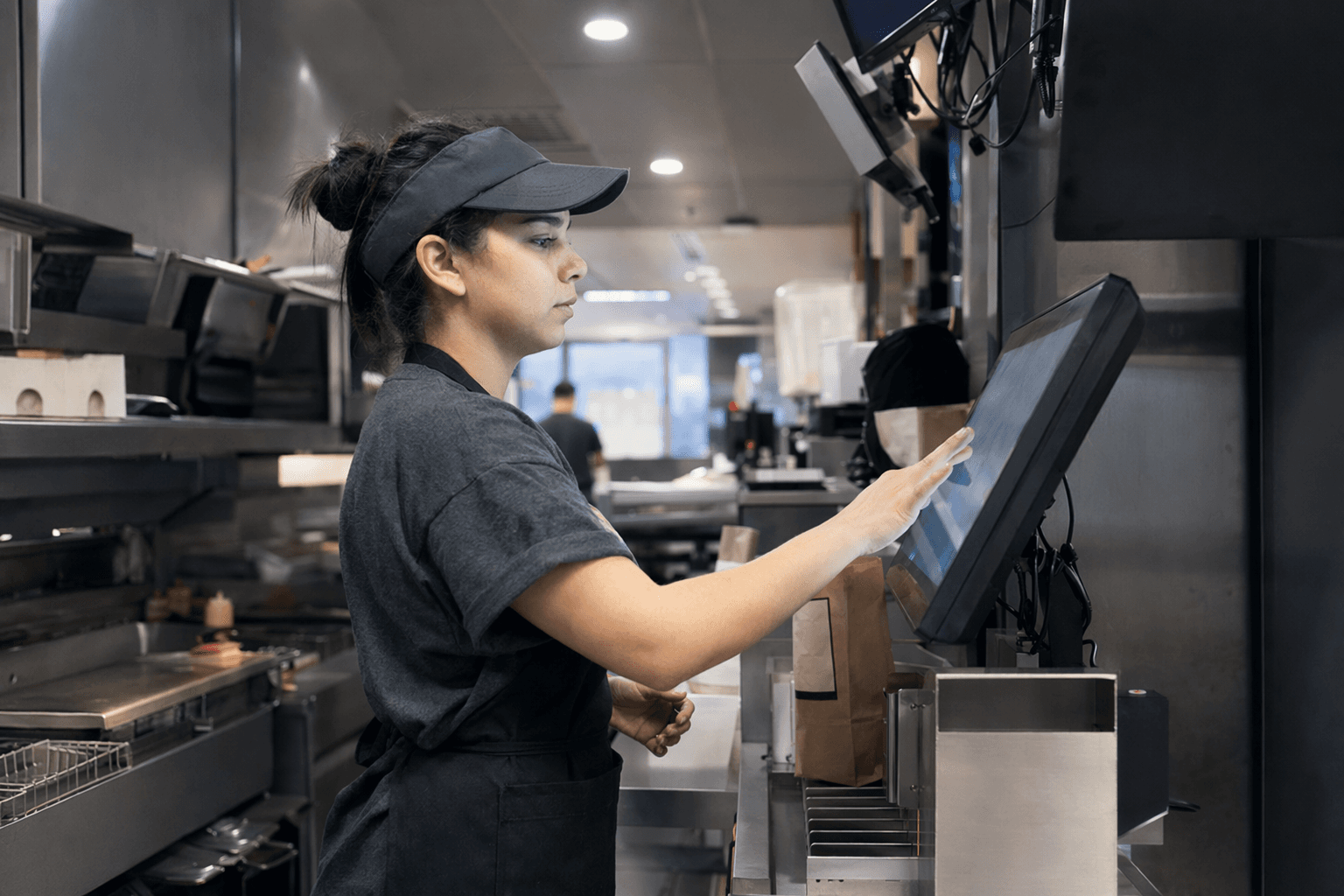
That affects the drive-thru crew before it affects the dining room. Voice AI can take a little pressure off order takers during peaks, but it also changes the pace of the window. A smoother front end can mean fewer repeats, fewer corrections and less chaos at handoff. It can also mean tighter expectations, because the company now has a system that is supposed to catch errors and standardize the script.
McDonald’s is making a similar bet in a different part of the operation, deploying AI-powered accuracy scales across thousands of restaurants in drive-thru and delivery channels in a dozen markets. That is a strong signal that automation is not only about speed. It is about error control, which has direct consequences for kitchen workflow, remake rates and the pressure on shift leaders to get tickets right the first time.
The real job design shift is in the middle of the operation
The most important 12- to 24-month change may be the manager’s role. AI is best positioned to absorb the repetitive admin that keeps GMs and shift leads off the line, from staffing forecasts to ordering support to customer follow-up. If that works, the upside is more time spent on guests, coaching and recovery when something breaks.
But there is a downside workers will recognize quickly: more software usually means more surveillance, not less. When every handoff can be measured and every ticket can be timed, the floor can start to feel like a dashboard. Managers may have better data, but line cooks, bartenders and servers often experience that as tighter pressure, fewer excuses and faster discipline for mistakes.
That is why LaRue’s warning that there is no one-size-fits-all concept matters. A quick-service drive-thru, a full-service dining room and a bar with heavy late-night traffic are not the same business. The best operators will use AI to remove friction without stripping out the human judgment that good service still needs.
Gen Alpha is not a myth, but it is not the main customer story yet
Gen Alpha is often discussed like a future consumer revolution, but the age math matters. The U.S. Census Bureau classifies Generation Alpha as those born in or after 2013, while McCrindle uses 2010 to 2024. Either way, the cohort is still young. Most of them are not choosing the dinner check on their own yet, but they are shaping family routines, screen habits and expectations for instant, personalized interactions.
The useful takeaway for restaurants is not that Gen Alpha demands a hologram menu. It is that younger guests are being raised around convenience, technology and environment, and those habits will shape what feels normal in a dining experience. The National Restaurant Association says younger diners are motivated by convenience, technology and environment, while SevenRooms research finds diners across generations share expectations for convenience, personalization and value.
That combination should push operators toward simpler ordering flows, clearer customization tools and faster service recovery. If a guest is used to an app that remembers preferences, or a website that makes repeat ordering easy, the old friction points of restaurant life become more costly.
Digital ordering is growing, but phone habits have not disappeared
Deloitte notes that restaurant delivery has surged over the past 10 years and that restaurants are increasingly using personalization engines and channel-specific offers. At the same time, the consumer picture is more mixed than the tech hype suggests. Deloitte’s research found that 40% of customers prefer to order directly from restaurant websites, but 55% still prefer to use the phone to address service concerns.
That split should shape training now. Restaurants cannot assume every guest wants the same channel, and they cannot assume digital ordering eliminates the need for front-line communication skills. Hosts, servers and managers still need to handle complaints, substitutions and service failures in human terms. In many restaurants, the phone and the app are now parallel service desks, not replacements for one another.
What workers should prepare for now
The smartest operators will use the next two years to retrain, not just automate. That means preparing for a floor where tech fluency matters as much as menu knowledge.
- Hosts may need to manage digital waitlists and guest-flow software more tightly.
- Servers may need faster, cleaner handoffs between apps, POS systems and kitchen tickets.
- Line cooks may see more pressure around order accuracy and remake avoidance as AI checks expand.
- Managers will likely spend more time in labor planning, forecast tracking and system oversight.
It also means keeping an eye on how technology is deployed against labor shortages. If 47% of operators expect more automation for that reason, some of those changes will be sold as relief. Workers should judge them by the actual result: whether schedules get more stable, whether training gets better, and whether the extra systems reduce burnout or just add another layer of monitoring.
The bottom line
AI, automation and Gen Alpha are not abstract trends for restaurant labor. They are already showing up in drive-thrus, delivery checks, digital ordering and manager dashboards, with the biggest effect likely to land on how shifts are scheduled and how work is supervised. The operators who win the next phase will not be the ones who replace people with software. They will be the ones who use software to make restaurant jobs more workable without turning service into a machine that eats the people running it.
This article was produced by Prism’s automated news system from verified source data, official records, and press releases, then run through automated quality and moderation checks before publishing. The system is built and supervised by the people who set the standards it runs under. Read our full AI policy.
Did this article answer your question?